
The Many Sides of Miami, From Calle Ocho to Biscayne Bay
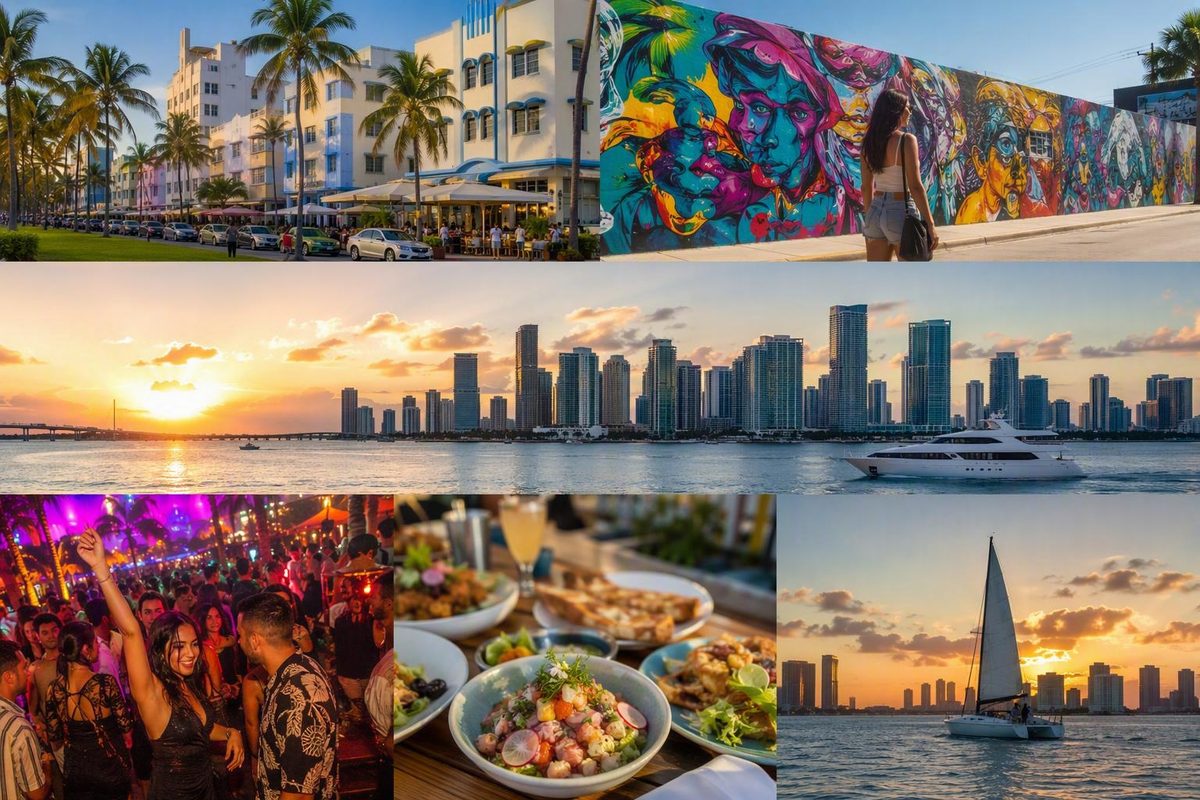
South Beach Art Deco, Wynwood street art, Biscayne Bay, energetic nightlife, cruising and a dramatic skyline round out its identity.
The short answer: What is Miami most famous for?
Miami is known for beaches, Cuban and broader Latin American culture, South Beach’s Art Deco imagery, energetic nightlife, international food, Wynwood’s street art, Biscayne Bay, cruising, a dramatic high-rise skyline, and international business.
That list matters because Miami is easy to flatten into a single postcard: palms, sand, pastel hotels, sports cars, and late-night clubs. Those images are real, but they are only part of the destination. Miami is simultaneously a tropical vacation center, a multilingual city shaped by migration, a waterfront playground, an arts destination, a cruise gateway, and a center of finance and trade.
Much of its identity comes from contrast. Beachfront leisure sits across Biscayne Bay from high-rise commerce. Historic neighborhoods and migration landmarks coexist with contemporary murals and modern towers. Walk-up coffee windows and neighborhood bakeries belong to the same dining landscape as waterfront restaurants and polished hotel dining rooms.
Miami is commonly called the “Magic City” and informally described as a “Gateway to Latin America.” These are reputational nicknames, not official designations. The second phrase helps explain how Miami’s geography, multilingual population, cultural ties, and commercial relationships connect it with Latin America and the Caribbean; the University of Miami characterizes the area as both multicultural and a gateway for global business.
For a first visit, the clearest way to understand Miami is by neighborhood and experience:
- South Beach and Ocean Drive: beaches, Art Deco architecture, people-watching, and nightlife
- Little Havana and Calle Ocho: Cuban heritage, coffee, food, music, murals, and community life
- Wynwood: large-scale murals, galleries, creative businesses, and casual evening activity
- Brickell: towers, restaurants, finance, rooftop venues, and modern urban energy
- Downtown: cultural institutions, sports and entertainment, waterfront attractions, and PortMiami views
- Coconut Grove: greenery, a waterfront atmosphere, and a slower neighborhood rhythm
- Biscayne Bay: boating, paddling, sightseeing cruises, and skyline views
One geographical point changes how this list should be understood: many places marketed under the broad name “Miami” are not within the City of Miami. South Beach is the most important example.
First, understand what “Miami” means
In travel conversations, “Miami” may refer to the City of Miami, the separate City of Miami Beach, or the larger destination spread across Miami-Dade County. Tourism guides regularly move among these meanings without marking every municipal boundary.
Miami Beach is a separate municipality on a barrier island connected to the mainland by causeways. South Beach, Ocean Drive, and the Art Deco Historic District are in Miami Beach, not the City of Miami, even though they provide some of the destination’s most recognizable “Miami” images. A first-time visitor guide confirms that Miami Beach is a separate municipality on a barrier island connected to mainland Miami.
That does not make it irrelevant to a Miami trip. It simply means a geographically accurate guide should distinguish the city proper from the surrounding destination.
Each requires its own transportation and activity plan.
Here is a compact orientation:
| Place | Where it is | What it is known for |
|---|---|---|
| South Beach | City of Miami Beach | Beach activity, Ocean Drive, Art Deco imagery, nightlife |
| Little Havana | City of Miami | Cuban culture, Calle Ocho, coffee, food, murals, dominoes |
| Wynwood | City of Miami | Murals, galleries, Wynwood Walls, creative businesses |
| Brickell | City of Miami | High-rises, finance, dining, rooftops, modern skyline |
| Downtown | City of Miami | Museums, entertainment, institutions, waterfront activity |
| Coconut Grove | City of Miami | Greenery, waterfront atmosphere, relaxed neighborhood feel |
| Coral Gables | Separate municipality | Historic architecture, landscaped streets, dining, shopping |
| Everglades National Park | Regional excursion | Wetlands, wildlife, trails, boat and tram experiences |
| Biscayne National Park | Regional excursion | Marine environments, boating, snorkeling, nature |
This layout has practical consequences. South Beach, Little Havana, Wynwood, and Coral Gables do not form one compact, walkable center. Bridges, traffic, heat, rain, and transit connections can make apparently short journeys take longer than expected.
It is more useful to think of “Miami” as a family of distinct places organized around the mainland, barrier islands, Biscayne Bay, and the surrounding county. That approach prevents geographical confusion and produces a more realistic itinerary.
Cuban, Latin American, and Caribbean culture
Latin culture is central to Miami because migration, geography, commerce, and family networks have shaped the city over generations.
Cuban culture is especially prominent, but it should not be treated as a decorative theme created for visitors. It reflects a living, multigenerational community shaped by migration and exile. Miami’s wider Latin American and Caribbean identity extends beyond Cuban heritage, even if many tourism narratives do not explore those other influences with equal depth.
Little Havana and Calle Ocho
Little Havana is the clearest place for a first-time visitor to encounter Miami’s Cuban cultural influence. Its central corridor is Calle Ocho, or Southwest Eighth Street. Restaurants, bakeries, fruit stands, cigar businesses, galleries, murals, music venues, and coffee counters turn everyday neighborhood commerce into a visible cultural landscape. The official Little Havana overview identifies Calle Ocho as the neighborhood’s center and highlights its mix of Latin restaurants, bakeries, fruit stands, cigar shops, art, and music.
A visit should be about more than checking off food stops. Listen to the languages around you, notice the murals and memorials, and look at how cafés and counters function as social spaces. Leave enough time to walk rather than moving directly from one business to the next.
Máximo Gómez Park, commonly known as Domino Park, is a small but symbolic gathering place associated with domino games, conversation, and political discussion. It is best understood as part of neighborhood life rather than as a performance staged for tourists.
Little Havana’s evening identity also differs from the club-centered image associated with South Beach. Live music, dancing, restaurants, and bars overlap, while bakeries and coffee windows give the district an equally strong morning and afternoon character.
Migration history beyond Calle Ocho
Freedom Tower adds historical depth to this story. Originally built as a newspaper headquarters, the building later became associated with processing and assistance for Cuban refugees during the 1960s and early 1970s. That role made it an important symbol of exile, arrival, and resettlement, as described in Visit Florida’s guide to Miami’s Cuban historical landmarks.
Other sites across Miami interpret Cuban migration, cultural memory, religion, art, and political history. They include museums, memorials, religious landmarks, public art, and institutions created or reshaped by exile communities. Together, they reveal a deeper Miami than a quick restaurant-and-cigar itinerary can provide.
This history also explains why “Gateway to Latin America” remains a useful informal description. The phrase refers not only to flight paths and trade routes but also to language, personal connections, foodways, cultural institutions, finance, and business networks. It is a shorthand, however—not an official title or a complete account of Miami’s population.
For visitors, the most respectful approach is to experience Little Havana as a neighborhood first and an attraction second. Buy coffee, eat locally, visit cultural institutions, learn some history, and avoid treating residents or daily routines as scenery.
Beaches, South Beach, and Art Deco style
The wider Miami destination is inseparable from warm-weather beach imagery: palms, colorful lifeguard stands, oceanfront hotels, swimmers, runners, cyclists, and long waterfront walks. South Beach brings many of those elements together in one place.
The beach itself is only part of the experience. Visitors swim, sunbathe, play beach sports, walk beside the ocean, cycle, exercise, picnic in waterfront parks, and watch the constant movement along the shore. Sand, water, and weather conditions vary, so it is better to expect an active urban beach than to rely on promises of uniformly pristine sand or perfectly clear water.
Ocean Drive creates the visual bridge between beach culture and architecture. On one side are palms, Lummus Park, sand, and the Atlantic waterfront; on the other are hotels, restaurants, terraces, and pastel façades with strong geometric details. Lighting and nightlife add another layer after dark.
The Art Deco Historic District gives South Beach much of its recognizable visual character. Rounded corners, horizontal lines, repeated geometric motifs, color, and compact hotel façades produce a theatrical streetscape that remains part of an active neighborhood. These buildings function as hotels, businesses, and residences rather than as an isolated architectural park.
The destination’s official first-timer guide connects South Beach with Ocean Drive, Lummus Park, colorful lifeguard stands, the Art Deco District, and the oceanfront route toward South Pointe Park. Together, architecture, recreation, public space, and nightlife create the classic Miami Beach image.
A satisfying South Beach visit does not require spending the entire day on the sand. A balanced outing might include an early beach walk, an architectural stroll, breakfast or lunch nearby, time in Lummus Park, and a walk or cycle toward South Pointe Park.
Travelers looking for a quieter waterfront atmosphere can explore less crowded stretches of Miami Beach or greener bayfront areas elsewhere in the destination. For the classic combination of pastel architecture, palms, oceanfront movement, and nightlife, however, South Beach remains the defining shorthand.
Street art, architecture, museums, and neighborhood character
Miami’s cultural identity does not sit inside a single museum district. It is spread among warehouse walls, historic estates, science exhibits, performing-arts spaces, shopping districts, waterfront parks, and high-rise neighborhoods. Exploring by type of experience makes those contrasts easier to understand.
Public art and creative streets
Wynwood is associated with large-scale murals, galleries, creative businesses, restaurants, bars, and converted industrial spaces. Wynwood Walls provides a concentrated introduction to mural art, but the district’s visual character extends beyond that attraction.
The important distinction is between a neighborhood and a single venue. Walking the surrounding streets reveals how art, hospitality, retail, and development interact across the district. Murals can change, businesses turn over, and gallery hours vary, so Wynwood rewards flexible exploration more than a rigid checklist.
Wynwood is also social. Coffee, lunch, breweries, bars, and evening activity make it easy to pair art with dining. Its atmosphere generally feels more casual and visually experimental than the polished towers and rooftops of Brickell.
Historic architecture and gardens
Vizcaya Museum and Gardens offers a different encounter with art and design. The historic estate sits on Biscayne Bay and combines architecture, interiors, formal gardens, and a waterfront setting. Where Wynwood emphasizes changing public art and adapted urban space, Vizcaya emphasizes historic design, landscape, and the relationship between a grand house and the bay.
Coral Gables contributes another architectural mood to the wider destination through historic buildings and landscaped streets. Coconut Grove feels greener and looser, with mature vegetation, waterfront associations, and a slower pace than Downtown or Brickell.
Miami Beach’s Art Deco district belongs in this architectural story as well, but its power comes from the concentration of buildings within an active beach neighborhood. Vizcaya is an estate experience; Art Deco Miami Beach is a streetscape; Wynwood is an evolving public canvas.
Museums, science, and performance
The Phillip and Patricia Frost Museum of Science gives families and weather-conscious visitors a substantial indoor option, with aquarium and planetarium experiences among its attractions. Miami also offers art museums, history-focused institutions, galleries, and performing arts.
Downtown is a useful anchor for this side of the city because cultural venues, waterfront spaces, entertainment, and transit connections sit relatively close together. The area can support a full day or provide an indoor alternative when beach weather turns poor.
A rainy forecast does not have to erase the itinerary. Museums, galleries, long lunches, cafés, and compact neighborhood stops can replace an outdoor-heavy schedule. Miami Finder’s flexible rainy-day discovery plan suggests organizing the day around indoor anchors while preserving short outdoor windows when conditions allow.
Modern urban design and distinct districts
Brickell and Downtown express Miami’s vertical, modern identity. Towers cluster around offices, residences, hotels, restaurants, retail, entertainment, and waterfront development. This is the Miami of finance, construction, rooftop dining, busy roads, and illuminated skylines.
The Design District offers another kind of contemporary urban experience, centered on design, architecture, shopping, galleries, and dining. It is more curated and retail-oriented than Wynwood. Coconut Grove is greener and more relaxed, while Coral Gables is associated with landscaped streets and historic architectural character.
Together, these areas show why “Miami architecture” cannot refer to a single style. The destination includes pastel Art Deco hotels, a bayfront estate, modern towers, adapted industrial spaces, mural-covered walls, and carefully designed shopping environments. Moving among neighborhoods is part of the experience because each presents a different version of Miami.
Cafecito, Cuban food, seafood, and international dining
Miami’s most recognizable everyday rituals include the small cup of strong Cuban coffee known as a cafecito. Compact, sweet, and social, it may be ordered from a walk-up window, shared at work, or paired with a pastry.
Bakery cases and casual counters introduce visitors to croquetas, pastelitos, and other savory and sweet snacks. More substantial Cuban meals may include lechón, sandwiches, rice, beans, and slow-cooked dishes. The Cuban sandwich is closely associated with South Florida, but its precise origin is disputed and should not be presented as settled history.
Little Havana makes these traditions particularly visible. Cafés, bakeries, restaurants, fruit stands, and gathering places sit close enough together for a self-guided tasting walk. The pleasure comes from variety: coffee at a window, a pastry from a bakery, croquetas as a snack, and a longer meal later.
Cuban cuisine is not the complete story of Miami food. The dining landscape also reflects broader Caribbean and Latin American influences, seafood, ceviche, tropical ingredients, and international cooking. A visitor who eats only one Cuban meal and one upscale dinner will experience two important parts of the spectrum while missing much of what lies between them.
Seafood is another central association because of the coastal setting. Stone crab claws are particularly connected with South Florida dining, while fish and shellfish appear in settings ranging from casual counters to polished waterfront restaurants. Availability can be seasonal, and preparations and market prices change, so it is better to ask what is currently available than to build a trip around one fixed menu.
Dining environments are as varied as the food:
- Walk-up coffee windows for a quick cafecito
- Neighborhood bakeries for croquetas and pastelitos
- Casual Cuban restaurants for sandwiches and full plates
- Latin American and Caribbean restaurants across several neighborhoods
- Seafood restaurants near the water
- Food halls and markets for groups with different tastes
- Brickell and Miami Beach dining rooms for a polished evening
- Rooftops, bars, and late-night restaurants that connect food with nightlife
This range is why Miami’s evening life should not be reduced to clubs. Dinner may lead to live music, cocktails, a rooftop view, a waterfront walk, or dessert and coffee. Little Havana, Wynwood, Brickell, Downtown, Coconut Grove, and Miami Beach each offer a different combination of food and social activity.
For a first visit, prioritize breadth over rankings. Try a cafecito, a pastry, croquetas, a Cuban sandwich or lechón dish, seafood such as stone crab when available, and at least one meal reflecting Miami’s wider Latin American or Caribbean character.
Nightlife, festivals, sports, and waterfront recreation
South Beach has the strongest international association with Miami nightlife. Clubs, bars, hotel lounges, restaurants, and late-night street activity reinforce the glamorous, high-energy image seen in films and music videos. Other districts offer noticeably different evenings.
Brickell leans toward polished restaurants, hotel bars, rooftops, and after-work energy among high-rises. Downtown combines performances, sports, waterfront attractions, restaurants, and event-driven crowds. Wynwood is more closely tied to murals, creative spaces, casual bars, breweries, and music-oriented venues. Little Havana may mean live music, dancing, dinner, and cultural atmosphere rather than a conventional nightclub itinerary.
No district is universally “best.” The right choice depends on whether the goal is a major club, cocktails with skyline views, live music, a relaxed brewery, a long dinner, or a walkable cluster of bars.
Events worth planning around
Several recurring events amplify different parts of the destination’s identity:
- Art Basel Miami Beach draws international attention to art and related fairs and programs.
- The Calle Ocho Festival celebrates music, food, and Latin culture.
- The Miami International Boat Show reflects the region’s boating industry and waterfront lifestyle.
These events are among those highlighted by Visit Florida’s Miami destination overview. Dates, venues, ticketing, and associated programming can change, so confirm current details before booking. Major events can also affect accommodation availability, restaurant reservations, traffic, and crowd levels.
A major sports market
The Miami area offers professional football, basketball, baseball, hockey, and soccer. A game can provide an alternative evening for travelers who are uninterested in clubs or who want to experience the city through a local crowd.
Venues are spread across the wider metropolitan area, so do not assume that every team plays in Downtown Miami. Check the venue, travel time, parking or transit options, and current schedule before committing.
Biscayne Bay and the Atlantic waterfront
Water is more than a backdrop to Miami. It is a recreational setting, a transportation corridor, an ecological environment, and one of the most revealing vantage points for the skyline.
Biscayne Bay supports sightseeing cruises, private and group boating, kayaking, paddleboarding, fishing, and other water-based activities. The Atlantic side adds beach swimming, ocean recreation, and coastal walks. Conditions, access, and operator schedules vary, so plans should remain responsive to the weather and current local information.
Kayaking or paddleboarding offers a slower perspective closer to the water, while boating and fishing extend farther into the region’s maritime culture.
PortMiami is a major cruise hub and a conspicuous part of the city’s visitor and maritime economy. It is more accurate to call PortMiami a major global cruise center than to repeat an undated “busiest in the world” ranking.
Family and nature options
Families and visitors uninterested in nightlife can build days around the Frost Museum of Science, Zoo Miami, parks, gardens, waterfront walks, and cultural attractions. These are not secondary substitutes; they reveal parts of Miami that the beach-and-club stereotype leaves out.
Everglades National Park and Biscayne National Park can broaden the trip further. The Everglades offers a major wetland landscape and wildlife-oriented outings, while Biscayne National Park is primarily a marine environment. Both are regional trips rather than City of Miami attractions, as reflected in a Miami-area itinerary covering the city and nearby national parks.
Beyond the postcard: business, trade, and practical trip planning
Miami is not only a tourism city. It is also associated with finance, banking, international commerce, aviation, port activity, and trade. Its multilingual population, geographic position, and relationships with Latin America and the Caribbean contribute to its role as an international-business gateway.
Brickell makes this most visible. Office and residential towers, hotels, restaurants, retail, and rooftop venues create a dense modern district far removed in appearance from the low-rise Art Deco streets of South Beach. Downtown adds government, cultural institutions, entertainment, waterfront development, and connections to port activity.
That contrast is fundamental to Miami. The skyline is not merely scenery for a boat tour; it represents workplaces, homes, institutions, and commerce. Port traffic is not only a backdrop for cruise passengers but part of a broader maritime economy.
Choose a base before choosing an itinerary
Miami works best when accommodation is chosen around the experiences that matter most.
Stay in or near Miami Beach if beach access, Art Deco walks, and South Beach nightlife are priorities. Consider Brickell or Downtown for an urban base with dining, skyline views, institutions, and transit connections. Wynwood may appeal to travelers prioritizing art, restaurants, and evening energy, while Coconut Grove suits those looking for a greener and slower atmosphere.
Then organize days into neighborhood clusters:
- South Beach, Ocean Drive, and South Pointe
- Downtown and Brickell
- Wynwood and the Design District
- Little Havana with Downtown
- Coconut Grove and Coral Gables
This reduces repeated cross-city journeys and leaves more time for exploration. Miami Finder’s guide to exploring Miami without renting a car develops this base-and-cluster approach through a combination of walking, transit, and short rides.
Transit and weather realities
Because routes, station access, operating hours, and service conditions can change, verify current details before relying on it.
Elsewhere, visitors commonly combine neighborhood walking with rail, buses, trolleys, rideshares, taxis, or a rental car. A car can improve access to spread-out and regional destinations, but parking, traffic, and accommodation fees may offset the convenience. A no-car trip is more practical when the base and daily clusters are chosen carefully.
Heat and rain can change how much walking feels comfortable. Build outdoor-heavy days around early starts, indoor breaks, water, and flexible timing. Winter demand can increase crowds and accommodation pressure.
Hurricane season is generally described as running from June through November. Travelers visiting during that period should monitor current official forecasts and local instructions rather than relying on long-range assumptions.
A simple fallback plan is useful throughout the year: identify one museum, gallery area, long lunch, market, or indoor attraction near each day’s main neighborhood. A storm can then change the order of the day rather than cancel it.
Match the city to your interests
For the classic postcard, combine South Beach with an Art Deco walk. For culture and migration history, pair Little Havana with Downtown, including Freedom Tower when current access allows. For contemporary art and modern city life, combine Wynwood with Brickell. For water and wildlife, spend time on Biscayne Bay, then arrange a separate regional outing to the Everglades or Biscayne National Park.
The central planning lesson is simple: choose the side of Miami that interests you most, stay somewhere that makes it accessible, and explore in neighborhood clusters rather than treating the destination as one continuous center.
Frequently asked questions
What are the five main things Miami is known for?
Five clear categories summarize Miami’s reputation:
- Beaches and waterfront recreation, especially the South Beach image associated with the wider destination
- Cuban, Latin American, and Caribbean culture, most visibly encountered in Little Havana
- Art and architecture, from Miami Beach Art Deco to Wynwood murals and Vizcaya
- Food and nightlife, ranging from cafecito windows to seafood restaurants, rooftops, music venues, and clubs
- Biscayne Bay, cruising, and international commerce, reflected in boating, PortMiami, Brickell, Downtown, and the skyline
Professional sports, museums, festivals, shopping, and regional nature excursions are also significant parts of the destination.
Is South Beach in Miami or Miami Beach?
Ocean Drive, Lummus Park, South Pointe Park, and the Art Deco Historic District are also in Miami Beach. They are routinely called “Miami” attractions because tourism often uses Miami as shorthand for the wider destination.
Why is Miami called the Magic City and the Gateway to Latin America?
One travel source attributes Miami’s “Magic City” nickname to journalist Ethan Blackburn 50 Things Miami is Famous for (it’s not just beaches) - Travels with Talek.
“Gateway to Latin America” is an informal description of Miami’s cultural, geographic, and commercial role. Migration history, multilingual communities, aviation connections, trade relationships, finance, institutions, and family networks connect the city closely with Latin America and the Caribbean. Neither phrase is an official designation.
What is Miami known for besides beaches and nightlife?
Miami is known for Little Havana and Cuban heritage, Wynwood murals, museums, performing arts, Vizcaya Museum and Gardens, high-rise architecture, international food, professional sports, finance, trade, cruising, boating, parks, and access to regional nature.
Its neighborhoods show the contrasts most clearly: Little Havana for cultural history, Wynwood for public art, Brickell for modern towers and dining, Downtown for institutions and entertainment, and Coconut Grove for a greener waterfront atmosphere.
What food should a first-time visitor try in Miami?
Start with a cafecito, then try croquetas and pastelitos from a bakery or coffee window. For a larger Cuban meal, consider lechón or a Cuban sandwich without treating the sandwich’s disputed origin as settled.
Add seafood—especially stone crab claws when available—and at least one meal representing Miami’s broader Latin American or Caribbean influences. The goal is not to identify one definitive restaurant but to experience the range from neighborhood counters and bakeries to seafood spots and modern international dining.
Miami’s defining quality is coexistence: it is a beach destination, a center of Cuban and wider Latin American life, an arts and food city, a waterfront playground, a cruise gateway, and an international business center. Plan around the version that interests you most, but remember that the fullest Miami experience usually comes from crossing the bay, moving among neighborhoods, and looking beyond the postcard.