
How to Spend a Memorable Day Along Calle Ocho
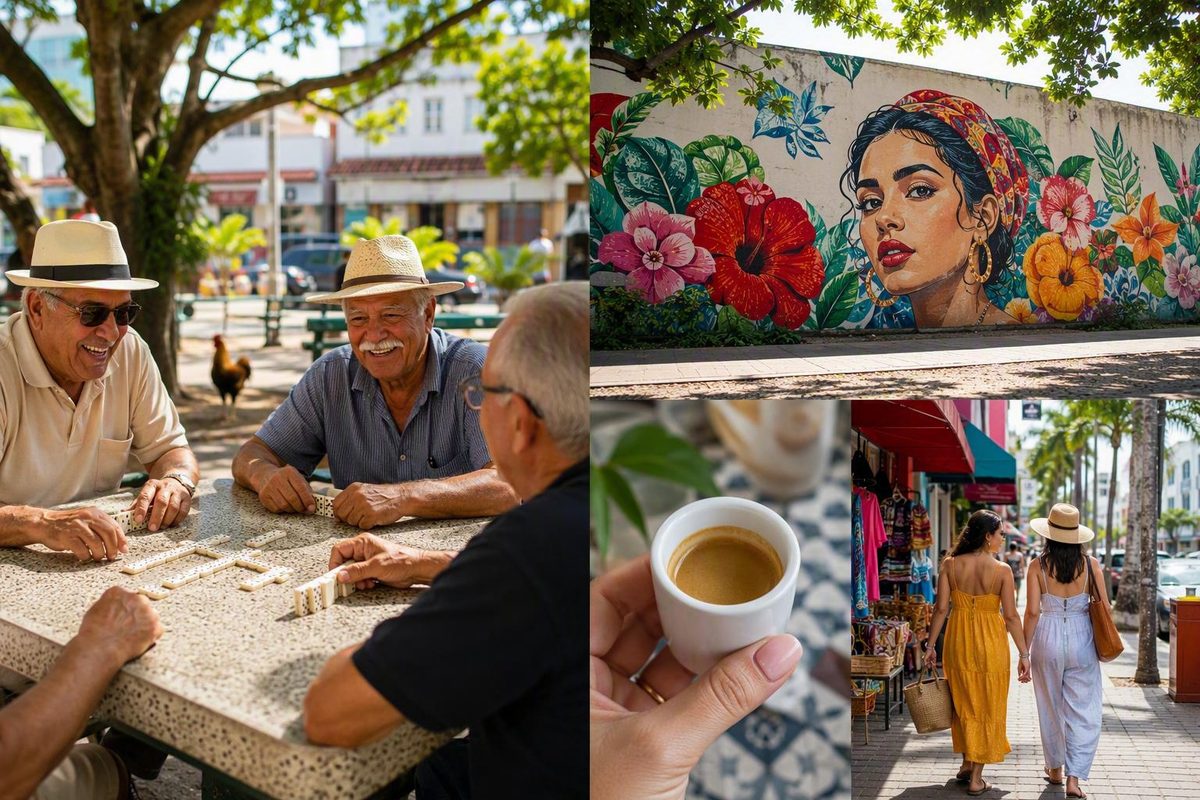
Domino Park, public art and one tasting stop fit a focused two-hour visit; a relaxed half day adds a meal, shopping and a cultural venue.
This guide is a route framework, not a real-time operations directory. Restaurant hours, venue access, performances, tours, event dates, transit, parking, accessibility, and dietary accommodations should be confirmed directly before your visit.
Start Here: The Essential Little Havana Experiences
For a first visit, concentrate on a short list of things to do in Little Havana:
- Walk Calle Ocho and look for sidewalk stars, murals, painted rooster sculptures, galleries, and distinctive storefronts.
- Pause at Máximo Gómez Park, better known as Domino Park, and observe the games respectfully.
- Try café Cubano, a pastry, croquetas, a Cuban sandwich, tropical juice, or guava-forward ice cream.
- Look for cigar rolling or another craftsmanship demonstration if a business is operating and visitors are allowed inside.
- Add a gallery, cultural space, longer meal, or live-music venue if time and current schedules permit.
Calle Ocho is Southwest 8th Street and the neighborhood’s principal commercial and cultural corridor. Little Havana extends well beyond the blocks most visitors walk, but the densest sightseeing cluster for a first trip is roughly between Southwest 12th and Southwest 17th avenues. The Calle Ocho Walk of Fame is reported to span those avenues, making that stretch a useful planning framework rather than a rigid neighborhood boundary. Miami’s official destination guide identifies the Walk of Fame span and names Celia Cruz, Gloria Estefan, and Andy Garcia among its honorees.
This compact core works because public art, neighborhood history, food windows, Domino Park, shops, and cultural businesses overlap. It is not a complete portrait of Little Havana. Treat it as an efficient introduction to a living Miami neighborhood with Cuban roots and a wider Latin American presence—not as a themed attraction or a substitute for visiting Cuba.
A focused visit of about two hours works for the central landmarks, Domino Park, public art, and one tasting stop; commercial visitor guidance similarly estimates that many visitors spend one to two hours before staying longer for restaurants or music. That broad duration estimate comes from a tour vendor’s neighborhood guide and should be treated as a planning reference, not a fixed itinerary. Choose a half day if you want a meal, several small tastings, shopping, art, and time to observe the street without rushing.
It also helps to separate relatively durable sights from changeable businesses:
- More dependable route anchors: Calle Ocho itself, sidewalk stars, murals, rooster sculptures, Domino Park, and Cuban Memorial Plaza.
- Verify before relying on them: restaurants, galleries, cigar demonstrations, theater access, tour departures, event dates, and live performances.
A storefront recommended in an older guide may have moved, changed its menu, altered its admission rules, or closed. Build your route around public landmarks first, then confirm the businesses that matter most to you.
A Walkable Calle Ocho Route for Two Hours or Half a Day
Tower Theater, near Southwest 15th Avenue, is a practical visual meeting point in the middle of the visitor corridor. Because it is not at the eastern edge of the route, the clearest plan is to meet there, make a short eastward leg toward Domino Park and—on the longer version—Cuban Memorial Plaza, then turn west and continue toward the creative spaces around Southwest 16th and 17th avenues.
This is a compact out-and-back framework, not a perfectly straight east-to-west march. If avoiding any retracing matters more than meeting at Tower Theater, begin near Cuban Memorial Plaza around Southwest 13th Avenue and proceed west instead.
The core route
- Meet outside Tower Theater. Use the building as a visual landmark, but do not assume screenings, tours, restrooms, or walk-in access are available.
- Walk east toward Domino Park. Notice the sidewalk stars, murals, painted roosters, mosaics, and changing storefront displays along the way.
- Pause at Domino Park. Watch from the edge without interrupting a game, blocking a table, or handling the pieces.
- For the half-day route, continue east to Cuban Memorial Plaza near Southwest 13th Avenue. Treat this as the route’s eastern endpoint.
- Turn west and choose a food or craft stop. A cafecito, pastry, croquetas, fruit juice, ice cream, or currently operating cigar workshop can fit here.
- Pass Tower Theater again and continue toward Southwest 16th and 17th avenues. Check whether the Futurama Building, Cubaocho, or another gallery or cultural space is open before using it as your final destination.
The route is described through cross streets rather than an exact measured distance. The Walk of Fame is reported between Southwest 12th and Southwest 17th avenues, but total walking depends on where you start, how often you cross Calle Ocho, and which shops or food counters you enter.
A two-hour version
For a focused two-hour visit, keep the priorities simple:
- See the exterior of Tower Theater.
- Walk past a selection of sidewalk stars, murals, and painted rooster sculptures.
- Observe the activity at Domino Park.
- Enter one cigar or craft business only if a demonstration is available and the conditions suit your group.
- Choose one coffee, pastry, juice, sandwich, or ice-cream stop.
- Finish west of Tower Theater or return to your original meeting point.
Do not attempt a complete tasting crawl in this version. One food stop leaves room to notice the public art, storefronts, and street life that make the corridor more than a sequence of restaurants.
If you want to avoid retracing your steps, arrange to arrive near Southwest 13th Avenue and leave from the western end of the core rather than using Tower Theater as both the meeting point and finish.
A half-day version
With a half day, expand the same route rather than creating a second, disconnected itinerary:
- Begin near Cuban Memorial Plaza around Southwest 13th Avenue or include it as an eastward extension from Tower Theater.
- Stop at Los Pinareños for tropical fruit or sugarcane juice if it is operating.
- Share croquetas or a pastelito early, then have a sandwich or sit-down meal later.
- Visit a currently operating gallery or cultural venue around Futurama or Cubaocho.
- Allow time for books, recorded music, domino sets, clothing, local art, or other selective souvenir shopping.
- Return to a mural, memorial, or workshop that you passed too quickly.
A half day is also more forgiving if a preferred venue is closed. Instead of abandoning the itinerary, substitute another confirmed gallery, café, restaurant, or shop within the same corridor.
Shortcuts for weather, children, or limited stamina
In hot conditions, begin earlier, carry water, and divide the route into short outdoor segments. In rain, confirm one indoor anchor before arriving and use dry intervals for the stars, murals, memorial, and park. A flexible approach built around indoor stops and brief outdoor links is more workable than treating the entire street as one uninterrupted walk.
Families and travelers with limited stamina can omit the eastern extension to Cuban Memorial Plaza, choose either a cigar stop or a gallery rather than both, and finish with juice or ice cream. This is only a planning shortcut. It is not a guarantee of smooth sidewalks, shade, seating, public restrooms, stroller access, or step-free entrances.
What not to include in the compact circuit
Treat it as a separate dining excursion requiring additional transportation rather than forcing it into a short walking itinerary.
A route can be labeled “Little Havana” while extending well beyond the core most first-time visitors expect to walk.
Pre-trip verification checklist
- Confirm that priority restaurants, galleries, shops, and cultural venues are operating.
- Check whether indoor attractions require admission, reservations, identification, a purchase, or a minimum age.
- Review menus, current prices, dietary options, and allergy procedures.
- Check live-music calendars and event pages for your exact date.
- Review the forecast and prepare a shorter heat or rain version.
- Confirm transit, parking, entrances, restroom access, seating, and accessibility details important to your group.
Landmarks, Art, and Everyday Culture Along the Route
Food may draw many visitors to Calle Ocho, but the corridor also supports a strong sightseeing route built around public art, gathering places, memorials, and creative businesses.
Calle Ocho Walk of Fame
Look down as well as across the street. The Walk of Fame consists of stars embedded in the sidewalk honoring figures connected to Latin heritage and South Florida. Frequently identified honorees include singer Celia Cruz, musician Gloria Estefan, and actor Andy Garcia.
The stars are distributed along the corridor rather than gathered in one plaza. Notice them while moving between the theater, park, restaurants, and galleries instead of treating the Walk of Fame as a single brief stop.
Murals and painted roosters
Murals, painted tiles, and large rooster sculptures give the route much of its visible color. Some works refer to Cuban music, public figures, or neighborhood identity; others function as contemporary street art or business decoration. Locations and conditions can change, so use older photographs as clues rather than a checklist that the street must match exactly.
Gallery and gift-shop windows extend the visual experience indoors. A working gallery or store is not automatically a free exhibition space, however. Ask before photographing artwork, merchandise, artists, staff, or other customers.
Domino Park
Máximo Gómez Park is commonly called Domino Park and remains one of the clearest places to observe everyday social activity along the visitor corridor. Current destination guidance says games are typically played by members, although visitors are welcome to watch.
Good etiquette is straightforward:
- Stand where you do not block players, tables, or onlookers.
- Keep conversations quiet near active games.
- Do not touch dominoes, chairs, or game tables without an invitation.
- Do not ask players to repeat a move for a photograph.
- Ask permission before taking a close photograph of an identifiable person.
Treat an invitation to join as a pleasant exception, not an expected tourist activity.
Cuban Memorial Plaza
Near Southwest 13th Avenue, Cuban Memorial Plaza provides a more history-oriented pause. Florida’s official tourism guide describes the plaza as containing monuments and an eternal flame honoring people who fought for Cuban independence. Visit Florida identifies the memorial’s location and purpose in its Little Havana overview.
Approach the site as a memorial rather than simply a photo backdrop. Read what is present, leave pathways clear, and avoid using a short visit to make sweeping political conclusions about a diverse neighborhood.
Tower Theater and creative spaces
Tower Theater is a longstanding visual landmark on Calle Ocho and a useful orientation point. Its presence reflects the corridor’s relationship with film and community life, but building access and current programming are separate questions. Check directly before planning around a screening, exhibit, restroom, or indoor visit.
Farther west, the Futurama Building has been associated with galleries and creative workspaces. Cubaocho has been described as combining Cuban art, music, and hospitality. Tenant lineups, collections, admission practices, age rules, and operating hours can change, so use these as provisional cultural stops rather than guaranteed museum visits.
Most importantly, look beyond the objects. Calle Ocho is part of a functioning neighborhood where people work, shop, meet friends, and conduct daily business. Cuban cultural roots remain highly visible, while broader Latin American influences are also present. Visitors gain more from the route when they observe that complexity instead of expecting every block to perform one fixed version of “Cuban atmosphere.”
What to Eat and Drink: Build a Cuban Tasting Crawl
A tasting crawl works better than ordering several complete meals. Pick a few small items, share when practical, and leave room for a stop you discover while walking.
A shareable tasting checklist
- Café Cubano or cafecito: sweetened espresso commonly prepared with a dark roast
- Pastelito: a pastry available with different fillings, with guava frequently featured
- Croquetas: a convenient savory item to divide among a group
- Cuban sandwich: split one unless it is your main meal
- Guarapo: sugarcane juice, when available
- Tropical fruit or another juice: a useful alcohol-free option
- Guava-forward ice cream: a natural final stop
The goal is variety, not volume. Coffee, a pastry, croquetas, part of a sandwich, juice, and dessert can quickly add up to a substantial meal.
How to sequence the food
Begin with coffee and a pastry or croquetas. Save a sandwich or sit-down meal for the middle of a longer visit, then finish with juice or ice cream. Alternating food with landmarks prevents the itinerary from becoming a chain of waiting lines and dining rooms.
Café Cubano is sweetened espresso commonly made with a dark roast. Coffee terminology and serving formats can vary by counter, so ask staff what each available size or preparation contains rather than relying on an elaborate glossary.
Places to consider—not rankings
Use these businesses as examples and verify their current status:
- El Pub for coffee-window foods and Cuban staples
- Sanguich de Miami for a sandwich-focused stop
- Los Pinareños for tropical fruit and sugarcane juice
- Azucar for tropical and Cuban-inspired ice cream
- Old’s Havana or Cafe La Trova for a longer meal
Azucar’s documented Abuela Maria flavor has been described as combining vanilla ice cream, guava, and cream cheese. A listed self-guided food route records those components, but recipes and available flavors can change.
For a short walk, choose one or two food stops. For a half day, a practical pattern is coffee or a pastry, one savory tasting, a shared sandwich or meal, and dessert. If you plan to return for dinner, keep the daytime crawl lighter.
Compact route versus farther restaurants
Versailles and La Carreta appear in many Miami dining guides, but neither should be treated as an effortless addition to the central Calle Ocho circuit. Visit one on a separate ride if it has particular significance to you; otherwise, stay within the compact core and reduce transit time.
This distinction is especially important when evaluating self-guided food routes.
Dietary needs and allergies
Menus, prices, ingredients, and preparation methods change. Contact businesses directly about vegetarian or vegan meals, gluten-related needs, serious allergies, and cross-contact practices. Do not assume that a tour marketplace’s general accommodation label applies to every restaurant or every departure.
Confirm reservations and age policies for dinner venues as well. A restaurant that becomes music-oriented later in the evening may operate differently from its daytime service.
Cigar Rolling, Galleries, Shopping, and Cultural Craft
Cigar rolling can be approached as a craftsmanship experience without making tobacco consumption part of the day. Businesses such as Cuba Tobacco Cigar Company and other Calle Ocho cigar shops have been associated with hand-rolling demonstrations, but access is not standardized.
One documented shop visit described a process involving:
- sorting tobacco leaves,
- removing central veins,
- arranging and rolling filler and wrapper leaves,
- pressing the formed cigars,
- finishing the exterior, and
- packing the completed product.
The published account describes those stages at one Calle Ocho cigar business, but it does not establish that every shop offers a formal tour or demonstration.
Before entering, ask whether visitors may observe, whether a purchase is expected, and whether photography is permitted. Families should confirm minimum ages and whether smoke is present indoors. Anyone avoiding tobacco or smoke can skip these businesses without losing the broader cultural shape of the itinerary.
Use precise language when describing what is sold. “Cuban-style” or “locally rolled” does not establish that a cigar or its tobacco originated in Cuba. Visit Florida reports that tobacco used by local cigar makers generally comes from Central America or elsewhere in the Caribbean and attributes that sourcing pattern to the U.S. trade embargo. That is a tourism guide’s bounded description, not a complete statement of current federal trade law.
Tobacco-free cultural alternatives
Travelers who prefer not to enter cigar businesses can:
- Browse galleries and changing creative spaces around the Futurama Building.
- Visit Cubaocho if its current art access and age policies suit the group.
- Look for local books, recorded music, prints, or small works of art.
- Shop for domino sets or practical souvenirs.
- Browse guayaberas and other clothing after checking current store locations.
- Spend more time studying murals, tiles, sculptures, and storefront details.
Shopping is most rewarding when it is selective. Decide whether you want clothing, a game set, music, art, or a food item before entering every store. Addresses, prices, tenant rosters, demonstrations, and collections can all change.
Live Music, Dancing, and an Evening in Little Havana
An evening extension can add live music, dancing, dinner, or cocktails, but it requires more verification than the daytime walk. Do not assume that a venue presents the same style of music every night—or that a performance will occur on your date.
Frequently named options include:
- Ball & Chain, associated in visitor guides with salsa, jazz, and bachata
- Cafe La Trova, combining Cuban dining with trova-style music
- Cubaocho, associated with Cuban art, rum, salsa, Latin jam sessions, and jazz
- Hoy Como Ayer, commonly mentioned for salsa-oriented nightlife
These descriptions help narrow the choices; they do not predict a particular night’s program. Venue operations, performers, covers, table policies, and minimum ages can change.
A simple evening sequence
- Choose and reserve dinner if the restaurant recommends it.
- Locate the venue’s own website or social account and check the calendar on the day of your visit.
- Compare the performance start time with your dinner reservation.
- Select one music venue rather than building a multi-stop crawl around unverified schedules.
- Confirm the cover charge, minimum age, dress expectations, reservation policy, and entrance arrangements.
Choosing one place creates room for delays and lets you stay if the performance suits you. A rigid multi-venue plan is more vulnerable to lines, covers, schedule changes, and age restrictions.
An alcohol-free evening
Cocktails are not necessary for an evening in the neighborhood. Have dinner, order coffee or a nonalcoholic drink, take a short dessert walk, and attend music where the venue’s entry and age policies permit.
Families and nondrinkers may prefer an earlier performance or restaurant-centered evening rather than a late-night dance venue. If current music details remain unclear, make dinner the anchor and treat entertainment as optional.
Guided Tour or Self-Guided Visit? Compare the Tradeoffs
A self-guided visit is usually better for travelers who want control. A guided tour is useful when commentary and prearranged tastings matter more than flexibility.
Choose self-guided if you want to:
- Start and finish when you choose.
- Spend more time with murals, memorials, or photography.
- Skip alcohol, cigar interiors, or foods you do not want.
- Control portions instead of following a meal-sized tasting sequence.
- Change plans because of heat, rain, children, or fatigue.
- Leave early without abandoning a prepaid itinerary.
The disadvantage is that you must research the route, confirm businesses, and supply your own historical context. Popular counters may also require separate ordering and waiting at each stop.
Choose a guided tour if you want:
- A fixed sequence that reduces navigation decisions.
- Cultural commentary and help interpreting landmarks.
- Several tastings without researching each order.
- A scheduled group activity.
- A business visit or demonstration arranged by the operator.
Supplied commercial listings generally show Little Havana food and culture tours lasting about two to three hours, although exact formats vary by operator. One tour company lists separate two-hour and three-hour options, illustrating why “food and culture tour” does not describe one standardized product. The operator’s advertised durations, inclusions, and prices remain subject to change.
In the Miami Culinary Tours listing reviewed for this guide on September 4, 2026, the advertised public tour lasted 2.5 hours, covered approximately half a mile, and cost $69.99 per adult. The operator described the tastings as sufficient for a meal and warned that restaurant stops and dishes could vary. Check the current product page before relying on the quoted price, route, or inclusions.
Some tours emphasize coffee and pastries. Others add a sit-down meal, fruit juice, a cigar demonstration, or alcohol. Read the current product description rather than inferring inclusions from the tour title.
Audio and GPS alternatives
A self-guided audio or GPS route offers a middle ground: you retain control of the pace while receiving navigation prompts or commentary.
One listed food route is 2.3 miles long with an estimated duration of two hours. Those figures and the stop list appear on the commercial GPS guide and may change.
Before downloading any route, compare its map with the compact corridor. Check whether the advertised distance includes every detour and whether the final stop leaves you far from your starting point.
Booking checklist
Before paying, compare:
- Exact meeting and ending points
- Total walking distance
- Tour duration
- Group size
- Included food and drinks
- Whether tastings replace a meal
- Guide language
- Minimum age and alcohol rules
- Cancellation and weather policies
- Rest opportunities
- Accessibility for your specific needs
- Dietary substitutions and cross-contact limitations
Operator and marketplace descriptions can conflict, especially around vegan meals, severe allergies, alcoholic beverages, wheelchair access, and stroller use. A general accessibility label cannot establish that every sidewalk, threshold, restroom, restaurant, or cigar shop will work for a particular traveler.
A tour is most useful when you value commentary, sequencing, and included tastings. If your priorities are public landmarks, one snack, and flexibility, a self-guided walk is likely the simpler choice.
Practical Planning: Getting There, Weather, Events, and Verification
Treat Little Havana as one neighborhood cluster within your Miami day. Walk inside the Calle Ocho core, then use transit or a short ride for longer links. Repeatedly crossing the city between isolated attractions wastes time and makes weather disruptions harder to manage.
This article does not provide a verified, date-specific transit or parking plan. Use the appropriate public-agency trip planner for your travel date, and confirm the final walking route from your stop or parking location before departure.
Transit and parking
Supplied guides mention city buses and trolley service in Little Havana, but routes and stops can change. Consult current official transit information rather than copying a route number from an older article or travel blog.
If driving, do not assume a lot is free or rely on a price quoted in an old guide. Check posted signs, municipal rules, payment instructions, time limits, and restrictions where you actually park. Allow enough time to understand the signs before beginning the walk.
Heat and rain
For hotter conditions:
- Start earlier.
- Carry water.
- Keep outdoor segments short.
- Alternate street landmarks with confirmed indoor stops.
- Avoid scheduling every meal or ticket so tightly that you cannot pause.
For rain, keep a café, restaurant, gallery, cultural venue, or shop as an indoor fallback—but confirm that it is open. A plan based entirely on presumed access to Tower Theater or an unverified gallery is not a dependable fallback.
Viernes Culturales and the Calle Ocho festival
Published tourism sources conflict about the recurring date of Viernes Culturales. Miami’s destination guide describes it as a third-Friday event, while other guides describe it as occurring on the last Friday. The destination guide also associates the Calle Ocho festival with March.
A separate commercial destination guide describes Viernes Culturales as a last-Friday event and also associates the Calle Ocho festival with March. That disagreement is why the organizer’s current calendar should control your plans.
Do not build a trip around either recurring-event description without confirming the exact date. For the Calle Ocho festival, verify the current route, closures, stages, transportation arrangements, and programming as well. A festival visit will differ substantially from an ordinary Calle Ocho walk because crowds and street access may alter the route.
Planning for different travelers
Families: Favor murals, painted roosters, sidewalk stars, Domino Park, bakeries, fruit juice, ice cream, and daytime cultural spaces. Confirm age policies before entering cigar shops, bars, or evening venues.
Nondrinkers: Build the day around coffee, juice, food, dessert, public art, and music where entry rules permit. Alcohol is optional.
Tobacco-avoidant visitors: Skip cigar interiors and substitute a gallery, shop, mural walk, or clothing stop. Do not assume a workshop is smoke-free merely because rolling is the advertised activity.
Visitors with mobility or sensory needs: Ask directly about entrances, thresholds, sidewalk conditions, seating, restroom access, crowd levels, music volume, and the route between stops. General accessibility labels cannot answer every practical question.
Reliable public restrooms, shaded seating, wheelchair and stroller conditions, venue entrances, and accommodations for serious dietary needs are not consistently established by the available guides. Verify them directly rather than treating them as guaranteed neighborhood amenities.
Frequently Asked Questions
How much time do you need in Little Havana?
About two hours is enough for a focused route covering the central Calle Ocho landmarks, Domino Park, public art, and one tasting stop. A half day is better for a meal, several small tastings, shopping, a gallery or cultural venue, and slower observation.
Commercial guided food tours commonly fall within a two-to-three-hour window because they combine commentary with scheduled tastings. Dinner or a music performance can extend the visit into the evening, but there is no need to include every possible experience in one day.
Can tourists play dominoes at Domino Park?
Do not assume so. Current visitor guidance says games are typically played by members, while visitors are welcome to watch. An individual player may invite a visitor to participate, but that is not guaranteed.
Observe from a respectful distance, avoid interrupting play, do not handle the pieces, and ask before photographing identifiable people.
What are the best free things to do in Little Havana?
A largely free route can include:
- Walking Calle Ocho
- Finding Walk of Fame stars
- Viewing murals and painted rooster sculptures
- Observing games at Domino Park
- Visiting Cuban Memorial Plaza
- Window-shopping at galleries and local businesses
- Seeing the exterior of Tower Theater
Performances, gallery admission, demonstrations, tours, and special events may involve charges or restricted access. Verify them rather than assuming they are free.
Is a Little Havana food tour worth it compared with a self-guided walk?
A tour can be worthwhile if you want structured tastings, cultural commentary, and an arranged sequence. Some operators advertise enough food for a meal and may include landmarks, artist spaces, memorials, or cigar demonstrations, but stops and menus can change.
A self-guided walk is better if you value flexible timing, smaller portions, lower commitment, or the ability to skip alcohol and tobacco. Compare meeting points, walking distance, food quantity, language, cancellation terms, age rules, accessibility, and dietary limitations before booking.
When are Viernes Culturales and the Calle Ocho festival?
Viernes Culturales is recurring, but supplied tourism sources conflict between the third and last Friday of the month. Use the organizer’s current calendar for the next confirmed date.
The Calle Ocho festival is associated with March in the supplied guides, but its exact date, route, closures, and programming require official confirmation each year. Festival conditions may also make the ordinary compact walking itinerary impractical.
Final Planning Decision
Choose either a focused two-hour route or a more relaxed half day. Anchor the visit with the Walk of Fame, public art, Domino Park, one food stop, and one cultural or craftsmanship stop. Add a guided tour or evening performance only if it fits your interests, budget, and confirmed schedule.
Keep the visit flexible and observe respectfully. Little Havana is a living neighborhood, not a checklist. Immediately before departure, confirm event dates, venue hours, music calendars, transit, parking, accessibility, age policies, and dietary needs.