
Choose the Miami Base That Fits the Trip You Actually Want
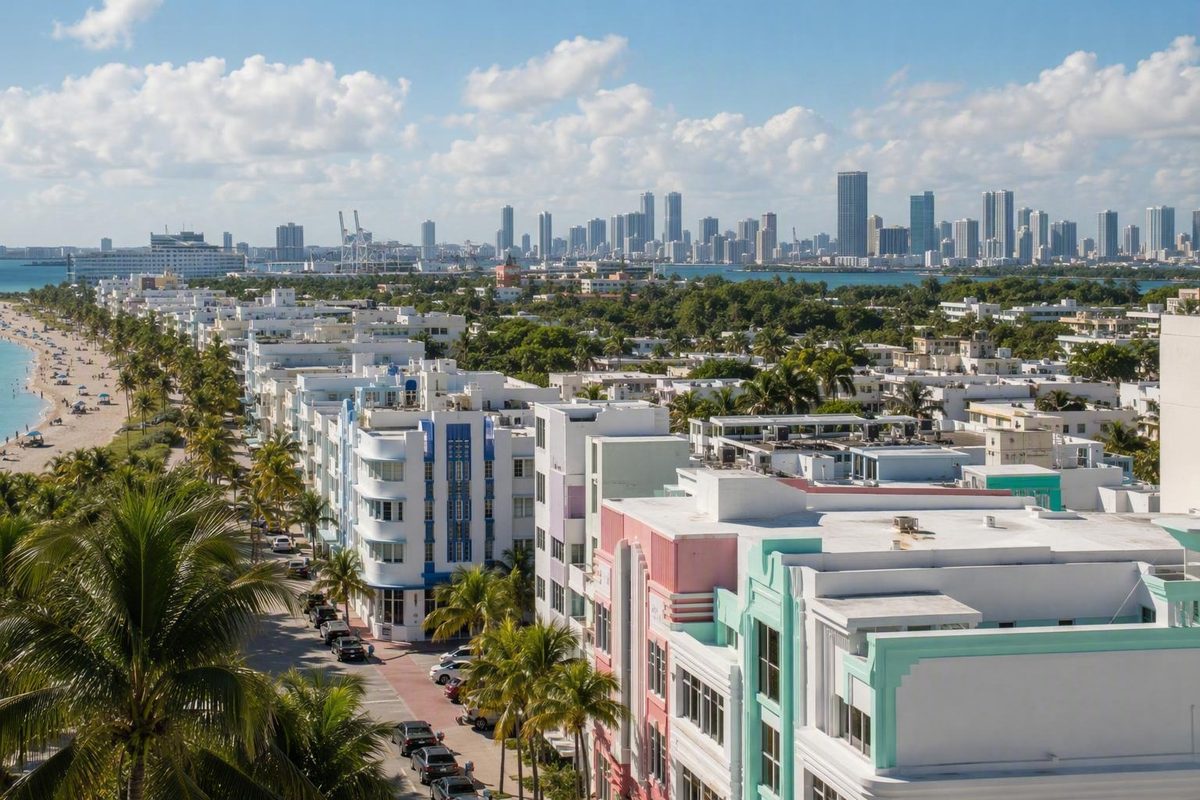
Miami makes more sense when you stop treating it as one continuous destination. Beaches, cultural districts, the urban core, waterfront neighborhoods, and nearby municipalities are separated by Biscayne Bay, causeways, major roads, and distances that can look deceptively short on a map.
That geography changes the central planning question. Instead of asking, “Which Miami neighborhood is best?” ask, “Where do I want most of my mornings and evenings to happen?”
A base near the beach makes spontaneous swims and waterfront walks easier. Brickell or Downtown favors urban dining, museums, events, and central connections. Coconut Grove trades immediate access to South Beach for greenery, Biscayne Bay, and a slower daily rhythm.
The right choice depends on what you want to repeat—not simply which attraction you plan to visit once.
Related: Miami Beach vs Brickell vs Wynwood: Choose by Trip Type.
First, define what counts as a Miami neighborhood
In everyday travel language, “Miami neighborhoods” is an umbrella term. It often mixes three different geographic categories:
- neighborhoods within the City of Miami;
- districts and subareas within the separate City of Miami Beach;
- other incorporated municipalities in Miami-Dade County.
Brickell, Downtown, Wynwood, Little Havana, Little Haiti, Historic Overtown, Edgewater, and Coconut Grove are within the City of Miami. South Beach, Mid-Beach, North Beach, and South of Fifth are areas of Miami Beach.
Names and boundaries are not always fixed, either. Historical usage, redevelopment, and real-estate branding have repeatedly changed how parts of Miami are described. The area now commonly called the Arts & Entertainment District was previously branded as Omni, while Midtown emerged around the Midtown Miami development in territory traditionally associated with Edgewater. Published neighborhood lists also caution that the exact extent of some districts varies by source or speaker because Miami neighborhood names and boundaries have changed over time.
This guide therefore uses familiar visitor geography. It does not claim that every boundary is official, exact, universally accepted, or comprehensive.
It also helps to distinguish a larger district from a street, subarea, or enclave within it:
- Calle Ocho is the familiar name for Southwest 8th Street and is also identified as a sub-neighborhood within Little Havana.
- Spring Garden is listed as a sub-neighborhood within Overtown.
- Morningside and the MiMo Historic District are associated with the broader Upper Eastside.
- South of Fifth is a section of Miami Beach rather than a separate municipality.
- Brickell Key is a connected enclave beside mainland Brickell.
These distinctions matter when booking. Check the exact address, nearby streets, and walking route rather than relying entirely on the neighborhood label in a listing.
Miami neighborhoods at a glance: choose by trip priority
The following matrix compares major visitor areas without pretending that one is universally superior. Its walkability descriptions refer to movement within the principal visitor area, not between Miami’s separated districts.
The transit column uses a simple editorial framework:
- Strong means the area is useful for circulation within Miami’s central visitor core.
- Moderate means local options may be useful, but many cross-city outings still require a transfer or rideshare.
- Limited means most broader sightseeing itineraries require a deliberate connection.
These are planning descriptions, not measured transit scores. Routes, service levels, accessibility, and operating conditions should be checked with current official transportation providers.
| Area | Geographic category | Defining experience | Signature landmarks or anchors | Beach access | Internal walkability | Central circulation | Evening atmosphere | Principal trade-off |
|---|---|---|---|---|---|---|---|---|
| South Beach | Miami Beach district | Oceanfront days, Art Deco streets, dining, shopping, and nightlife | Ocean Drive, Art Deco District, Lincoln Road | Direct | Many visitor needs are concentrated within the district | Moderate; mainland trips require a connection | Active around major dining and nightlife concentrations | Crowds and noise may conflict with rest |
| Mid-Beach | Miami Beach district | Resort-centered beach stay | Fontainebleau Miami Beach | Direct | Depends heavily on hotel location and itinerary | Moderate; mainland sightseeing requires a connection | Primarily hotel- and resort-oriented | Fewer concentrated street attractions than South Beach |
| Downtown | City of Miami neighborhood | Museums, events, parks, and civic destinations | Bayfront Park, Pérez Art Museum Miami, Frost Museum of Science | No walkable ocean beach | Useful in selected central pockets | Strong for the urban core | Changes with the block and event schedule | Does not provide a doorstep-ocean experience |
| Brickell | City of Miami neighborhood | High-rise urban stay with shopping, restaurants, and business activity | Brickell City Centre, Mary Brickell Village | No walkable ocean beach | Many daily needs are concentrated in the core | Strong for the urban core | Restaurant, bar, and high-rise activity | Every ocean-beach visit is a separate trip |
| Wynwood | City of Miami neighborhood | Murals, galleries, casual dining, breweries, and bars | Wynwood Walls | No | Main visitor circuit can be explored on foot after arrival | Moderate; broader trips usually need another connection | Active around dining, bars, and events | No beach access and a different atmosphere by time of day |
| Design District | City of Miami district | Design, architecture, public art, and high-end retail | Institute of Contemporary Art, Museum Garage | No | Major destinations occupy a relatively compact area | Moderate; often combined with Wynwood or Midtown | Destination dining and retail | Shopping emphasis and price point may not suit every visitor |
| Little Havana | City of Miami neighborhood | Cuban American cultural context, music, food, and neighborhood history | Calle Ocho, Máximo Gómez Park | No | Best along the central Calle Ocho visitor corridor | Moderate to limited, depending on the itinerary | Restaurants, music, and community activity | A brief food stop can miss the district’s history and context |
| Coconut Grove | City of Miami neighborhood | Bayfront greenery, historic sites, marina activity, and outdoor dining | CocoWalk, The Barnacle, Vizcaya | Bayfront, not an ocean-beach base | Compact commercial areas are walkable, but attractions are dispersed | Moderate for selected trips | Relaxed dining and waterfront-oriented outings | Longer transfers to Miami Beach and northern districts |
| Edgewater | City of Miami neighborhood | Residential waterfront setting between Downtown and Wynwood | Margaret Pace Park and Biscayne Bay frontage | No nearby ocean beach | Useful for local routines, with fewer visitor sights at the door | Moderate because of its central geography | Quieter and more residential in emphasis | Fewer immediate attractions than Downtown or Wynwood |
| Little Haiti | City of Miami neighborhood | Haitian cultural institutions, businesses, and community life | Best approached through specific institutions and programs | No | Depends on the destination selected | Limited for a general visitor itinerary | Destination- and event-specific | Visitor circuits and boundaries are less standardized |
| Historic Overtown | City of Miami neighborhood | Miami’s Black heritage and cultural history | Historic and community institutions; Spring Garden is a subarea | No | Best approached through selected destinations | Moderate because of its proximity to the central core | Varies by venue and event | Requires historical context beyond a quick sightseeing pass |
The clearest conditional matches are:
- Choose South Beach when beach access and nightlife should shape most days.
- Compare Brickell and Downtown for an urban base with useful central connections.
- Visit or stay near Wynwood for murals, casual dining, breweries, bars, and gallery activity.
- Choose the Design District for design, architecture, contemporary art, and luxury-brand retail.
- Center Little Havana when Cuban American cultural context is a major priority.
- Consider Coconut Grove for bayfront greenery, outdoor dining, historic sites, and a slower pace.
Every advantage carries a limitation. South Beach offers direct ocean access but can bring crowds and nightlife noise. Brickell supports an urban routine but has no walkable ocean beach. Downtown places museums and event venues close at hand but may not match a beach-centered image of Miami. Wynwood creates an easy art-and-dining circuit after arrival, yet still requires transportation to the ocean. Coconut Grove provides a calmer setting but sits farther from several heavily visited districts.
A useful decision rule is simple: choose the base that supports most of your mornings and evenings, then visit other clusters during the middle of the day. Do not choose a hotel solely because it is near one attraction you expect to see once.
Miami Beach areas: South Beach, South of Fifth, Mid-Beach, and North Beach
Miami Beach is a separate municipality across Biscayne Bay, not a neighborhood within the City of Miami. Within Miami Beach, the experience changes as you move among South Beach, Mid-Beach, and North Beach—and even between different blocks in the same district.
South Beach is the most concentrated choice for travelers who want the ocean, recognizable architecture, restaurants, shopping, cultural venues, and nightlife in the same general area. Its stable identifiers include the Art Deco District, Ocean Drive, Lincoln Road, and the beachfront. The regional tourism organization also identifies New World Center and The Bass among the district’s cultural attractions and associates Fontainebleau Miami Beach with Mid-Beach and the Miami Beach Bandshell with North Beach in its overview of Miami Beach visitor areas.
That concentration is both South Beach’s strength and its drawback. You can begin the morning beside the ocean, spend the afternoon around shops or architecture, and remain nearby for dinner. The most active blocks, however, may bring pedestrian traffic, music, and late-night activity.
Travelers sensitive to noise should investigate:
- the hotel’s exact street;
- room orientation;
- nearby clubs, bars, restaurants, or event spaces;
- whether the room faces a busy road, courtyard, pool, or service area;
- and recent guest reports about the specific property.
Treating all of South Beach as equally loud—or equally calm—produces poor booking decisions.
South of Fifth, often shortened to SoFi, is the southernmost section of Miami Beach. South Pointe Park, its pier, and the nearby marina give the area a distinct waterfront identity.
South of Fifth can work well for visitors who still want access to South Beach but prefer to begin and end the day away from its busiest central concentrations. Its appeal is not isolation; it is proximity with some separation.
Mid-Beach emphasizes the resort side of a Miami Beach stay. The area can suit travelers who want the hotel property, pool, beach, and resort routine to be central to the trip rather than merely a place to sleep between city excursions.
The trade-off is that a resort-focused location may not provide the same dense, walk-out-the-door collection of street attractions found in parts of South Beach. Compare the specific hotel with your expected meals, evening plans, and transportation needs rather than assuming that every Mid-Beach property provides the same experience.
North Beach is another distinct Miami Beach area, with the Miami Beach Bandshell serving as a recognizable cultural anchor. It may appeal when staying farther from South Beach’s principal nightlife concentration feels more appropriate. As elsewhere, the precise location matters: “North Beach” describes a broader area, not the conditions on every block.
It does not make mainland neighborhoods adjacent. Visiting Wynwood, Downtown, Brickell, Little Havana, or Coconut Grove still requires a bus, rideshare, or combination of modes.
The choice is therefore not “best versus worst.” It is a choice among:
- concentrated attractions and nightlife in South Beach;
- relative separation from the busiest core in South of Fifth;
- a stronger resort emphasis in Mid-Beach;
- or a stay less centered on South Beach in North Beach.
Downtown and Brickell: neighboring urban districts with different emphasis
Downtown and Brickell sit next to each other in Miami’s central core, but they are not the same neighborhood. Brickell is south of Downtown, and the Miami River is commonly identified as Brickell’s northern boundary.
Downtown Miami is a practical match for travelers prioritizing museums, civic destinations, major events, waterfront parks, and central connections. Its visitor anchors include Bayfront Park, Pérez Art Museum Miami, and the Phillip and Patricia Frost Museum of Science. Pérez Art Museum and Frost Science share the Maurice A. Ferré Park campus overlooking Biscayne Bay.
Downtown also includes government and event functions. Its character can change by block, day, and event schedule: the area around a museum or major event will not feel identical to a quieter period elsewhere in the district. Exact hotel placement therefore matters, especially if the immediate evening environment is important to you.
Brickell is more closely associated with dense high-rise business and residential activity, restaurants, shopping, and bars. Brickell City Centre and Mary Brickell Village are recognizable commercial anchors. In the central part of the district, many meals and routine visitor needs can be handled on foot.
The shared practical advantage is circulation within the urban core. Available travel guidance identifies Metromover service in Downtown and Brickell, but routes, operating status, accessibility, and any fare conditions should be confirmed through current official transportation information before travel. Do not assume that central service eliminates the need for buses, rideshares, or other connections elsewhere in Greater Miami.
Their difference is one of emphasis, not an impermeable border:
- Downtown leans toward museums, parks, government, civic destinations, and event access.
- Brickell leans toward business, high-rise living, shopping, dining, and an after-work urban atmosphere.
Neither provides a walkable ocean beach. That is the central trade-off. If swimming or a beachfront morning is part of every day, an urban-core hotel creates repeated transfers. If the beach is one planned outing and museums, business appointments, dining, events, or central circulation matter more, Downtown or Brickell may be more efficient.
Nearby Brickell Key is an enclave connected to mainland Brickell by Brickell Key Drive. Its perimeter baywalk, park, marketplace, and playground give it a more self-contained waterfront character than the mainland business core, according to a commercial neighborhood profile of Brickell and Downtown. That distinction matters when comparing accommodations: staying on Brickell Key is not identical to stepping directly into the busiest part of mainland Brickell.
Choose between Downtown and Brickell by looking at the itinerary you will actually follow. Museum-heavy days and event access may favor Downtown. Business appointments and a restaurant-centered urban stay may favor Brickell. If both appear practical, compare the exact address, nearby evening environment, and walking route to the places you expect to use repeatedly.
Wynwood, the Design District, Midtown, and Edgewater: close on the map, different in purpose
Wynwood, the Design District, Midtown, and Edgewater occupy a relatively compact part of the mainland map. Their proximity makes them convenient to combine, but it does not make them interchangeable.
Wynwood is associated with murals, Wynwood Walls, galleries, restaurants, breweries, bars, and event venues. Its principal visitor circuit works well as a walking segment once you have arrived. A visit might combine street art, a gallery or shop, lunch, and an evening drink without requiring a vehicle for every stop.
The limitation is geographic. Wynwood is not an oceanfront district, and it is not a substitute for a beach base if frequent swims are important. Its concentration of venues can also produce a different atmosphere by time and day. A daytime mural walk does not necessarily show what the same blocks feel like later in the evening.
The Miami Design District has a different emphasis: design showrooms, architecture, public art, galleries, Museum Garage, the Institute of Contemporary Art, and luxury-brand shopping. Although both Wynwood and the Design District involve art, they invite different kinds of visits.
Wynwood is commonly approached through street art and a casual food-and-nightlife circuit. The Design District places greater emphasis on designed spaces, architecture, contemporary art, and high-end retail.
That distinction should shape the schedule:
- Travelers prioritizing murals, breweries, and informal browsing may spend more time in Wynwood.
- Travelers interested in architecture, galleries, public art, or designer stores may give the Design District the larger share of the day.
- Visitors interested in both can combine them instead of crossing the city on separate days.
Midtown illustrates why Miami labels require flexibility. The name became associated with the Midtown Miami development in an area traditionally identified with Edgewater. Travelers may now encounter “Midtown,” “Edgewater,” or “Wynwood–Edgewater” in different guides and accommodation listings. Those labels can refer to related geography without implying that every source draws identical boundaries.
Edgewater lies along the waterfront between Downtown and Wynwood. It can make sense for someone seeking a more residential base near—but not necessarily inside—the busiest visitor circuits. Its location may look ideal on a broad map, yet geographic proximity should not be confused with doorstep sightseeing. One third-party car-free lodging guide characterizes Edgewater as having relatively few tourist attractions within immediate walking distance and no nearby ocean beach.
For many short visits, the efficient pattern is to cluster these areas:
- Begin with galleries, architecture, or shopping in the Design District.
- Continue through Midtown if you have a specific meal, shop, or appointment there.
- Spend the later afternoon or evening around Wynwood’s mural, dining, and bar circuit.
- Treat Edgewater as a waterfront or lodging context rather than automatically adding it as another attraction checklist.
A half-day can work when your interests are narrow. A full day is more realistic if you want galleries, shopping, street art, a long meal, and evening activity without rushing.
Little Havana, Little Haiti, and Historic Overtown: cultural districts with living histories
They should not be treated as themed entertainment zones or reduced to a few foods and photographs.
The regional destination guide broadly associates Little Havana with Cuban culture, Little Haiti with Haitian culture, and Historic Overtown with Miami’s Black heritage in its Greater Miami neighborhood overview. Those associations are useful starting points, but they do not amount to complete histories or fixed demographic definitions.
Little Havana is closely associated with Cuban American culture. Calle Ocho—the familiar name for Southwest 8th Street—is its central visitor corridor and is also identified as a Little Havana sub-neighborhood in published City of Miami neighborhood lists. Music, restaurants, bakeries, cafés, shops, and gathering places all contribute to the experience.
Máximo Gómez Park, widely known as Domino Park, is one of the district’s most recognizable landmarks. A useful visit does more than photograph a game or order one meal. Build in time to understand why Calle Ocho matters, notice the mixture of community-serving and visitor-facing businesses, and support places rooted in the neighborhood. A local real-estate guide identifies Calle Ocho as Little Havana’s main street and Máximo Gómez Park as Domino Park.
Little Haiti is associated with Haitian culture, but a concise visitor guide should not pretend to define its complete history, demographics, or exact boundaries from broad tourism descriptions. It is better approached through specific community institutions, restaurants, shops, cultural programming, and events selected with current information.
Look for programs led by organizations based in the neighborhood rather than relying only on generic attraction lists. A named event, exhibition, performance, or community institution provides a stronger anchor than arriving with a vague plan to “see the neighborhood.”
Historic Overtown is central to Miami’s Black heritage. Spring Garden is identified as an Overtown sub-neighborhood, illustrating again that a larger cultural district can contain smaller areas with their own identities. As with Little Haiti, a responsible visit should begin with history and community institutions—not only with whichever restaurant, mural, or event ranks prominently in a search result.
A respectful approach across all three districts includes four practices:
- Learn before arriving. Read enough history to understand some of the people and forces that shaped the area.
- Use community institutions as anchors. Museums, cultural centers, historic sites, performance spaces, and locally led tours can provide context that a self-guided food stop cannot.
- Spend locally and thoughtfully. Patronize neighborhood businesses without treating residents as part of the scenery.
- Avoid flattening the district. No community can be summarized solely through cuisine, nightlife, murals, or one cultural label.
The available visitor evidence is stronger for broad cultural associations than for comprehensive history, current demographics, exact boundaries, or present-day social conditions. These profiles should therefore be treated as starting points for community-led interpretation, not definitive accounts.
Coconut Grove, Coral Gables, and other slower-paced alternatives
Geographically, however, they are not the same kind of place. Coconut Grove is a City of Miami neighborhood; Coral Gables is a separate municipality.
Coconut Grove sits along Biscayne Bay. Its visitor identity draws from waterfront parks, a marina, CocoWalk, outdoor dining, shopping, historic attractions, and tree-lined streets. Vizcaya Museum and Gardens and The Barnacle Historic State Park are major anchors, although their locations and the wider Grove should be mapped before assuming that every stop forms one compact walking loop.
Compared with Miami districts whose labels have shifted, Coconut Grove’s name and broad identity have remained relatively consistent. Supplied neighborhood sources identify it as Miami’s oldest community. A commercial neighborhood guide also lists CocoWalk, waterfront parks, Vizcaya, and The Barnacle among Coconut Grove’s principal visitor features and identifies Miracle Mile, Venetian Pool, the University of Miami, Shops at Merrick Park, and Fairchild Botanic Garden with Coral Gables.
Coconut Grove can suit visitors who want the bay, greenery, historic settings, cafés, and outdoor meals to play a larger role than clubbing or repeated South Beach visits. Its compact commercial core can be explored on foot, but the entire neighborhood and all its attractions do not form one continuous pedestrian zone. The principal trade-off is distance from Miami Beach, Wynwood, and some central attractions.
Coral Gables is associated with Mediterranean-inspired architecture and a carefully planned streetscape. Its major anchors include Miracle Mile, the University of Miami campus, Venetian Pool, Shops at Merrick Park, and Fairchild Tropical Botanic Garden.
Staying in Coral Gables therefore does not automatically put every attraction within walking distance. The strongest reasons to consider it are architectural interest, shopping or dining around a compact core, gardens, and an itinerary less focused on nightlife.
The practical comparison is:
| Choose Coconut Grove when… | Choose Coral Gables when… |
|---|---|
| Biscayne Bay, waterfront parks, marina activity, and historic sites lead the list | Architecture, Miracle Mile, gardens, or university-related plans lead the list |
| You want outdoor dining and a commercial core with a bayfront identity | You want a composed municipal center with several destination attractions |
| You accept longer transfers in exchange for a slower base | You accept that major sights extend beyond one walkable core |
Key Biscayne is another separate municipality, not a City of Miami neighborhood. It can be considered as a quieter beach and outdoor-recreation alternative. Its access pattern makes it a different proposition from Miami Beach, so compare transportation needs, the exact accommodation, and the balance between outdoor time and mainland sightseeing before choosing it as a base.
None of these descriptions establishes suitability for families, long-term residence, schools, safety, affordability, or investment. They address only visitor experience and geographic trade-offs.
Plan the city in clusters, not as one continuous walk
Walking works well inside selected districts. It generally does not work as the primary method of travel among Miami Beach, Downtown, Brickell, Wynwood, Little Havana, Coconut Grove, and Coral Gables.
That distinction prevents a common planning mistake: seeing two places near each other on a zoomed-out map and assuming that the connection will be a pleasant walk. Water, major roads, weather, distance, and pedestrian conditions can make a short-looking line impractical.
A car-free trip may combine:
- Metrorail;
- Metromover;
- Metrobus;
- Miami Beach trolleys;
- rideshares;
- bicycles where conditions and rider experience make sense;
- and a rental car reserved for selected days.
Routes, fares, schedules, service disruptions, bicycle rules, operating conditions, and accessibility provisions can change. Confirm them with the relevant official transportation provider shortly before travel rather than relying on an undated itinerary or a hotel’s general description.
Miami Finder’s car-free Miami planning guide recommends organizing the city into five practical clusters:
- Miami Beach for the ocean, waterfront walking, architecture, restaurants, and nightlife.
- Downtown and Brickell for museums, events, the urban core, shopping, and dining.
- Wynwood and the Design District for street art, galleries, design, retail, and evening venues.
- Little Havana for a culturally grounded Calle Ocho visit.
- Coral Gables or Coconut Grove for a slower southern cluster.
This structure reduces backtracking.
A practical day follows this pattern:
- Begin in your base. Have breakfast, walk the waterfront, or complete one nearby activity.
- Move to one additional cluster. Use transit or rideshare for the longer connection.
- Explore locally on foot. Group lunch, sights, shopping, and cultural stops within that area.
- Finish deliberately. Eat dinner in the same cluster or return to your base before dinner instead of adding another complicated late transfer.
A central trip can often work without a rental car if you accept that car-free does not mean ride-free. You may still use rail, buses, trolleys, or occasional rideshares.
A car becomes more justifiable for an independent Everglades outing, a trip toward the Florida Keys, multiple suburban stops, shopping that involves carrying many items, or accommodation in a poorly connected outlying area. Renting selectively for those days may be more practical than keeping a vehicle throughout the trip.
Weather adaptation
Build uncertain days around dependable indoor stops, brief transfers, and outdoor segments that can expand or contract with the weather.
Downtown and Brickell may support relatively compact transitions between indoor destinations. Wynwood can still work when galleries, shops, or meals anchor the visit, although its murals require outdoor exposure. A beach-centered day may need reduced expectations when rain persists.
Start near your base, preserve one optional outdoor walk, and finish where dinner does not require another difficult transfer. Miami Finder’s rainy-day planning framework develops this approach further.
The goal is not to maximize the number of neighborhoods visited. It is to minimize wasted movement while giving each selected district enough time to feel distinct.
Visitor guide versus relocation research: know what this comparison cannot decide
This guide can compare visitor geography, atmosphere, landmarks, beach access, and broad transportation trade-offs. It cannot determine whether a neighborhood is suitable for living, renting, or buying.
Tourism convenience and residential suitability answer different questions. A hotel guest may value nightlife outside the door; a resident may care more about sleep, groceries, building management, insurance, accessibility, or a daily commute. A district that works beautifully for a three-day visit may be inconvenient for someone’s routine, while a residential area with few attractions may support that routine well.
A relocation decision requires current, address-specific research into:
- total housing costs beyond the advertised rent or purchase price;
- insurance availability and cost;
- flood and storm-surge exposure;
- evacuation information;
- building age, maintenance, reserves, inspections, and condition;
- work commutes at the times you would actually travel;
- transit frequency and accessibility;
- groceries, healthcare, childcare, and other daily services;
- schools where relevant;
- nighttime noise and activity;
- and safety information with transparent methods and appropriate geographic detail.
Do not rank affordability from undated listing prices, asking-price ranges, or unexplained “average values.” Real-estate directories can supply names for further investigation, but figures without a retrieval date, consistent geography, and stated methodology do not support a fair current comparison.
Likewise, population counts reported from 2010 should not be presented as current descriptions of Miami’s demographics; the supplied City of Miami neighborhood list explicitly identifies its population figures as 2010 data in its neighborhood table and notes.
Use this relocation checklist for every exact address under consideration:
- Boundary: Which municipality, neighborhood, subarea, evacuation zone, and service jurisdiction contain the address?
- Housing: What is the complete monthly or annual cost, including association charges, insurance, parking, utilities, assessments, and likely maintenance?
- Building: What do inspection records, maintenance history, reserves, and management documents show?
- Flood and storms: What do current official flood, storm-surge, and evacuation resources indicate for the property?
- Commute: How does the trip to work perform at the times and on the days you will travel?
- Transit: Is the relevant service available when needed, and does it meet your mobility requirements?
- Daily errands: Can you realistically reach groceries, medical care, exercise, childcare, and other recurring needs?
- Night conditions: What are noise, lighting, access, and activity like after dark and on weekends?
- Accessibility: Do sidewalks, entrances, elevators, transit stops, common areas, and unit features meet specific needs?
- Future change: Are construction, redevelopment, assessments, or infrastructure projects likely to affect daily life?
No single visitor comparison can replace that address-level research.
A simple framework for choosing your Miami base
There is no best Miami neighborhood independent of the traveler and purpose.
Choose South Beach or another Miami Beach area when the ocean should shape every day. Compare Downtown and Brickell for an urban base with central connections, museums, events, business activity, shopping, and dining. Visit Wynwood and the Design District as distinct art-and-design experiences rather than treating them as interchangeable.
Approach Little Havana, Little Haiti, and Historic Overtown with cultural and historical context. Consider Coconut Grove or Coral Gables when greenery, architecture, bayfront activity, or a slower pace matters more than immediate access to South Beach.
The most workable trip begins with one base, groups nearby districts, and treats every attractive feature—beach access, nightlife, transit convenience, or relative quiet—as a trade-off rather than proof of a universal best.
Frequently asked questions
What is the best Miami neighborhood for a first-time visitor?
There is no universal answer. South Beach is the clearest match when a first visit centers on the ocean, Art Deco architecture, restaurants, shopping, and nightlife. Its drawbacks include possible noise, crowds, and repeated transfers to mainland districts.
Brickell or Downtown may be better when museums, urban dining, events, business, or central transportation matter more than having a beach outside the hotel. Wynwood can suit an art-and-dining-led stay, although every beach visit requires transportation.
Miami Finder’s accommodation comparison recommends evaluating Miami Beach, Brickell, and Wynwood by beach access, transit, nightlife, and neighborhood feel rather than choosing by reputation alone.
For a first visit, identify the activity you want to do spontaneously most mornings or evenings. Put that near the hotel and schedule everything else as a clustered outing.
What is the difference between Miami and Miami Beach?
The City of Miami is on the mainland and includes neighborhoods such as Downtown, Brickell, Wynwood, Little Havana, Little Haiti, Historic Overtown, Edgewater, and Coconut Grove.
Miami Beach is a separate municipality across Biscayne Bay. South Beach, Mid-Beach, North Beach, and South of Fifth are areas within Miami Beach. They are commonly grouped under “Miami” in travel discussions, but reaching mainland districts requires a causeway connection and some form of transportation.
Can you visit Miami neighborhoods without renting a car?
Yes, particularly when you choose a central or beach-oriented base, group nearby districts, and combine walking with transit and occasional rideshares.
Walk within one area rather than expecting to walk between all major visitor districts. A workable itinerary uses one principal cluster per half-day or day: Miami Beach; Downtown and Brickell; Wynwood and the Design District; Little Havana; or Coconut Grove and Coral Gables.
A rental car may still be useful for an independent Everglades trip, travel toward the Florida Keys, several suburban destinations, or an outlying hotel. Verify current transit routes, schedules, fares, accessibility, and operating conditions through official providers.
Are Downtown Miami and Brickell the same neighborhood?
No. They are neighboring districts in Miami’s urban core. Brickell lies south of Downtown, with the Miami River commonly identified as its northern boundary.
Downtown is more closely associated with Bayfront Park, museums, civic destinations, government functions, and events. Brickell is more closely associated with high-rise business and residential activity, Brickell City Centre, Mary Brickell Village, restaurants, and shopping.
Both can support an urban stay and central circulation. Neither offers a walkable ocean beach.
Which Miami neighborhoods are best for art and culture?
Choose according to the kind of experience you want:
- Wynwood for murals, Wynwood Walls, galleries, and a casual food-and-evening circuit.
- The Design District for contemporary art, architecture, public art, design, galleries, and high-end retail.
- Downtown for Pérez Art Museum Miami, Frost Science, and other central cultural destinations.
- South Beach for Art Deco architecture and cultural venues alongside the ocean.
- Little Havana for Cuban American cultural context centered on Calle Ocho.
- Little Haiti for Haitian cultural institutions, businesses, and community programming.
- Historic Overtown for Miami’s Black heritage and history.
Do not force all of these into one day. Pair Wynwood with the Design District, Downtown with Brickell, or one museum visit with a heritage neighborhood. Give Little Havana, Little Haiti, and Historic Overtown enough time and context to be understood as communities rather than decorative stops.