
Plan a Grown-Up Miami Trip Around the Experiences You Actually Want
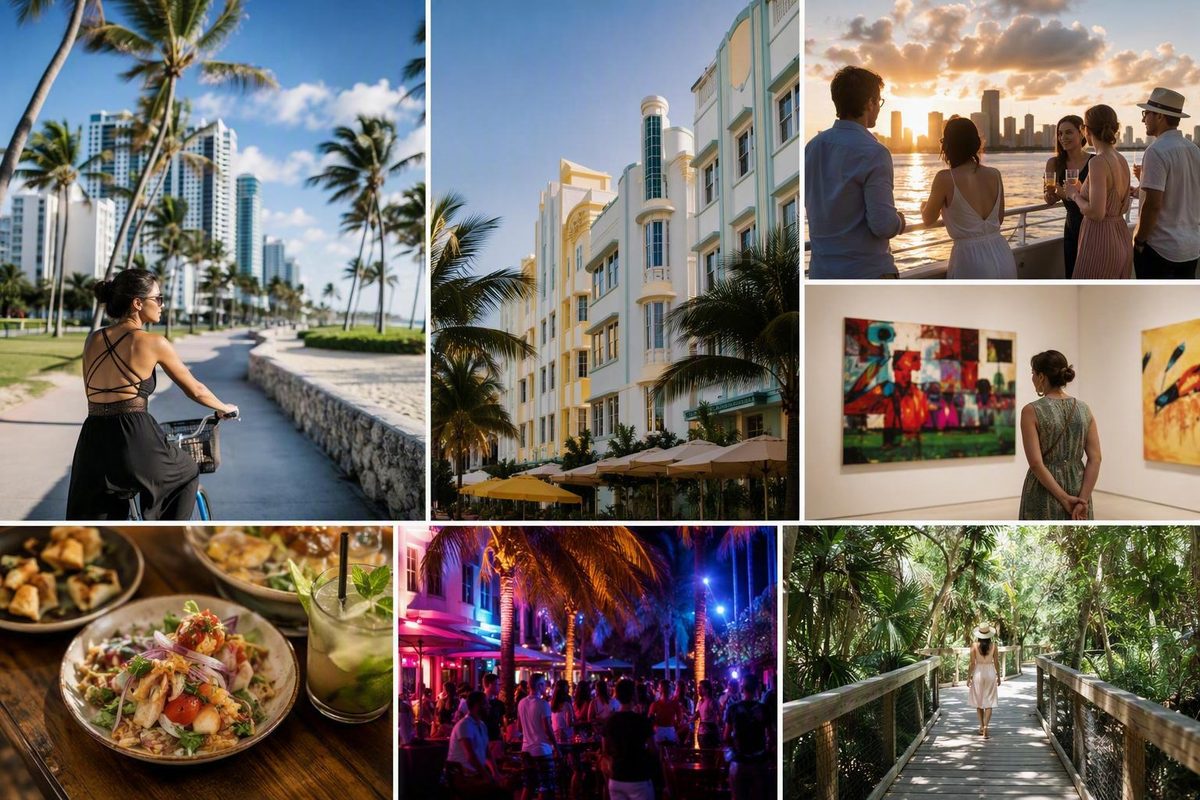
Explore Art Deco, Cuban culture, bay cruises, museums, nature and nightlife alternatives, with options matched to your mood, budget and time.
Miami can deliver sand, sunshine, and late nights, but that is only one version of the destination. Adults can also build a trip around Art Deco architecture, contemporary art, Cuban culture, historic estates, public murals, bay cruises, waterfront walks, sports, nature, dining, and live performance.
The useful question is not “What are the definitive best things to do in Miami, Florida, for adults?” It is “Which experiences fit your mood, companions, budget, weather, and available time?” Start with one neighborhood cluster per day, choose a main activity, and keep a nearby indoor alternative available.
Related: 8 Things to Do in Miami Beach, Plus Day Plans.
Start Here: Choose the Right Miami Experience for Your Trip
Use this table to narrow the choices before building an itinerary. “Free-access” means you generally do not need an admission ticket to enter the public space. Transportation, parking, rentals, food, and optional attractions can still cost money.
| Experience type | Area to consider | Typical commitment | Setting | General cost tier | Adult-friendly examples |
|---|---|---|---|---|---|
| Beach and waterfront | South Beach, Mid-Beach, South Pointe, Brickell Key | Short outing to half-day | Mainly outdoors | Free-access to moderate | Beach time, architecture walk, oceanfront walking or cycling, sunset stroll |
| Art and architecture | South Beach, Wynwood, Downtown, Design District | Short outing to full day | Mixed | Free-access to moderate | Art Deco buildings, public murals, galleries, PAMM |
| Food and culture | Little Havana, Wynwood, Coconut Grove | Half-day or evening | Mixed | Low to premium | Calle Ocho walk, Cuban coffee, food tour, live Latin music |
| Water recreation | Biscayne Bay, Biscayne National Park, Miami Beach | Short outing to full day | Outdoors | Moderate to premium | Sightseeing cruise, charter, kayaking, paddleboarding, snorkeling |
| Nature | Everglades, Biscayne National Park, Coconut Grove | Half-day to full day | Mainly outdoors | Moderate to premium | Paddling, boat outing, wildlife viewing, historic park |
| Relaxed evening | South Pointe, Brickell Key, Downtown waterfront | Short outing or evening | Mixed | Free-access to premium | Sunset walk, dinner, performance, sports, evening cruise |
| High-energy nightlife | South Beach, Wynwood, Downtown, Brickell | Evening to late night | Mainly indoors | Usually purchase-dependent | Dancing, DJs, live music, ticketed events |
These are adult-friendly choices, not necessarily adults-only experiences. Museums, beaches, cruises, parks, neighborhoods, and walking tours commonly serve a broad audience. Treat terms such as 21-plus, adults-only, and clothing-optional as venue or operator policies that require direct confirmation. A marketplace listing sold at an “adult” price does not prove that children are prohibited.
Different choices suit different travelers:
- Couples: sunset walks, bay cruises, waterfront meals, gardens, and architecture.
- Friend groups: shared or private boating, food tours, sports, live music, and dancing.
- Solo travelers: museums, guided tours, public art, and self-directed neighborhood walks.
- Quieter travelers and older visitors: formal gardens, historic properties, galleries, Mid-Beach, waterfront paths, and scheduled performances.
- Travelers avoiding alcohol: museums, sports, theater, architecture, nature, dining, and evening sightseeing.
Geography matters. Miami Beach sits across Biscayne Bay. Biscayne National Park, the Everglades, Fort Lauderdale, and Key West require additional travel and should be planned as excursions rather than inserted between central-city stops.
This guide is therefore a menu, not a ranking. A free-access South Pointe sunset, a museum afternoon, and a private boat charter offer different moods, costs, and logistical demands. None is automatically the right choice for every adult trip.
Miami Beach: Art Deco, Oceanfront Walks, and a Flexible Beach Day
A well-paced Miami Beach day can combine architecture, the ocean, exercise, museums, and dinner without requiring repeated cross-town travel. The most compact version begins around Ocean Drive, continues to the public beach or oceanfront path, and finishes at South Pointe Park.
Start with Ocean Drive and the surrounding Art Deco streets. This is not merely a nightlife area: the architecture makes it a sightseeing route, while the sidewalks support people-watching, cafe stops, dining, and a possible evening return. Walk independently if you mainly want the visual experience, or consider a guided architecture tour if historical context matters more than flexibility.
From there, cross toward the public beach or follow the oceanfront route on foot or by bicycle. Travel sources use different names, endpoints, and measurements for the Miami Beach Boardwalk and Beachwalk, so choose a turnaround point according to the weather, your energy, and where you want to eat. Walking gives you more time to examine buildings and pause at the beach; cycling works when movement itself is part of the outing.
Public beach access does not make the entire day free. Chairs, umbrellas, bicycle rentals, parking, food, drinks, and guided tours are optional expenses. A lower-cost version uses a towel and a self-guided walk. A comfort-oriented version adds rented equipment and a meal near the beach.
Continue south to South Pointe Park for a different waterfront perspective. Travel coverage describes the park as combining walking areas, beach access, picnic and barbecue facilities, a cafe, and a pier, making it useful even for adults who do not want a long session on the sand (adult Miami activity guide). Check current facility access before making one particular feature the purpose of your visit.
If South Beach feels too active, shift the balance north. Mid-Beach can support a quieter beach period or shorter waterfront walk without abandoning Miami Beach altogether. Another option is to see Ocean Drive early and spend most of the afternoon away from its busiest blocks.
Museums can provide indoor additions or weather alternatives:
- The Bass for contemporary art
- The Wolfsonian–FIU for art and design
- Jewish Museum of Florida–FIU for history and culture
- Art Deco Museum for architectural context
Do not assume that all four belong in one day. Choose one according to your interests and the exhibitions available during your trip. Confirm hours, admission, reservations, accessibility, and temporary closures directly with the institution before visiting.
A sensible daytime-to-evening progression is:
- Walk Ocean Drive and adjacent Art Deco streets.
- Choose beach time, a museum, or the oceanfront path.
- Continue to South Pointe Park.
- Stay nearby for dinner, live entertainment, or a sunset walk.
That sequence leaves room to linger and avoids turning a Miami Beach day into a transportation exercise.
Museums, Historic Homes, and Public Art on the Mainland
Mainland Miami is the stronger choice when art, architecture, and history matter more than spending most of the day at the beach. The major attractions are spread among Coconut Grove, Downtown, Wynwood, and the Design District, so select one or two compatible clusters rather than attempting all of them at once.
Vizcaya Museum and Gardens is a historic waterfront estate built for industrialist James Deering. Its large house and formal gardens create a substantially different experience from Miami’s modern skyline and contemporary galleries. Older travel accounts include historical admission prices, but those should not be treated as current rates. Check the institution’s current information for admission, hours, reservation requirements, accessibility, and any house or garden closures.
For a slower historical stop, consider The Barnacle Historic State Park in Coconut Grove. Its house dates to 1891 and has been described as the oldest Miami-Dade County home still standing in its original location (Miami museums, parks, and culture guide). It suits travelers interested in local history and a quieter setting rather than a large museum experience. Confirm house-tour availability separately from access to the surrounding park.
Downtown offers the easiest cultural pairing. Pérez Art Museum Miami, commonly shortened to PAMM, focuses on modern and contemporary art, including work connected to Latin America and the Caribbean. Nearby, Maurice A. Ferré Park adds bay views and publicly accessible sculpture areas. Together they create an efficient museum-and-waterfront cluster.
If you still have energy, remain Downtown for another cultural venue, lunch, or a walk toward Bayside. Downtown and neighboring Brickell combine museums, historic architecture, dining, performance spaces, sports, rooftop venues, and waterfront settings, allowing you to move between indoor and outdoor activities without abandoning the area (Downtown Miami and Brickell visitor guide).
Wynwood requires one important distinction: the neighborhood’s outdoor murals and street art are not the same thing as Wynwood Walls, a separate ticketed attraction. A self-directed visit can focus on neighborhood art, food, and galleries. A paid version might include Wynwood Walls, the Museum of Graffiti, or a guided mural tour. These are distinct spaces and businesses, not rooms within one admission area.
The nearby Design District is a possible extension for design, galleries, shopping, or dining. It is close enough to pair deliberately with Wynwood, but do not assume that every destination is inside one pedestrian enclosure. Choose specific stops before adding it to the day.
For rain or intense heat, use an indoor-heavy structure:
- Choose one major museum as the anchor.
- Schedule a long lunch or cafe stop nearby.
- Add a second cultural venue only if admission, opening times, and energy allow.
- Use a brief park or public-art window if conditions improve.
PAMM and Maurice A. Ferré Park make a natural version of this plan. Wynwood can also work if your selected galleries, museum, and restaurant are open, although seeing the neighborhood’s public art still requires outdoor movement.
Exhibitions, admission, free-entry programs, reservations, and access arrangements can change. Verify each venue individually, especially when a particular exhibition or accommodation is essential to the day.
Little Havana and Miami’s Food, Music, and Neighborhood Culture
Little Havana is both a living cultural neighborhood and a visitor destination. Approach it as a place to walk, eat, observe, and learn—not as a themed nightlife set created only for tourists.
Build the outing around Calle Ocho, where Cuban cafes and restaurants, cigar shops, cultural landmarks, and street life support several possible itineraries. Depending on your route and interests, reference points can include Calle Ocho Plaza, the Calle Ocho Walk of Fame, and Cuban Memorial Boulevard.
Viernes Culturales, or Cultural Fridays, is a recurring arts concept associated with the neighborhood. Event dates and programming are time-sensitive, so consult a current calendar before arranging your visit around it. A commercial itinerary also identifies Cultural Fridays as a recurring Little Havana event but advises visitors to check the calendar (Miami itinerary for first-time visitors).
Food should be part of the outing, not a race to identify one universally essential restaurant. Try Cuban coffee if caffeine suits you, then choose a bakery, counter-service meal, or sit-down lunch according to your schedule and budget. Cuban sandwiches and other familiar dishes can provide an entry point, but the neighborhood’s food culture is broader than one item. Claims that a particular restaurant is the most “authentic” are inherently subjective.
A guided food-and-history walk can be worthwhile when you want historical context, introductions to several foods, and a route chosen for you. The tradeoff is a higher cost and less spontaneity.
Commercial marketplaces show that Little Havana food walks, city tours, cruises, charters, and other activities are widely sold, but marketplace prices, ratings, availability, and rankings change. They should be treated as comparison tools rather than independent proof of quality (Miami tours and activities marketplace).
Salsa and live Latin music can extend the day into the evening. Search current calendars rather than assuming a venue named in an older guide still presents music on your chosen night. Ticketing, identification, dress, and age policies may vary by event, and a restaurant that hosts music on one evening may use a different format on another.
A practical half-day sequence looks like this:
- Arrive in late morning for a Calle Ocho walk.
- Stop for coffee, juice, or a snack.
- Visit selected cultural landmarks and shops.
- Have lunch without rushing.
- Pause or return to your accommodation.
- Add live music, salsa, or another performance if the current schedule aligns.
You can also look beyond Little Havana. Little Haiti and Overtown are culturally significant Miami neighborhoods that merit their own research and focused visits. They should not be treated as quick decorative additions to a Calle Ocho itinerary.
Biscayne Bay, Water Sports, and Nature Excursions
Water activities range from passive sightseeing to physically demanding recreation. Compare them by privacy, effort, price structure, and weather exposure rather than treating every boat trip as interchangeable.
| Water option | Best fit | Commitment | Cost tier | Main tradeoff |
|---|---|---|---|---|
| Shared Biscayne Bay cruise | First-time visitors, couples, solo travelers | Short outing plus check-in | Moderate | Less privacy and a fixed schedule |
| Private charter | Groups, celebrations, couples seeking privacy | Half-day or longer | Premium | Higher total cost and more contract details |
| Active water sport | Travelers who want movement or underwater views | Short outing to half-day | Moderate to premium | Ability, conditions, and operator rules matter |
| Self-directed waterfront recreation | Flexible or lower-cost days | Short outing to half-day | Free-access to moderate | Limited access to distant parts of the bay or park |
A shared Biscayne Bay sightseeing cruise is the simplest introduction. Routes commonly feature skyline views, islands, and waterfront properties, but the exact route, vessel, seating, and commentary depend on the operator. It is a passive outing, which can be useful after a walking-heavy morning.
A private charter can make sense as a group splurge because some options are priced by boat rather than by passenger. That does not automatically make a charter good value. Before paying, ask the operator to confirm:
- Passenger capacity
- Base price and additional charges
- Deposit and cancellation terms
- Weather and rescheduling policy
- Departure location and check-in requirements
- Food and drink rules
- Equipment provided
- The exact itinerary and advertised duration
Do not infer that a charter includes food, drinks, music, personal watercraft, snorkeling equipment, or a sandbar stop unless the current agreement says so.
For active travelers, possible options include:
- Kayaking
- Canoeing
- Paddleboarding
- Snorkeling
- Scuba diving
- Jet-skiing
- Cycling beside the water
Requirements vary by activity and provider. Before booking, ask whether participants need swimming ability, prior experience, certification, identification, instruction, or a signed waiver. Also confirm what safety equipment is provided and what happens if conditions prevent the planned activity. “Beginner-friendly” marketing does not establish that an experience is suitable for every traveler.
Biscayne National Park is primarily aquatic, so a meaningful visit often depends on a paddling, boating, snorkeling, or diving plan. Treat it as a dedicated outing rather than a quick stop between Downtown attractions. Verify access arrangements and available activities for your date before traveling to the park area.
An Everglades excursion is also a substantial commitment. Once transportation, check-in, and the activity are included, it can take up much of a day. Decide whether you want an airboat-oriented excursion, paddling, walking, or another style of visit, then compare pickup logistics and what the advertised duration includes. Wildlife sightings are possible but never guaranteed.
Keep Key West outside the core schedule for a short Miami visit. Commercial itineraries describe it as an all-day excursion, meaning it can replace a full day in Miami rather than function as a quick addition (Miami itinerary and excursions guide). It may suit a longer Florida trip, but it is inefficient within a short city break.
Before booking any water activity, ask about:
- Weather thresholds and cancellation or rescheduling terms
- Required identification and minimum age
- Swimming expectations or physical prerequisites
- Equipment and safety gear
- Instruction or guide supervision
- Waivers and deposit requirements
- Taxes, gratuities, and other possible charges
- Meeting point and check-in procedure
- Food, drinks, storage, showers, and transportation
- What the advertised duration includes
These questions form a comparison checklist; not every item applies to every activity. If conditions make the outing unavailable, use your nearby indoor alternative rather than building the entire day around an uncertain departure.
What to Do at Night Besides Going to a Club
Miami evenings can be quiet, cultural, active, or late-night. Choose by energy level instead of assuming nightlife must mean bottle service and a crowded dance floor.
Low energy: sunset and waterfront walks
South Pointe Park works well when you are already in Miami Beach. Brickell Key offers a waterfront setting with skyline views, while the Downtown bayfront can be paired with dinner or an event. These options do not require alcohol and can be shortened when conditions or energy change.
Low to moderate energy: dinner with a view
A rooftop or waterfront meal can turn dinner into the main evening experience. Downtown and Brickell have dining, rooftop venues, entertainment, and waterfront settings—not only bars. Reserve when a particular time or view matters, but keep a nearby alternative in case outdoor seating is unavailable.
Moderate energy: an evening cruise
A sunset or after-dark cruise can provide skyline views with less walking. Confirm whether the experience is sightseeing-focused or party-focused, and check seating, music level, food and drink arrangements, age policy, departure point, and return time.
Moderate energy: live music or salsa
Live Latin music and salsa offer culturally focused alternatives to conventional clubbing. Check the exact calendar for your date; do not assume an establishment has live music every evening or that every event uses the same age policy.
If dancing matters, look for current information about lessons, floor format, tickets, and entry requirements rather than relying on a venue’s general description.
Moderate energy: performing arts
Look at schedules for the Adrienne Arsht Center and Olympia Theatre. Theater, dance, comedy, and concerts can anchor the night, after which you can eat nearby instead of crossing the city again. Availability and venue rules vary by production.
Moderate to high energy: professional sports or arena entertainment
The Kaseya Center is a major Downtown sports and entertainment venue on Biscayne Bay. A team with “Miami” in its name does not necessarily play Downtown or within the City of Miami.
High energy: late-night dancing
Conventional clubs remain an option, but entry policies are too variable to generalize. Before going, verify:
- Identification requirements
- Minimum age
- Dress rules
- Tickets or cover charges
- Last entry
- Bag policies
- Whether a ticket guarantees admission
- Transportation options for the return trip
Sober-friendly evening choices include a performance, sports event, waterfront walk, museum program, architecture walk, sightseeing tour, or a meal where food and setting—not alcohol—are the focus.
Free, Low-Commitment, and Weather-Flexible Activities
Miami is not automatically a low-cost destination, but several defining experiences are free-access or easy to scale down.
Free-access ideas
- Public beach time
- Ocean Drive and adjacent Art Deco streets
- Miami Beach’s oceanfront path
- South Pointe Park
- Neighborhood murals in Wynwood
- Maurice A. Ferré Park and its public sculpture areas
- The Metromover within Downtown and Brickell
- Self-directed walks around Downtown or Brickell Key
“Free” does not mean zero-cost. Parking, transportation, food, bicycle or beach rentals, and nearby ticketed attractions can change the total. Set an extras budget even when the main activity has no admission charge.
The Metromover is described as a free transit service within Downtown and Brickell, but it should not be treated as a direct connection to Miami Beach, Wynwood, or Little Havana (Miami activities and transportation guide). Check current service information for your travel dates.
Museum free-entry programs require more caution. Dates, eligibility, capacity, and reservation systems can change, so consult the institution rather than building a trip around an older article. Apply the same rule to gallery hours and community events.
For ordinary rain or high heat, use a four-part framework:
- Indoor anchor: PAMM, another museum, a gallery, or an indoor cultural venue.
- Long meal or cafe stop: make this part of the plan rather than treating it as dead time.
- Second indoor option: choose one nearby, but keep it flexible.
- Short outdoor window: use improving conditions for a local waterfront or public-art walk.
Brickell and Downtown are useful for indoor-outdoor transitions. Wynwood can work for food, the Museum of Graffiti, or galleries when only short walks are practical. On Miami Beach, pair an indoor museum with a shortened architecture walk rather than abandoning the neighborhood.
Miami Finder’s weather-flexible approach uses indoor anchors, cafe or meal stops, and brief local outdoor windows when conditions improve (Miami rainy-day planning framework). A simple rule makes the framework practical: give every outdoor activity one indoor substitute in the same area.
| Outdoor plan | Nearby-style substitute |
|---|---|
| Ocean Drive architecture | Art Deco Museum, The Wolfsonian–FIU, or The Bass |
| Wynwood murals | Museum of Graffiti, a gallery, or a long meal |
| Maurice A. Ferré Park | PAMM or another Downtown indoor venue |
| Little Havana walk | Cafe, restaurant, or scheduled indoor cultural stop |
| Brickell waterfront walk | Indoor meal, shopping, or scheduled entertainment |
This flexible framework is intended for ordinary rain or heat. When more serious conditions affect travel or outdoor operations, follow the relevant public guidance and venue or operator instructions rather than trying to preserve the original itinerary.
Plan One, Two, or Three Days Without Crossing Miami Repeatedly
Miami’s attractions are spread across the mainland, Miami Beach, and outlying excursion areas. Repeatedly switching between Miami Beach and mainland neighborhoods can consume time and energy. Use a base-first framework:
- Choose where to stay according to the trip’s main purpose.
- Give each day one primary neighborhood cluster.
- Use the appropriate transportation mode for each leg.
- Return toward your base for dinner when practical.
- Keep the weather backup within the same cluster.
Miami Finder’s car-free method similarly recommends walking within neighborhoods, using transit for suitable longer links, and taking short rides for awkward gaps instead of treating the region as one continuous walking route (car-free Miami neighborhood strategy).
One-day classic Miami Beach plan
Morning: Walk Ocean Drive and the surrounding Art Deco streets. Add one museum or a guided architecture tour if you want more context.
Afternoon: Choose public beach time, the oceanfront path, or a bicycle ride. Eat nearby rather than leaving Miami Beach for lunch.
Late afternoon: Continue to South Pointe Park for waterfront time.
Evening: Have dinner nearby, take a sunset walk, see live entertainment, or attend a scheduled Miami Beach event.
This is the most coherent plan when recognizable architecture and the beach are your priorities.
One-day culture plan
Morning: Begin at Vizcaya Museum and Gardens. Allow time for both the house and grounds rather than treating the estate as a quick photo stop.
Afternoon: Move to Little Havana for lunch, coffee, Calle Ocho, and selected cultural landmarks.
Evening: Stay for a scheduled music or salsa event, or return toward your base for a performance or quiet dinner.
Confirm Vizcaya’s admission arrangements and the evening program before finalizing the day.
One-day art and Downtown plan
Morning: See Wynwood’s neighborhood murals. Add Wynwood Walls, the Museum of Graffiti, or galleries only when they fit your interests and opening times.
Lunch: Eat in Wynwood, or add the Design District if you have chosen a specific destination there.
Afternoon: Move to PAMM and Maurice A. Ferré Park.
Evening: Choose Bayside, a bay cruise, dinner, a performance, or a Kaseya Center event according to the schedule.
Do not overfill this day. A long museum visit may mean skipping the Design District or cruise.
Two-day plan
Day one: Miami Beach
- Art Deco streets and Ocean Drive
- Beach or oceanfront walking
- South Pointe Park
- Miami Beach dinner or evening event
Day two: one mainland cluster
Choose one pairing:
- Vizcaya and Little Havana
- Wynwood and Downtown
- Coconut Grove and Vizcaya
- Downtown and Brickell
The central principle is to dedicate each day to one side of the bay instead of switching back and forth repeatedly.
Three-day plan
Use the two-day structure above, then add one of the following:
- An Everglades excursion
- A Biscayne National Park water activity
- Another central culture day using compatible mainland districts
- A relaxed second Miami Beach day focused on Mid-Beach, museums, or waterfront time
Do not try to add both national parks and Key West to a short city break. Long excursions displace time that could otherwise be used to experience Miami itself.
Match the transportation mode to the leg
Walk within compact sightseeing areas such as the Ocean Drive core, parts of Wynwood, Calle Ocho, or the Downtown waterfront. Use transit when it suits your origin and destination, and consider a short taxi or rideshare for gaps that are awkward by transit.
The Metromover is useful within Downtown and Brickell, but it does not directly connect Miami Beach, Wynwood, or Little Havana. Do not mistake a central circulator for a region-wide sightseeing system.
Avoid planning around exact cross-town travel times. Traffic, weather, events, bridge conditions, origin, and transit disruptions can alter a journey. Leave slack before timed museum admission, boat departures, performances, and sports events.
Book in the right order
- Reserve the weather-sensitive or capacity-limited anchor first, such as a boat trip, water sport, major tour, or timed museum visit.
- Confirm schedules for performances, sports, and live music.
- Check transportation and return options.
- Place flexible walks, public art, parks, and meals around the anchor.
- Identify one nearby indoor substitute.
Frequently Asked Questions
What are the best things to do in Miami for adults besides the beach?
Strong alternatives include Vizcaya Museum and Gardens, PAMM and Maurice A. Ferré Park, Wynwood’s public art, Little Havana food and cultural exploration, Art Deco architecture, Biscayne Bay cruises, live music, performing arts, professional sports, and historic places such as The Barnacle.
Choose by interest rather than reputation. Art-focused visitors can pair Wynwood with Downtown; history and food travelers can pair Vizcaya with Little Havana; quieter visitors can choose Coconut Grove, gardens, museums, and waterfront paths.
Can adults enjoy Miami without drinking or going to nightclubs?
Yes. Build the trip around museums, architecture, public art, Cuban food, coffee, parks, sports, performances, bay sightseeing, cycling, paddling, gardens, or waterfront walks.
Evening options can include a sunset, theater performance, arena event, dinner, or sightseeing cruise. Verify whether a particular music venue has an age policy or alcohol-centered format before going.
Can you explore Miami without renting a car?
A car-free trip can work when you choose a practical base, group activities by neighborhood, and combine walking with transit and occasional short rides. Downtown and Brickell have the Metromover, while areas such as South Beach, Wynwood, and Little Havana can support compact local walking routes.
The plan becomes less efficient when each day jumps among distant districts. National-park excursions also require separate transportation arrangements, whether through a tour, rental car, or another option.
How many days do adults need for a first Miami trip?
Two days can cover Miami Beach and one mainland cluster. Three days allow a more balanced introduction: one beach-and-architecture day, one art or culture day, and either another central neighborhood or one nature excursion. Commercial itinerary guidance similarly treats three days as enough for major neighborhoods and four or five as more suitable for additional excursions or a slower pace (three-day Miami planning guide).
The right length depends less on the number of attractions than on how many geographic areas you want to include.
Are the activities in this guide adults-only or 21-plus?
Generally, no. They are described as adult-friendly because they suit adult interests and trip styles, not because children are prohibited. Beaches, parks, neighborhoods, museums, architecture tours, cruises, and many cultural attractions may welcome visitors of different ages.
Confirm current rules directly for clubs, bars, late-night events, boats, water sports, and any venue using an adults-only or 21-plus label. Bring the identification required by the operator or venue, and do not infer an age policy from a marketplace’s “adult” ticket category.
Build the Trip Around One Clear Priority
The goal is not to complete a citywide checklist. Choose one primary experience and one neighborhood cluster per day. A strong adult Miami itinerary can include beach or waterfront time, art or culture, a memorable meal, and an evening activity without depending on nightclubs.
Shortly before the trip, confirm volatile details directly with the relevant venue, operator, transit provider, or public authority. That includes hours, admission, reservations, age rules, accessibility, event schedules, weather policies, and transportation arrangements. Then keep one nearby indoor alternative ready.