
How to Walk Ocean Drive From Art Deco Mornings to Neon Nights
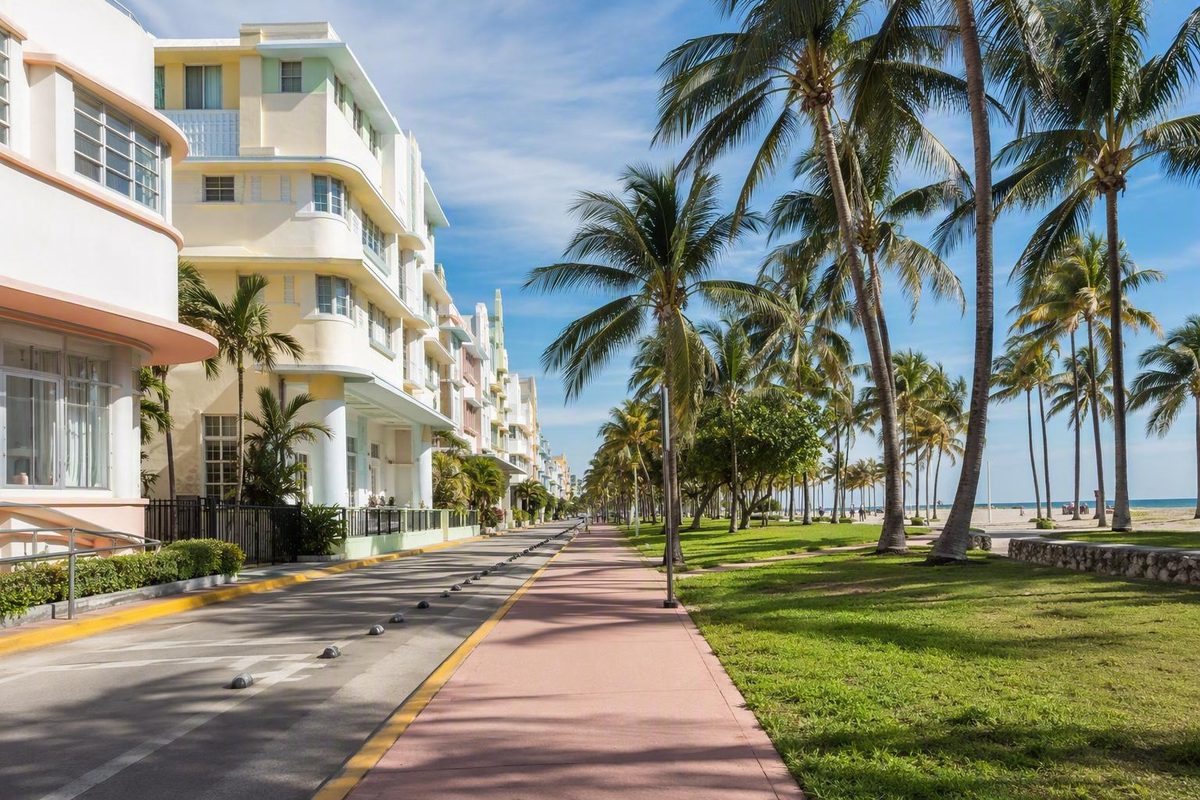
Begin near the Art Deco Welcome Center, choose a short loop or a longer architecture walk, cross into Lummus Park, and add the beach if time allows.
Ocean Drive works best as a walk-first South Beach outing rather than a drive-by attraction. Begin near the Art Deco Welcome Center, choose a short loop or a longer architecture walk, cross into Lummus Park, and add the beach if time allows. Visit in daylight to study the façades, then stay or return around dusk if you want to see the neon and evening atmosphere.
Ocean Drive at a glance: where it is and what to expect
Ocean Drive is a street within South Beach, a neighborhood of the City of Miami Beach. It is not another name for South Beach, and it is not in the separate City of Miami on the mainland.
Think of the area as three parallel experiences:
- Ocean Drive: Art Deco and Streamline Moderne façades, hotels, restaurants, and entertainment venues line the west side.
- Lummus Park: Lawns, paths, palms, and recreation areas sit across the street.
- The public beach: The sand and Atlantic shoreline are farther east, beyond the park.
This geography matters when planning your visit. Ocean Drive is commonly described as beachfront, but the street itself does not sit directly on the sand along its main visitor stretch. Lummus Park separates much of the street from the beach.
Sources commonly place Ocean Drive between South Pointe Drive near 1st Street and 15th Street, although descriptions of its precise length and block count vary. The mapped street description identifies those southern and northern endpoints.
For a first visit, focus on roughly 5th through 15th Streets rather than trying to cover every possible block. A commercial architecture guide describes this section as having the densest concentration of preserved façades and the greatest visitor activity. It also identifies the Art Deco Welcome Center at 1001 Ocean Drive as the natural starting point for exploring the district. See the guide’s district orientation and architectural details.
The attraction is the combination rather than any single building: preserved architecture, exterior hotel façades, restaurants, entertainment, park recreation, public beach access, and people-watching. A quick walk gives you the broad setting, but a slower route makes it easier to notice the building details and the contrast between the street, park, and shoreline.
Choose your visit length and time of day
There is no dependable end-to-end walking time for every visitor. Crossings, photographs, heat, crowds, route boundaries, and spontaneous stops can all change the pace. Choose a time block according to what you want to see rather than treating Ocean Drive as a fixed-duration attraction.
| Time available | Best use | What it includes |
|---|---|---|
| About 1 hour | Editorial short-loop plan | A few nearby façades, part of Lummus Park, and a beach view |
| About 1.5 hours | MDPL audio tour | App-based commentary and an accompanying map at your own pace |
| About 2–2.5 hours | Broader DIY architecture route | More Ocean Drive façades, photography, and selected Collins Avenue stops |
| Half a day | Architecture, park, and beach | A longer walk plus beach time, a meal, or dusk views |
The Miami Design Preservation League estimates approximately 1.5 hours for its app-based self-guided tour. Commentary is available in English, Spanish, German, and French, and visitors can set their own pace. Check the MDPL audio-tour details.
The broader two- to 2.5-hour estimate comes from a third-party DIY route that extends beyond Ocean Drive to selected buildings on Collins Avenue. It excludes optional food, drink, and shopping stops, so it should be treated as a route-dependent estimate rather than a guaranteed duration. Review the published DIY architecture route.
Daylight is better for studying architecture. Look for stepped rooflines, long eyebrow shades above windows, geometric ornament, glass blocks, rounded corners, porthole-like windows, tropical reliefs, and horizontal bands. Daytime also fits naturally with Lummus Park and beach recreation.
Dusk shows the transition. Building colors soften, vertical neon signs become more prominent, and the street begins shifting toward dining, music, entertainment, and nightlife.
Morning and evening are complementary rather than interchangeable. First-time visitors primarily interested in architecture will usually get more from daylight. Visitors interested in illuminated façades and evening energy can arrive before sunset or return later. Weekend nights may be louder and more crowded, so daytime is generally the better fit for travelers seeking a lower-key walk.
A practical Ocean Drive walking route
Start at the Art Deco Welcome Center. It provides an easy point of orientation near the middle of the main visitor stretch and is the documented starting place for the Miami Design Preservation League’s app-based audio tour.
Use the following buildings and spaces as exterior waypoints:
- Clevelander
- Breakwater
- Colony Hotel
- Villa Casa Casuarina
- Carlyle
- Lummus Park
These are visual reference points, not promises of public interior access. Hotels, restaurants, and entertainment properties set their own hours, entry rules, and reservation requirements. A public view of a façade does not mean the building is open for casual entry.
Do not focus only on pastel colors. Look for:
- stepped or terraced rooflines;
- horizontal eyebrow overhangs above windows;
- rounded corners and repeated horizontal bands;
- porthole-like windows and glass blocks;
- geometric ornament and tropical reliefs;
- vertical signs and neon lighting.
The park side often provides a broader view of complete façades than the sidewalk directly beneath them. Use designated pedestrian crossings, obey traffic signals, and do not assume that current vehicle patterns match photographs or older route descriptions.
Choose one of three route tiers.
Short loop: Begin at the Welcome Center, inspect several nearby façades, and cross into Lummus Park at a designated crossing. Walk a few blocks through the park before returning toward the starting area. Treat one hour as a planning allowance, not a guaranteed completion time.
Architecture-focused walk: From the Welcome Center, examine the Breakwater, Colony Hotel, Clevelander, Villa Casa Casuarina, and Carlyle as exterior orientation points. Continue toward 14th or 15th Street if your available time and walking pace allow. For wider photographs, view selected buildings from the park side rather than repeatedly crossing the street.
Extended route: Continue south through the Ocean Drive area toward South Pointe Park, then return north using the beachfront path. This changes the outing from a compact architecture walk into a longer recreational route, so allow additional time and confirm current path access before setting out.
Build a half-day without backtracking
A half-day allows you to combine architecture, Lummus Park, and the beach without repeatedly retracing the same sidewalk. The most efficient structure is a loop: use Ocean Drive for the architecture leg and the park or beachfront side for the return.
- Arrive near the Welcome Center. Use it as your fixed starting point rather than wandering until you locate the historic stretch.
- Walk the architecture first. Head through the central blocks while your attention and daylight are strongest. Concentrate on exterior details instead of trying to enter each property.
- Cross into Lummus Park at a designated crossing. This changes both the scenery and your viewing angle on the façades.
- Return through the park or along the beachfront side. This avoids repeating the exact same street-side route.
- Add beach time. Make this a quick shoreline look or a longer break according to your schedule.
- Finish near Ocean Drive. End with a meal, rest, or dusk viewing rather than beginning another complete circuit.
Lummus Park is the physical connector between the street and the beach. A third-party walking guide lists paved walking and biking paths, workout areas, volleyball courts, playgrounds, restrooms, and water fountains. The same guide presents an extended Ocean Drive–South Pointe Park–beachfront loop of approximately 3.5 miles. Facility availability, route access, and conditions can change, so confirm anything essential before relying on it. Review the published route and listed park amenities.
For a compact half-day, turn back toward the central Ocean Drive area after your park and beach segment. For a longer outing, continue south to South Pointe Park before returning along the beachfront path. The extension adds meaningful distance, so consider your pace and the day’s conditions before committing to it.
If an ordinary shower interrupts the walk, shorten the outdoor section and use a nearby meal or indoor stop as an editorial fallback. Keep the substitute within South Beach so you do not turn a weather delay into unnecessary cross-city travel. If current city alerts or on-site officials indicate closures or hazardous conditions, follow that guidance rather than trying to complete the route.
Paid tours, rentals, meals, lodging, and entertainment are separate expenses. Miami’s official tourism site describes the area’s walkable street, park recreation, and beach access.
Getting there without a car
Once you are in South Beach, walking is generally the simplest way to explore Ocean Drive. The main sights are concentrated along several blocks, and walking makes it easy to shift between the façades, Lummus Park, and the beach.
The South Beach Trolley can help with the approach. The City of Miami Beach lists Loop A as clockwise and Loop B as counterclockwise, with daily service from 8 a.m. to 11 p.m. and an approximate frequency of 20 minutes. The published stop information does not show a stop directly on Ocean Drive. Washington Avenue appears in the route listings, but the best place to get off depends on the active route and stop status. Check the current city trolley map, schedule, stops, and alerts.
Do not assume the trolley’s fare from an unofficial or older guide. The supplied city route information establishes its loops, scheduled hours, approximate frequency, and stops, but it does not state a fare. Confirm any fare requirement before traveling.
Other workable approaches include:
- Walking from elsewhere in South Beach
- Cycling on suitable nearby routes
- Using the Beachwalk for a north–south approach
- Taking a rideshare to a nearby cross street
Rental availability and prices can change, so compare them only for your actual travel date. Whichever mode you choose, treat Ocean Drive as a compact neighborhood stop: use transit or rideshare for the approach, then explore the central area on foot.
Driving, parking, crowds, and changing restrictions
Do not build a short visit around the assumption that parking will be easy or that Ocean Drive vehicle access will remain unchanged. Ordinary congestion, major events, enforcement periods, garage closures, and temporary traffic controls can all affect South Beach.
March 2025 provides a dated example of how extensive those changes can become. During that specific high-impact period, the City of Miami Beach announced controlled Ocean Drive vehicle access, selected beach entrances, parking closures, checkpoints, and enhanced enforcement on designated dates. Read the city’s March 2025 announcement.
Those measures were temporary. Do not treat their parking fees, towing rates, checkpoints, beach-entry locations, or traffic patterns as current guidance for another date.
Before departure, check:
- City of Miami Beach traffic alerts
- Current municipal parking locations, rates, and closures
- South Beach Trolley service updates and active stops
- Beach notices and access information
- Major event schedules
- High-impact-period rules
- Temporary vehicle restrictions affecting Ocean Drive
This check matters even if you have visited before. Historic parking promotions, old towing rates, and previous event procedures are not reliable planning information for a future trip. If your schedule is flexible, arriving without a car also removes the risk of spending part of a short visit searching for parking or adjusting to a closure.
Crowd levels vary with the time, date, and events. Daytime generally emphasizes architecture, the park, and beach activity. Evening brings more dining and entertainment activity, while weekend nights may be louder and more crowded. These are planning expectations, not guarantees of a particular atmosphere.
Match Ocean Drive to your trip style
Ocean Drive can fit several kinds of South Beach day, but the timing and route should reflect what matters most to you.
| Visitor type | Best approach | Main tradeoff |
|---|---|---|
| Architecture-focused | Begin in daylight at the Welcome Center and follow a structured façade route | Neon is atmospheric, but details are easier to study by day |
| Beach-focused | Pair Lummus Park with public beach access | A longer beach stop leaves less time for architecture |
| Budget-focused | Emphasize exterior sightseeing and public spaces | Tours, rentals, meals, and entertainment add costs |
| Nightlife-focused | Arrive near dusk and continue into the evening | Expect more noise, activity, and possible crowds |
Architecture-focused visitors should prioritize daylight and spend less time trying to enter individual properties. The most rewarding details are often visible from outside, especially when viewed from across the street or from the edge of the park.
Beach-focused visitors can treat Lummus Park as the link rather than a separate destination. Walk the façades first, cross through the park, and then decide whether the beach will be a brief view or the main part of the outing.
Budget-focused visitors can build the day around exterior architecture, the park, and beach access. Paid additions are optional, but costs can rise quickly when a walk becomes a tour, rental, meal, or evening entertainment plan.
Nightlife-focused visitors should arrive around dusk if they want to see both versions of the street: architectural detail before dark and illuminated façades afterward. The evening atmosphere is more entertainment-oriented than the daytime experience.
Families and groups can adapt the same daylight route, but public street access does not establish the operating hours or suitability of parks, restrooms, tours, restaurants, hotels, or beach facilities. Do not assume that a named venue is currently open, accessible, affordable, or appropriate for a particular group based only on its location.
Wheelchair routes, restroom hours, changing facilities, shade, and venue-level accessibility can vary. If any of those factors will determine whether the outing works, confirm them through current city or venue information before arrival.
For most first-time visitors, the clearest plan is to see Ocean Drive in daylight and stay—or return—around dusk if illuminated façades and evening energy matter. Begin near the Welcome Center, choose a route that matches your time, connect the architecture with Lummus Park and the beach, and check current city transit, parking, traffic, beach, and event notices before leaving.
Is Ocean Drive in Miami or Miami Beach?
Ocean Drive is in the City of Miami Beach. More specifically, it is in the South Beach neighborhood of Miami Beach, not in the separate City of Miami on the mainland.
Is it free to visit Ocean Drive?
Yes, a walk-only visit generally is. Tours, rentals, dining, lodging, and entertainment may cost extra. See the official tourism overview of Ocean Drive’s public and commercial experiences.
Does the South Beach Trolley stop directly on Ocean Drive?
The City of Miami Beach’s published South Beach Trolley stop information does not show a stop directly on Ocean Drive. Depending on the active loop and stop status, you may need to get off on Washington Avenue or another nearby street and walk east.
Where does the self-guided Art Deco audio tour begin?
The Miami Design Preservation League’s self-guided Art Deco audio tour begins at the Art Deco Welcome Center at 1001 Ocean Drive. MDPL estimates approximately 1.5 hours for the complete tour, although participants can set their own pace. See the MDPL self-guided tour information.