
Plan a Waterfront Day at the Southern Tip of Miami Beach
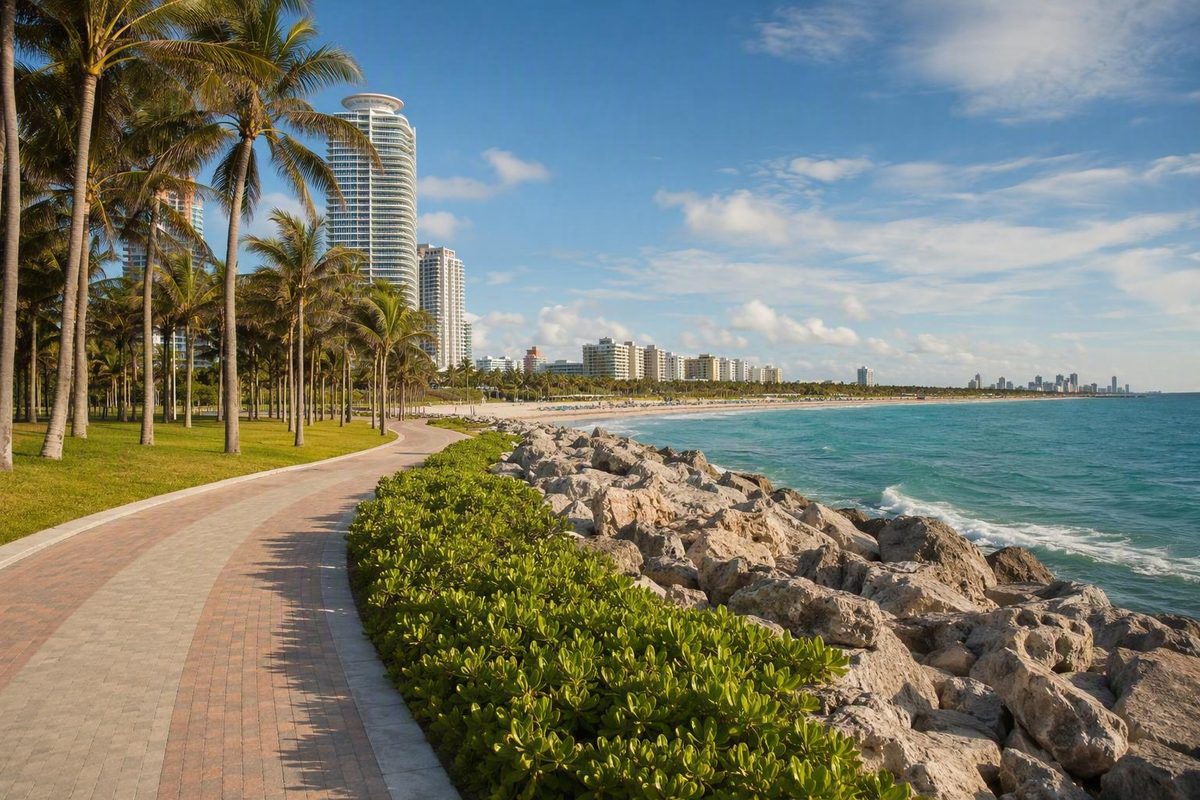
South Pointe Park at a glance: location, hours, and essential facts
South Pointe Park is a City of Miami Beach park at 1 Washington Avenue, at the southern tip of Miami Beach in the South Beach neighborhood—not in the City of Miami. It is open daily from sunrise to sunset, and the City lists 305-673-7779 as the park’s contact number. Officially listed amenities include beach access, accessible facilities, restrooms, paid parking, seating, a water fountain, outdoor fitness equipment, a playground, a bark park, and a water feature. Check the City of Miami Beach park listing for current information.
Quick facts
- Address: 1 Washington Avenue, Miami Beach
- Neighborhood: South Beach
- Official hours: Sunrise to sunset daily
- Phone: 305-673-7779
- Parking: Paid parking is listed; current rates and availability vary
- Admission: Third-party guides describe the park and pier as free, but the official park page does not state an admission policy
- Best planning approach: Treat the park, pier, beach, playground, and meal as flexible parts of the day rather than one fixed itinerary
Depending on your position, views may include the Atlantic, the South Beach shoreline, vessels using Government Cut, Fisher Island, PortMiami, and the Downtown Miami skyline.
Because the official schedule is tied to daylight, opening and closing times change throughout the year. Look up the date’s sunrise and sunset if you want to arrive when the park opens or stay until closing.
Park hours should not be treated as operating hours for every facility in or beside the park. Separate schedules or temporary closures may apply to:
- South Pointe Pier
- Lifeguard towers
- The children’s splash feature
- Manual beach-wheelchair service
- Restrooms and outdoor showers
- Restaurants, concessions, and food vendors
- Beach-chair, umbrella, bicycle, and other rentals
Third-party travel guides describe admission to both the park and pier as free. The official City of Miami Beach listing does not explicitly confirm that policy, however. If admission matters to your plans—particularly during a special event or when using a separately operated service—check with the City or call the listed park number.
What to check before leaving
A short same-day review can prevent most avoidable problems:
- Daylight: Confirm that day’s sunrise and sunset.
- Weather: Check temperature, heat, rain, wind, and lightning risk.
- Ocean conditions: Review warning flags and choose a swimming area near a staffed lifeguard tower. Visit Florida summarizes the area’s lifeguard and beach-safety guidance.
- Closures: Look for park, pier, beach, or facility notices.
- Children’s facilities: Confirm whether the splash feature is operating.
- Accessibility services: Verify beach-wheelchair hours, pickup procedures, and availability.
- Transportation: Recheck transit stops, routes, fares, and service notices.
- Parking: Compare current municipal options and payment requirements.
- Food: Confirm what is open instead of assuming refreshments will be available onsite.
The easiest way to plan South Pointe is to separate stable features—its location, lawns, paths, playground, pier, and beach access—from conditions that can change by the hour or day.
Understand the layout: park, promenade, pier, beach, and Government Cut
“South Pointe” is sometimes used for several adjoining waterfront spaces. They are connected, but they are not interchangeable:
- South Pointe Park is the landscaped municipal park with lawns, paved paths, seating, play facilities, outdoor fitness equipment, and a bark park.
- South Pointe Beach is the Atlantic-facing sand and swimming area reached from the park.
- South Pointe Pier extends over the water and is used for sightseeing and fishing.
- The promenade is the broad paved waterfront route through the park.
- Government Cut is the channel south of the park used by cruise ships, cargo vessels, yachts, and other marine traffic.
From the landscaped interior, paths lead through the lawns and toward the waterfront. Miami & Beaches describes the principal promenade as approximately 20 feet wide and South Pointe Pier as approximately 450 feet long. These are destination-guide measurements rather than figures from a current municipal survey. See the Miami & Beaches description of the promenade and pier.
The view changes as you move. Face east for the Atlantic, look north along the South Beach shoreline, or turn toward Government Cut to watch vessels enter and leave the channel. Fisher Island lies across the water, while PortMiami infrastructure and cruise traffic occupy other sight lines. Downtown Miami appears farther inland.
The pier is both a destination and a viewing platform. Miami & Beaches reports viewing stations, turtle-safe lighting, fishing-line recycling bins, bait-cutting areas, and places to wash fish. Ship-watching is a recurring attraction, but a particular cruise ship or vessel passage is never guaranteed without consulting live port or vessel information.
Facilities are distributed throughout the park rather than concentrated in a visitor center. Destination guidance also reports restrooms, outdoor showers, and food facilities near the children’s splash area. The bark park is on the western side.
Those descriptions are adequate for general orientation, but they do not identify the best entrance or document every step-free connection. Anyone who needs a particular curb cut, restroom configuration, passenger drop-off, or shortest accessible route should confirm it before arrival.
South Pointe can also serve as an endpoint within a longer South Beach waterfront outing. Area guidance describes waterfront routes used for walking, running, and cycling north through Miami Beach, but continuity and cycling permission depend on the particular segment and posted signs. Do not assume every park path or beach-access route allows every wheeled device.
Things to do: choose a walk, beach stop, workout, picnic, or pier visit
South Pointe Park works well for mixed-interest groups because its activities are close together. One visitor can walk the promenade while another fishes; children can use the playground while adults plan a picnic or short beach stop.
Common options include:
- Walking or running on paved routes
- Cycling where permitted
- Sightseeing and waterfront photography
- Visiting South Pointe Beach
- Picnicking near the lawns
- Using the outdoor fitness station
- Taking children to the playground or water feature
- Fishing from the pier
- Watching cruise ships, cargo vessels, yachts, and other traffic in Government Cut
- Resting on benches and taking in the skyline
Miami & Beaches also describes rollerblading and skateboarding on park paths. That does not mean every device is allowed everywhere: bicycles, rollerblades, and skateboards are reported as prohibited on the grass, and posted restrictions control.
A one-hour promenade-and-pier walk
For a compact first visit, enter through the landscaped park, follow the waterfront promenade toward Government Cut, walk out onto the pier if it is open, and return through the lawns.
Allow time for pauses. The appeal is not simply covering the route but seeing how the outlook changes—from the Atlantic and beach to Fisher Island, passing vessels, and the inland skyline. A ship moving through Government Cut can easily turn a short stop into a longer one.
This route suits first-time visitors, photographers scouting viewpoints, and travelers adding South Pointe to a broader South Beach day. It also works when ocean conditions are unsuitable for swimming but the weather remains comfortable for walking.
A two-to-three-hour family outing
Start at the playground while children have energy. Add the splash feature if it is operating, then stop for a snack or picnic and use the restrooms. Finish with either a short pier walk or a brief beach visit near a staffed lifeguard tower, depending on weather and ocean conditions.
Bring water, sun protection, towels, a change of clothes, and food unless you have confirmed that a suitable concession or restaurant is open. This plan gives the outing several possible anchors, so rough water or an inactive splash feature does not cancel the whole visit.
A half-day park, pier, beach, and meal
Begin with the promenade and pier before committing to beach time. This lets you assess heat, wind, cloud cover, and ocean conditions while seeing the waterfront. Follow with a beach session near a staffed tower, then finish with a meal.
Keep food plans conditional. Sources differ on the exact status of cafes, concessions, restaurants, vendors, and rentals. Verify the specific business or service you intend to use, including its hours and whether it offers dine-in, takeaway, or beach-related equipment.
Routes for different visitors
For first-time visitors: Make a loop through the lawns, along the promenade, onto the pier, and back beside the water. This gives a broad introduction without requiring beach gear.
For families: Combine the playground with the splash feature if it is active, then use a picnic break to decide whether conditions favor the beach or pier.
For dog owners: Begin at the western bark park for off-leash time, then leash your dog before entering the rest of the landscaped park. Do not continue onto the city beach with a pet.
For active visitors: Walk or run the permitted paths, then use the outdoor fitness station behind the playground and adjacent building. Check signs before taking a bicycle or other wheeled device onto a particular route.
For photographers and ship-watchers: Move between the pier and the Government Cut edge instead of remaining at one viewpoint. If you hope to see a specific cruise departure or arrival, check live PortMiami or vessel information rather than relying on a remembered schedule.
Picnic and barbecue areas are reported, but available information does not establish reservation procedures or current rules for grills, alcohol, amplified sound, or large gatherings. Contact the City before organizing anything beyond an informal picnic.
Visiting with children: playground, splash zone, beach, and facilities
The park gives families several activities in one area, reducing the need to make the ocean the sole focus of the visit. The City says the playground serves children ages 2–5 and 5–12. Features include poured-in-place rubber surfacing, slides, climbing and upper-body components, play panels, tot swings, and a splash spray zone. Review the City’s official playground and amenity details.
Destination guidance describes the splash feature as motion-activated, with water cannons near the picnic and barbecue areas. Its current hours and operating status are not established, so treat water play as a possible bonus rather than the central promise of the outing. Pack towels and dry clothes, but have a fallback ready.
A practical family sequence is:
- Playground time
- Splash play if the feature is operating
- Seating and a snack or picnic
- Restroom break
- A short pier walk or beach visit
The City places public restrooms near the concession area. Destination guidance also reports restrooms and outdoor showers near the splash area. Seating, a water fountain, picnic space, and direct beach access provide additional support, although current food sales should be checked rather than assumed.
Beach time requires a separate decision from park time. Lifeguard towers are present along this stretch, but tower staffing should be confirmed because it does not necessarily match the park’s sunrise-to-sunset schedule. Visit Florida advises swimming near a staffed tower and checking warning flags and current beach conditions before entering the water.
For a two-to-three-hour visit, begin at the playground, try the splash area if active, pause for food, and then reassess. If weather and ocean conditions are suitable and a nearby tower is staffed, add a short beach stop. If the water is rough, flags are unfavorable, or a storm is approaching, choose the promenade or pier only while conditions remain safe.
The mix of playground, water play, lawns, restrooms, beach access, and pier views makes the park practical for many families. It does not guarantee lower crowds, calmer water, or safer conditions than elsewhere in South Beach. Active supervision remains necessary around water, play equipment, paths, and the pier.
Dog rules, cycling, skating, and fishing: know the zones
Rules can change when you move from a lawn to a path, bark park, beach, or pier. Miami & Beaches reports that dogs may be off leash in the designated western bark park but must be leashed elsewhere in the park; it also says bicycles, rollerblades, and skateboards are not allowed on the grass. Review its zone-specific park guidance.
| Zone | Dogs | Bikes, rollerblades, and skateboards | Fishing |
|---|---|---|---|
| Lawns and general park areas | Leash dogs outside the designated bark park | Not allowed on the grass | Not identified as a fishing area |
| Paved paths | Keep dogs leashed and follow posted signs | Reported as used for wheeled recreation, subject to posted restrictions | Generally not relevant |
| Western bark park | Off-leash use is reported within the designated area | Do not assume riding is allowed inside | Not applicable |
| City beach | Pets are prohibited except qualifying service animals | Follow beach and access-route signs | Check beach-specific rules |
| Pier | The dog rule is not established here | Check posted restrictions | Fishing facilities are provided, but current legal requirements still apply |
Visit Florida’s South Beach guidance states that pets are prohibited on Miami Beach city beaches except qualifying service animals. See its beach-access and pet guidance. Available park guidance does not establish whether dogs may enter South Pointe Pier, so check signs rather than extending either the general park rule or the beach prohibition to the pier.
The same caution applies to wheeled recreation. Paths are described as accommodating activities such as cycling, rollerblading, and skateboarding, but that does not establish universal permission. Current rules for e-bikes, scooters, speed limits, and dismount zones are not documented here. Follow signs and yield in shared spaces.
The pier’s line-recycling bins, bait-cutting surfaces, and fish-washing areas indicate that fishing is an intended activity. They do not settle licensing or catch rules. Before bringing tackle, verify current Florida and local requirements, including licenses, any pier-specific exemption, size and bag limits, equipment restrictions, and temporary closures. Do not assume that a general public-pier exemption applies.
The simplest approach is to reset your assumptions whenever you cross a boundary. The park, bark park, pier, and beach are physically connected but may be governed differently.
Accessibility: plan the complete route before arrival
The City of Miami Beach lists accessible facilities at South Pointe Park, and destination guidance describes the playground as accessible. Those statements are useful starting points, but they do not establish that every entrance, route, restroom, parking space, pier feature, or beach-access point is fully accessible.
Visit Florida describes the broader Beachwalk as a hard-surfaced route behind the dunes, with more than 20 beach access points using boardwalks or firm mats. That area-wide description does not document every connection inside South Pointe Park or guarantee a continuous route to a particular facility.
Manual beach wheelchairs are reported at South Pointe Park on a free, first-come, first-served basis. The published seasonal service hours are:
- February through October: 9 a.m.–6 p.m.
- November through January: 9 a.m.–4:30 p.m.
A companion is required to push the manual chair, and the chair may enter only about six inches of water. Because service hours, supply, and procedures can change, confirm the pickup location, current availability, assistance expectations, and whether reservations are possible before traveling.
A complete accessibility plan should cover the whole journey:
- Verify the required service. Ask about beach-wheelchair supply, current hours, pickup procedures, and assistance requirements.
- Choose the arrival mode. Decide whether transit, ride-hailing, or driving will minimize difficult transfers.
- Confirm the arrival point. Locate accessible parking, passenger drop-off, or the most suitable transit stop.
- Map essential facilities. Establish a workable route to restrooms, seating, the playground, promenade, pier, or beach access.
- Check route continuity. Do not assume every segment has the same width, slope, surface, matting, or curb treatment.
- Keep a weather fallback. Heat, wind, heavy rain, or lightning can make an otherwise manageable waterfront route impractical.
Details that remain unresolved include accessible parking locations, curb cuts, restroom configurations, the easiest entrance, continuous accessible routes between every amenity, and access to all pier or beach features. For current park-specific information, call 305-673-7779.
Getting there without a car and navigating South Beach
For visitors already staying in South Beach, walking may be the simplest option. South Pointe sits at the neighborhood’s southern end and can be combined with a waterfront walk. Cycling may also work, but only on routes where it is permitted; watch for restrictions as paths approach lawns, pedestrian areas, and beach access points.
Other options include the free Miami Beach Trolley, Miami-Dade buses, taxis, and ride-hailing. Routes, stops, fares, schedules, and accessibility provisions can change, so use the relevant operator’s live planner on the day of travel.
Your precise origin matters. “From Miami” might mean Downtown, Brickell, MiamiCentral, the airport, Wynwood, or another district. A Rome2Rio result for a broadly labeled Miami origin lists a direct line 14 bus from Omni Bus Terminal to South Pointe Drive and Washington Avenue, but the route, fare, frequency, and journey estimate require confirmation with Miami-Dade Transit. Use Rome2Rio only for an initial route comparison.
Brightline’s city guide places the park 4.9 miles from MiamiCentral Station, but that figure does not provide a complete last-mile route or dependable travel time. See Brightline’s South Pointe Park entry. Intercity rail passengers still need to arrange the connection from Downtown Miami to Miami Beach.
There is no Metrorail station on Miami Beach. Visitors coming from the mainland should therefore expect the final leg to involve a bus, trolley connection, walk, bicycle, taxi, or ride-hailing vehicle. Older travel articles may display airport-bus fares or trolley schedules, but those details should not be treated as current without operator confirmation.
A practical car-free strategy is to use transit or a short ride for the long link and then keep the rest of the outing concentrated within South Pointe and South Beach. This follows Miami Finder’s general neighborhood-cluster approach to exploring Miami without a rental car:
- Travel to the South Pointe area once.
- Walk the park, promenade, and pier.
- Add the beach only if conditions suit.
- Eat nearby rather than immediately crossing back to the mainland.
- Continue north through South Beach on foot or along an allowed cycling route if weather and energy permit.
This structure reduces backtracking and makes transit delays easier to absorb because the activities after arrival are close together.
Parking, weather, beach safety, and same-day checks
The official City listing confirms paid parking, while destination guidance reports nearby meters and garages. Current prices, payment systems, garage height limits, availability, and demand are not established here. Drivers should compare official options shortly before departure and allow extra time when planning around a sunset, reservation, or expected ship passage.
Traveler reports do not settle the parking question. One Tripadvisor reviewer reported difficulty finding a space, while another considered longer-duration parking reasonably priced. Those experiences occurred on different visits and do not establish what a typical driver will encounter.
Beach safety requires its own check. Park opening does not mean a nearby lifeguard tower is staffed, and pleasant weather on land does not guarantee suitable ocean conditions. Follow Visit Florida’s guidance to review current warning flags, swim near a staffed tower, and obey lifeguard instructions.
Waterfront exposure can intensify heat, wind, and sudden weather changes. Carry drinking water, use sun protection, and shorten the outing when necessary. During lightning, leave the beach, pier, and other exposed waterfront areas and follow official alerts; Nomado Travel likewise cautions visitors against remaining on the exposed pier during lightning. See its South Pointe Park planning guide.
Same-day South Pointe checklist
Before departure, verify:
- Today’s sunrise and sunset
- Temperature, heat, rain, wind, and lightning outlook
- Beach warning flags and ocean conditions
- Lifeguard tower status
- Park, pier, beach, or facility closures
- Playground and splash-feature status
- Beach-wheelchair availability and service hours
- Transit routes, stops, fares, and notices
- Parking locations, payment methods, and availability
- Restaurant, concession, and food-vendor hours
- Any rental service you expect to use
Keep the sequence flexible. In stable conditions, begin with the pier or playground and add the beach. If the ocean is unsuitable, retain the lawns, promenade, playground, or fitness area while weather permits. If storms threaten, shorten the outdoor portion and shift to a nearby indoor plan. Miami Finder’s rainy-day framework similarly recommends using short outdoor windows without making them responsible for the entire day.
The goal is not to schedule every feature as mandatory. Treat the beach, pier, playground, splash feature, and meal as modules, then let live conditions determine their order.
A short history of the waterfront park and pier
South Pointe’s development is best understood as a sequence rather than a single founding date. According to a secondary historical summary, the federal government donated the land to Miami Beach in 1979. Before conversion into a public park, the site reportedly contained police horse stables, a police intelligence unit, and facilities used by Port of Miami harbor pilots.
The park reportedly opened to the public on October 25, 1985. The 1979 land donation and 1985 public opening therefore represent different milestones. Read the secondary historical overview of South Pointe Park.
A major redesign reportedly began in 2008 and was completed around March 2009. The work introduced broad Florida-limestone walkways and an ocean-themed playground, helping create the open, landscaped waterfront seen today.
Nomado Travel reports that construction began in 2013 and that the approximately 450-foot replacement pier opened in 2014. These dates and dimensions come from a commercial travel history rather than the current municipal park listing.
The history helps explain the park’s present form: former institutional waterfront land was transformed into lawns, paths, play space, beach access, and a pier intended for both viewing and fishing. For present-day operations, rely on the City of Miami Beach rather than historical or third-party operator descriptions.
Frequently asked questions
Is South Pointe Park free to enter?
Third-party travel guides report that South Pointe Park and South Pointe Pier are free to enter. The City of Miami Beach park listing does not explicitly state an admission policy. Contact the City if you need confirmation, particularly for special events or separately operated services.
What time does South Pointe Park open and close?
The official schedule is sunrise to sunset daily. Exact clock times change by date. Those hours do not establish schedules for the pier, lifeguards, splash feature, concessions, rentals, showers, or beach-wheelchair service.
Can dogs go to South Pointe Park and South Pointe Beach?
Dogs may be off leash in the bark park on the western side of South Pointe Park but must be leashed in all other areas of the park South Pointe Park | Miami & Miami Beach. Pets are prohibited on Miami Beach city beaches except qualifying service animals. The available guidance does not establish whether dogs are allowed on South Pointe Pier, so check posted signs.
Is South Pointe Park accessible for wheelchair users?
The City lists accessible facilities, and the playground is reported as accessible, but that does not confirm that every route or amenity is fully accessible. Manual beach wheelchairs are reported as free and first-come, first-served; they require a companion to push and have limited water-entry capability. Confirm availability, pickup procedures, parking, restrooms, and the intended route before traveling.
Can you fish from South Pointe Pier?
Yes. The pier has reported fishing infrastructure, including line-recycling bins, bait-cutting areas, and fish-washing stations. Before fishing, verify current Florida and local license requirements, any pier-specific exemption, catch limits, equipment rules, and closures.
Plan your South Pointe Park visit
Treat South Pointe Park as a compact Miami Beach waterfront cluster rather than a single attraction. Choose the version that fits your day: a one-hour promenade and pier walk, a playground-centered family outing, a bark-park stop, an accessible beach plan, a fitness session, or a half-day combining the park, pier, beach, and food.
Before leaving, verify daylight, weather, beach flags, lifeguard status, transit, parking, and any facility essential to your plans. South Pointe’s practical appeal comes from placing lawns, paths, children’s facilities, a pier, beach access, and broad water and skyline views in one area—not from guarantees about crowds, parking, calm water, or every service being open.