
How to Make a Crisp, Cleanly Sliced California-Style Sushi Roll
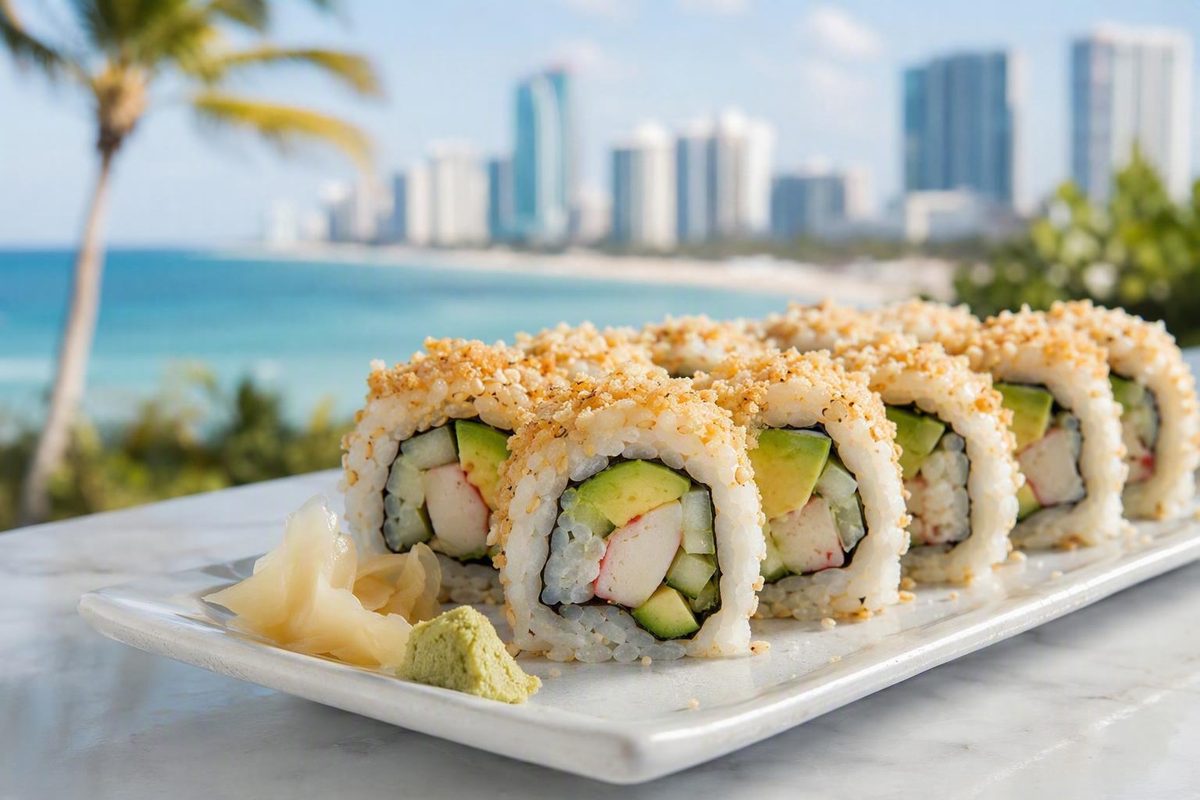
For the crunchy coating, an inside-out version can use toasted panko, tempura flakes, crispy onions or sesame seeds, giving you four distinct options.
A crunch California roll is commonly an inside-out sushi roll with seasoned rice outside the nori and crab or imitation crab, avocado, and cucumber inside. Toasted panko, tempura flakes, fried onions, sesame seeds, or—in a substantially different preparation—a battered and fried exterior supplies the crunch.
The name is not standardized. “Crunch California roll,” “crunchy California roll,” “California crunch roll,” and “crispy California roll” can refer to overlapping but different dishes. The practical approach is to begin with a California-style base, choose a crunchy treatment, and keep both the rice layer and filling restrained enough for the roll to close.
The measured formula below is best understood as an assembly recipe for cooks who already have four cups of prepared, seasoned sushi rice. Because the supporting evidence does not establish a complete dry-rice, water, and seasoning formula, none has been added or merged from a different recipe.
What Is a Crunch California Roll?
A common crunch California roll contains:
- Seasoned sushi rice
- Nori
- Crab or imitation crab
- Avocado
- Cucumber
- A crunchy exterior or topping
It is usually made inside-out: rice forms the exterior, while the nori sits immediately around the filling. Crab or imitation crab and avocado are central to many California-roll descriptions; cucumber, mayonnaise, roe, sesame, and sauces vary by recipe. A specialist guide likewise describes the California roll as a crab-and-avocado roll with rice outside the nori while acknowledging several optional ingredients and crunchy variations (California Roll Sushi Guide).
The word crunch may refer to:
- Toasted panko pressed onto the rice
- Tempura flakes scattered over the roll
- Crushed crispy onions
- Toasted sesame seeds
- A tempura-battered and fried exterior
- A crunchy filling, such as shrimp tempura
That flexibility explains why similarly named rolls may look and taste different. One may retain a crab-centered California filling and add panko. Another may combine spicy imitation crab with fried onions and sauces. A third may be battered and fried after assembly.
A crunch California roll should also be distinguished from the broader category of crunch rolls. The California-style version generally keeps crab or imitation crab at the center. Generic crunch rolls may instead contain shrimp tempura, cream cheese, raw fish, or other fillings. Shrimp-tempura rolls are related variations, not automatically the same dish as a crab-based California roll.
The Main Styles and What Makes Each One Crunchy
Before shopping, choose whether you want a light toasted accent, a crumb coating, a strongly flavored topping, or a fried roll. The choice changes the flavor, preparation, and labels that need to be checked.
| Style | What supplies the crunch | Flavor contribution | Preparation effort | Common allergens to investigate |
|---|---|---|---|---|
| Sesame-coated California roll | Toasted sesame seeds on the rice | Light, nutty accent | Low | Sesame, plus allergens in the filling and sauces |
| Panko- or tempura-flake-coated roll | Toasted crumbs or flakes pressed onto the exterior | Toasted, savory crust | Moderate | Often wheat; other allergens depend on the product |
| Crispy-onion-topped roll | Crushed or whole fried onion flakes | Pronounced onion flavor and richness | Low | Often wheat; sauces and frying ingredients may add others |
| Battered or fried roll | Batter and frying create a crisp shell | Richer fried flavor | High | Commonly wheat and possibly egg, milk, soy, fish, shellfish, or sesame |
Sesame-coated California roll
Toasted sesame seeds provide a light, scattered crunch rather than a thick crust. They allow the seasoned rice, avocado, crab, and cucumber to remain prominent.
Scatter the seeds over the rice before flipping the nori-and-rice assembly, or press them onto the formed exterior. White sesame, black sesame, or a mixture may be used. Any version containing sesame must be treated as a sesame-allergen concern.
Panko- or tempura-flake-coated roll
Panko produces a more substantial exterior. In the reference formula, it is toasted in a nonstick skillet until golden and fragrant, cooled, and then pressed onto the shaped roll. The crumbs should be ready before assembly begins.
Tempura flakes can play a similar role, but their ingredients vary. Do not assume that tempura flakes and plain panko have identical allergen profiles. Check the label for the specific product being used.
Crispy-onion-topped roll
Packaged fried onions add both crunch and an unmistakable onion flavor. Large pieces can be crushed into coarse flakes and pressed onto the rice exterior or scattered over the sliced pieces.
Fried-onion rolls are sometimes finished with spicy mayonnaise or a sweet sushi-style sauce. One documented retail example combines spicy imitation crab salad, avocado, cucumber, fried onion flakes, spicy mayonnaise, and sushi sauce (H-E-B Sushiya Crunchy California Sushi Roll).
Because fried onions may contain wheat flour, inspect their label separately from the imitation crab and sauces.
Fully battered or fried roll
A battered and fried California-style roll is a separate preparation, not a required step. The assembled roll may be coated in batter and fried before slicing, creating a crisp shell and a warmer, richer result.
This method requires frying equipment, oil management, and a separate batter formula. It should not be treated as an interchangeable substitute for pressing dry panko or onions onto an inside-out roll. The reference recipe in this guide is not a whole-roll frying recipe.
Where shrimp tempura fits
Shrimp tempura can supply crunch from inside a roll, and some recipes use names such as “crunch roll” or “California crunchy roll” for that preparation. It remains a related variation rather than the defining California version. A crab-centered filling aligns more closely with the base used in this guide.
Reference Recipe: A Three-Roll Toasted-Panko Version
This source-based formula makes three rolls, sliced into eight pieces each, for 24 pieces total. Its listed timing is 30 minutes of preparation, 20 minutes of cooking, and 50 minutes overall (three-roll crunchy California roll recipe).
These are the source recipe’s quantities and times, not universal standards or independently tested results. The amount that fits comfortably can vary with the size of the nori, cucumber, avocado, and filling pieces.
Yield: 3 rolls, or 24 pieces Slicing: 8 pieces per roll Listed preparation time: 30 minutes Listed cooking time: 20 minutes Listed total time: 50 minutes
Rice and wrappers
- 4 cups cooked, seasoned sushi rice
- 3 nori sheets
This is an assembly formula beginning with prepared sushi rice. The evidence does not supply a complete validated formula for the corresponding dry-rice quantity, cooking water, or vinegar seasoning. Prepare enough Japanese short-grain sushi rice to obtain four cups cooked, following the rice package or a separately tested sushi-rice recipe.
Do not combine an unrelated rice ratio with this formula and assume the resulting yield has been validated.
Filling
- 7 ounces imitation crab
- 1 cucumber
- 1 avocado
Cut the cucumber and avocado into long, narrow pieces. Separate stick-style imitation crab into slim pieces or cut it lengthwise. A narrow filling line is easier to enclose than a mound.
Crunchy coating
- 1 cup panko
Toast the panko until golden and fragrant, then transfer it to a wide plate and let it cool before coating the rolls.
Sauce
- 1/2 cup mayonnaise
- 1 teaspoon sriracha
Mix the mayonnaise and sriracha until uniform. Reserve most or all of it for serving rather than saturating the filling.
Equipment
Useful equipment includes:
- Bamboo sushi mat covered with plastic wrap
- Or plastic wrap, parchment, wax paper, or a flexible silicone mat
- Very sharp knife
- Nonstick skillet
- Cutting board
- Wide plate or shallow dish
- Small bowl of water or diluted rice-vinegar water
- Clean kitchen towel
Before serving the roll to anyone with dietary restrictions, inspect the physical labels on the imitation crab, mayonnaise, panko, sriracha, nori, and accompaniments. A product’s name alone does not establish that it is suitable for a restricted diet.
Prepare the Rice, Filling, Panko, and Spicy Mayo
Prepare every component before beginning assembly. This keeps the rolling process continuous and prevents you from having to cut vegetables or toast crumbs while a partially assembled roll waits on the work surface.
1. Prepare and cool the sushi rice
Use Japanese short-grain sushi rice prepared and seasoned as sushi rice. Chef-authored California-roll guidance recommends Japanese short-grain rice seasoned with sushi vinegar and emphasizes spreading it in a thin, even layer (California Roll Recipe with Real Crab).
Let the prepared rice cool before handling. It should no longer be giving off obvious heat or steam.
When assembling the roll, spread rather than mash the grains. A thick rice layer creates a larger cylinder and leaves less room for filling. If you have excess prepared rice, set it aside rather than forcing all of it onto the nori.
2. Prepare the imitation crab
For stick-style imitation crab, separate the pieces or slice them lengthwise. For flaked surimi, gather it into a narrow line rather than a tall mound.
The crab may be mixed with a small amount of spicy mayonnaise, but this is optional. A heavily dressed filling is more difficult to control, so reserving the sauce for a light finishing drizzle is the simpler approach for beginners.
3. Cut the avocado and cucumber
Cut the cucumber lengthwise into narrow batons. If the seed core is especially watery or bulky, trim it away.
Halve and pit the avocado, remove the flesh, and cut it lengthwise into slim slices. Handle very soft avocado gently because it can be compressed during rolling.
Arrange the crab, avocado, and cucumber beside the rolling area. Dividing each ingredient visually into thirds can help keep the three rolls similar.
4. Toast and cool the panko
Place the panko in a nonstick skillet over moderate heat. Stir or toss it frequently and remove it from the heat when the crumbs are golden and fragrant. The supporting recipe specifies appearance and aroma rather than an exact toasting time, so watch the crumbs instead of relying on a timer.
Transfer the toasted panko immediately to a wide plate or shallow dish and let it cool. The broad surface will also make coating the finished roll easier.
The reference formula does not specify oil. Adding it would be a modification rather than part of the measured recipe.
5. Mix the spicy mayonnaise
For the reference batch, combine:
- 1/2 cup mayonnaise
- 1 teaspoon sriracha
For a smaller and more chile-forward alternative, one separate home recipe uses 2 tablespoons mayonnaise with 1–2 teaspoons sriracha (small-batch spicy mayonnaise formula). This is not a direct scaled conversion of the reference sauce; it is a distinct optional ratio.
Mix the selected formula until uniform, then place the sauce in a small bowl or squeeze bottle.
6. Set up water for your hands and knife
Fill a small bowl with water or lightly diluted rice-vinegar water. Dampen your fingertips before touching the rice and wet the knife before slicing.
Shake off excess water. Fingers should be damp rather than dripping. Keep a towel nearby so you can dry your hands before touching nori, plastic wrap, or filling ingredients.
How to Roll It Inside-Out, With or Without a Sushi Mat
An inside-out roll places rice on the exterior and nori directly around the filling. The working sequence is:
- Spread rice over nori.
- Flip the paired layers.
- Add filling to the exposed nori.
- Roll and shape the cylinder.
Source instructions are not fully consistent about which side of the nori must face upward. Rather than treating one orientation as universal, focus on thin rice coverage, restrained filling, and an enclosed seam.
Bamboo-mat method
-
Cover the mat. Cover the bamboo mat completely with plastic wrap so the exterior rice does not lodge between the slats.
-
Position the nori. Place one nori sheet on the covered mat with a long edge facing you.
-
Dampen your hands. Dip your fingertips in the prepared water and shake off the excess.
-
Spread the rice. Distribute roughly one-third of the prepared rice over the nori. Fill major gaps, but keep the layer thin and avoid repeatedly compressing the grains.
-
Flip the assembly. Turn the rice-covered nori over so the rice faces the plastic-wrapped mat and the nori faces upward.
-
Add the filling. Arrange one-third of the crab, avocado, and cucumber in a narrow line across the nori. Keep the ingredients compact rather than stacking them high.
-
Begin rolling. Lift the near edge of the mat and bring the nori over the filling. Use your fingers to keep the ingredients tucked inward.
-
Continue with even pressure. Guide the cylinder forward while applying pressure across its full length. Avoid squeezing hard in one place.
-
Shape and release. Once the seam is enclosed, use the mat to compress the roll gently from the top and sides. Lift the mat away and inspect the cylinder.
If the seam will not close, partially open the roll and remove some filling. Do not add more rice or force the nori around an overfilled center.
Mat-free method
A bamboo mat is optional. Chef-authored guidance documents parchment, plastic wrap, and silicone mats as shaping alternatives; another mat-free recipe uses plastic wrap or wax paper.
- Place the flexible sheet on the work surface.
- Lay down the nori and cover it with a thin layer of rice.
- Flip the rice-covered nori so the rice faces down.
- Arrange the filling in a narrow line.
- Lift the near edge of the flexible sheet.
- Fold the nori over the filling while tucking the ingredients inward.
- Continue rolling forward.
- Use the sheet to compress the completed cylinder evenly.
- Peel the sheet away, making sure it does not become trapped inside the roll.
Plastic wrap conforms closely to the cylinder. Parchment and wax paper provide a broad lifting surface but are less clingy, while a flexible silicone mat is reusable.
Keep your fingers damp while spreading rice, then dry them before handling nori or fillings. If rice begins clinging to your hands, re-dampen your fingertips rather than pressing harder.
Coat, Slice, Sauce, and Serve Without Losing the Crunch
Dry toppings and wet sauces should not spend unnecessary time in contact. A practical finishing order is:
- Shape the roll.
- Press on the cooled crunchy coating.
- Slice the roll.
- Replace any topping dislodged by the knife.
- Add sauce sparingly.
- Serve promptly.
This sequence limits avoidable moisture exposure; it does not establish how long any topping will remain crisp.
Apply toasted panko
Spread the cooled panko across a plate or work surface. Place the shaped roll over it and press the crumbs gently into the rice. Rotate the cylinder to coat the top and sides.
Avoid squeezing hard enough to shift the filling. Press extra crumbs directly onto any bare areas.
Reserve a small amount of panko if desired. After slicing, it can be used to refresh the tops of pieces where the knife displaced the coating.
Use fried onions instead
Crush large fried-onion pieces into coarse flakes. Press them onto the shaped exterior or sprinkle them over the sliced pieces shortly before serving.
Because fried onions contribute a pronounced flavor, the roll does not necessarily need a thick, uniform coating. Check the package for wheat and other declared allergens.
Make clean slices
Use a very sharp knife. Wet the blade with water or diluted rice-vinegar water, then shake or wipe away the excess.
To cut each reference-recipe roll into eight pieces:
- Cut the cylinder in half.
- Position the halves securely.
- Divide each half into four pieces.
Clean the blade whenever rice or sauce accumulates, then re-wet it before continuing. Use a deliberate cutting motion rather than aggressively sawing through the roll.
If an end piece is uneven, adjust it gently with damp fingertips instead of repeatedly compressing the entire cylinder.
Add sauce and accompaniments
Drizzle spicy mayonnaise lightly across the pieces or serve it on the side. A heavy coating can obscure the crunchy topping and add unnecessary moisture.
Supported accompaniments include:
- Spicy mayonnaise
- Soy sauce
- Pickled ginger
- Wasabi
- Toasted sesame seeds
- Miso soup
- A simple salad
A shallow dish allows diners to dip one edge of a piece rather than soaking the whole roll.
Troubleshooting Sticky Rice, Loose Rolls, and Messy Cuts
Most inside-out rolling problems can be traced to moisture, proportions, pressure, or the knife.
The rice sticks to your hands
Dampen your fingertips before touching the rice and re-wet them as needed. Shake off visible droplets before returning to the roll.
Do not respond by pressing harder. Excess pressure compacts the rice and can make the exterior unnecessarily thick.
The rice sticks to the bamboo mat
Cover the mat completely with plastic wrap before assembly. Because the rice is outside the nori, an uncovered bamboo mat gives it many narrow spaces in which to lodge.
If rice reaches the mat, stop and clean the affected area rather than rolling loose grains back into the exterior.
The roll will not close
Reduce either the filling or the rice thickness. Remove some crab, avocado, or cucumber and try again.
Do not force the seam. An overfilled roll may appear closed temporarily but open when sliced.
The cylinder feels loose
Apply pressure evenly across the full length while rolling. After enclosing the seam, compress the cylinder from the top and sides before removing the mat or flexible sheet.
The objective is to close internal gaps without flattening the avocado.
The avocado is crushed or the filling slides out
Use narrow pieces and avoid building a tall stack. Roll with controlled, evenly distributed pressure.
Very soft avocado is particularly vulnerable. Position the filling compactly and allow the crab and cucumber to provide structure.
The slices are ragged
Check the following:
- Is the knife genuinely sharp?
- Is the blade damp and reasonably clean?
- Is the cylinder firm enough to hold its shape?
- Are you cutting deliberately instead of sawing?
Wipe and re-wet the blade when residue accumulates. If the roll itself is loose, reshape it before making another cut.
A shrimp-tempura recipe recommends chilling completed rolls for 15–30 minutes to make slicing easier (Studio Delicious mat-free crunchy roll). That is optional guidance for a different preparation, not a tested requirement for this crab-based formula. If trying it, consider adding or refreshing the dry topping after chilling.
The topping falls off
Press cooled panko or fried onions gently into exposed rice rather than merely pouring the topping over the cylinder.
Apply wet sauce after the dry coating, and use only a modest amount. Replace loose crumbs on individual pieces after slicing.
The topping becomes soft
Apply the dry topping and sauces near serving time. If the completed roll must wait, keep the sauce separate and reserve some crumbs or onions for a final touch-up.
No exact holding time can be promised because the result depends on the topping, sauce quantity, rice moisture, and handling conditions.
Cooked Seafood, Allergens, Nutrition, and Storage Limits
The reference filling uses imitation crab, a cooked seafood product, so this version does not rely on raw fish. The avocado and cucumber remain uncooked.
That statement applies only to the specified formula. Other restaurant and recipe versions may add raw tuna, salmon, roe, shrimp, real crab, or other ingredients. The dish name alone does not guarantee that every component is cooked.
Allergen checklist
Depending on the products and preparation facility, possible concerns include:
- Fish: Imitation crab commonly contains pollock or another white fish.
- Crustacean shellfish: Surimi may include crab extract or crab ingredients; shrimp variations introduce shellfish directly.
- Egg: Conventional mayonnaise and some batters contain egg.
- Wheat: Panko, tempura batter, fried onions, imitation crab, and sauces may contain wheat.
- Soy: Surimi, mayonnaise, sauces, and frying ingredients may contain soy-derived components.
- Sesame: Seeds or sesame oil may appear in toppings and sauces.
- Milk: Some batters, creamy fillings, and packaged fried rolls may contain milk.
- Anchovy: Certain prepared sauces may include anchovy.
Imitation crab is not one uniform ingredient. One commercial crunchy-roll label lists pollock or Pacific whiting, several starches, soybean oil, crab extract, and hydrolyzed soy protein in its surimi; its crispy onions include wheat flour, and the complete product also contains mayonnaise and sesame (Zenshi Crunchy California Roll ingredients).
Inspect the physical package for every ingredient, including any cross-contact statement. Do not describe the completed roll as gluten-free, shellfish-free, egg-free, soy-free, sesame-free, milk-free, or otherwise allergen-safe unless every product and relevant warning has been verified.
Why calorie estimates vary
There is no universal calorie or sodium value for a crunch California roll. Rice quantity, sauces, mayonnaise, crumbs, fillings, frying oil, piece size, and serving definition all affect the result.
Retail labels demonstrate that variation but cannot be used to calculate this homemade formula. H-E-B’s 10-piece crunchy California product displays 500 calories and 1,400 milligrams of sodium per serving, but the captured page does not clearly identify the serving size associated with that panel. Kroger’s frozen 10-ounce package containing two rolls lists 430 calories and 870 milligrams of sodium per package (Private Selection Crunchy Sushi California Rolls).
The products are not directly comparable. Their ingredients and formats differ, and neither label establishes the nutrition of the three-roll recipe in this guide.
To estimate a homemade batch, use the labels and actual quantities for the rice, seasoning, imitation crab, mayonnaise, panko, sriracha, and accompaniments consumed. Divide the total by the actual number of servings, not automatically by the number of pieces.
Serving and storage limits
Serve homemade rolls promptly for the intended texture. Rice and avocado change as they sit, while panko and fried onions can absorb moisture from the rice and sauce.
Some recipe sources discourage freezing because the texture of rice and avocado deteriorates. That is culinary texture guidance, not a food-safety rule.
The supplied evidence does not contain authoritative time-and-temperature guidance sufficient to establish a definitive refrigeration period or room-temperature limit for this seafood-and-mayonnaise preparation. Recipe blogs also conflict about whether refrigerated rolls should be kept for a few hours, one day, or two days. Those recommendations should not be converted into a safety guarantee.
Follow the storage directions on the actual packaged ingredients and applicable local food-safety guidance. Variations containing raw seafood or roe require separate handling guidance; the cooked imitation-crab formula should not be used to infer storage rules for them.
Frequently Asked Questions
Is a crunch California roll always deep-fried?
No. It can be an inside-out roll coated with toasted panko, tempura flakes, crispy onions, or sesame seeds. A battered and fried roll is a separate variation, not a required preparation.
Does a crunchy California roll contain raw fish?
The reference version does not: it uses cooked imitation crab. However, the name alone is not a guarantee because other recipes or restaurants may add raw fish, roe, shrimp, or different seafood. Check the menu description or package label.
Can I make an inside-out California roll without a bamboo mat?
Yes. Plastic wrap, parchment paper, wax paper, or a flexible silicone baking mat can be used to lift and compress the roll. Keep the rice layer thin, restrain the filling, and apply pressure evenly.
What can I use instead of panko for the crunchy topping?
Options include:
- Tempura flakes
- Crushed crispy fried onions
- Toasted sesame seeds
- Sesame combined with a smaller amount of crumbs
Fried onions add a stronger savory flavor, while sesame supplies a lighter accent. A battered and fried exterior is also possible, but it changes the method substantially and is not a one-for-one topping substitution.
How many calories are in a crunch California roll?
There is no category-wide value. Calories depend on the specific rice quantity, filling, mayonnaise, sauces, coating, frying method, roll size, and serving definition.
Retail figures apply only to the named products and cannot be transferred to this homemade recipe. Calculate a homemade estimate from the exact products and quantities used.
For a practical crunch California roll, start with prepared sushi rice, nori, crab or imitation crab, avocado, and cucumber. Choose toasted panko for a crumb coating, fried onions for a stronger savory topping, or sesame for a lighter accent. Then concentrate on the techniques that matter most: a thin rice layer, restrained filling, even shaping pressure, and a wet, sharp knife.
Names and preparations vary. Ingredient labels—not the dish name—determine allergen concerns, and nutrition belongs to the specific recipe or packaged product rather than the category as a whole.