
A Creamy Mustard Dip Built for Chilled Stone Crab Claws
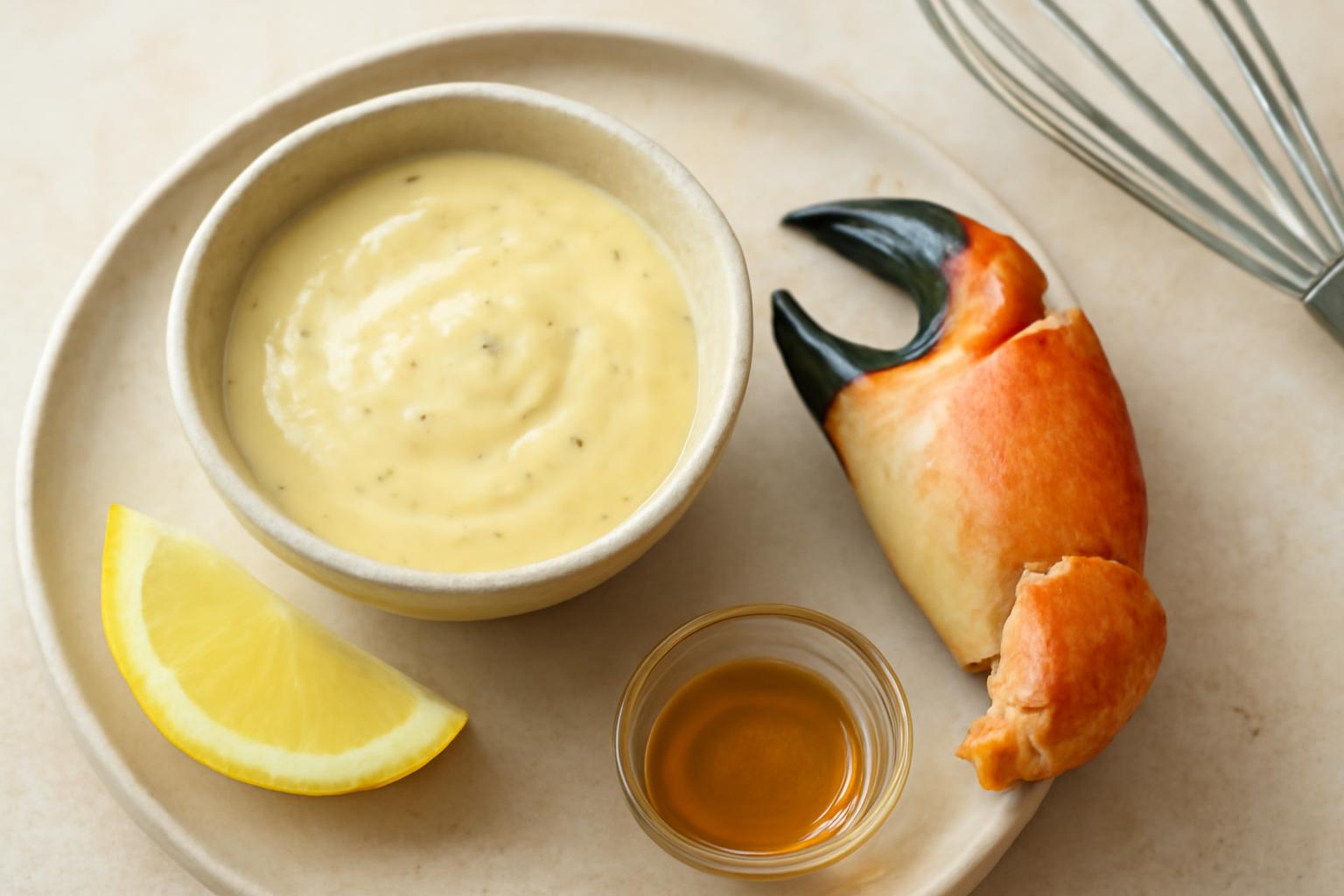
A quick base uses mayonnaise, Dijon, lemon, Worcestershire and hot sauce. Plan 1/3 cup per pound as a flexible benchmark, not a universal rule.
The quick stone crab sauce recipe
For a straightforward stone crab sauce, whisk together 1/2 cup mayonnaise, 1 tablespoon Dijon mustard, the juice of 1/2 lemon, 2 teaspoons Worcestershire sauce, and hot sauce to taste. This is a published Dijon-lemon formula, not an original or independently tested Miami Finder recipe. The associated recipe lists 15 minutes of preparation and four servings alongside 4 pounds of claws, but it does not state the sauce yield in cups or ounces (Garlic & Zest).
Put everything in a bowl and whisk until the color and consistency are even. Taste the sauce, preferably with a small piece of crab, and adjust one element at a time. More mayonnaise will soften the mustard; a little more lemon will increase the acidity; hot sauce will add heat. Cover the sauce, refrigerate it, and serve it cold.
The intended result is a creamy base with smooth mustard sharpness, citrus acidity, savory depth from Worcestershire sauce, and optional heat. Because the published recipe does not give a measured sauce yield, its four-pound serving context should not be treated as a universal sauce-to-crab ratio.
Quick stone crab sauce
Ingredients
- 1/2 cup mayonnaise
- 1 tablespoon Dijon mustard
- Juice of 1/2 lemon
- 2 teaspoons Worcestershire sauce
- Hot sauce to taste
Method
- Put all the ingredients in a bowl.
- Whisk until completely combined and smooth.
- Taste and make small adjustments one ingredient at a time.
- Cover and refrigerate until serving.
- Stir briefly and serve cold with chilled cooked stone crab claws.
Published context: The source lists 15 minutes of preparation and four servings with 4 pounds of claws, but no measured sauce yield (Garlic & Zest).
Ingredient note: Check the label of every packaged ingredient for information relevant to the people being served. The evidence supplied for this article does not include manufacturer labels or authoritative allergen guidance, so the finished sauce should not be described as allergen-free.
If you need the sauce immediately, it can be mixed in a few minutes. Making it first and refrigerating it while you arrange the claws follows the source’s cold-service method without requiring any cooking.
What each ingredient contributes
Mayonnaise and mustard recur across the published formulas reviewed for this guide.
Dijon mustard blends readily into mayonnaise and produces a smooth, tangy sauce.
Dry mustard adds concentrated mustard intensity without contributing the liquid found in prepared mustard. This is a culinary distinction, not evidence that dry mustard is better than Dijon.
Citrus juice adds acidity and loosens the mayonnaise slightly. Lemon, Key lime, regular lime, and yuzu all appear in the supplied recipes, but those recipes do not establish that any one citrus is objectively superior. Lemon offers a familiar direction; lime makes the citrus more prominent; yuzu changes the aromatic profile when it is available.
Worcestershire sauce and steak sauce add savory complexity. Depending on the selected product, they may also change the sauce’s sweetness, acidity, salt level, and seasoning. They are compound condiments rather than interchangeable single ingredients, so substituting one for the other will not reproduce the same flavor.
Cream softens the mustard and loosens the finished dip. Light cream, whipping cream, coconut cream, and sour cream appear in different published formulas, but they do not behave identically.
Horseradish and hot sauce produce different kinds of intensity. Horseradish adds pungency, while hot sauce contributes chile heat and may also add acid or salt. Either can dominate a mild crab dip if added too quickly, so small additions are easier to control.
Seafood seasoning changes more than the salt level. Old Bay, Cajun seasoning, and crab-boil blends have different combinations of spices and aromatics. When using a seasoning blend, taste the sauce before adding separate salt.
Packaged condiments vary by brand and formulation. Check the exact mayonnaise, mustard, Worcestershire sauce, steak sauce, hot sauce, prepared horseradish, seasoning blend, and cream product being used. Without checking every component, do not label an adaptation vegan, vegetarian, egg-free, dairy-free, fish-free, or allergen-free.
Three documented ways to change the base sauce
The variations differ mainly in what they emphasize. The Dijon-lemon version is direct and citrusy; dry mustard creates concentrated sharpness softened by cream; Key lime moves citrus and Dijon to the foreground; and the small-batch horseradish version is more pungent and seasoned.
| Version | Published formula | Flavor direction | Texture modifiers | Stated serving context |
|---|---|---|---|---|
| Dijon-lemon | 1/2 cup mayonnaise; 1 tablespoon Dijon; juice of 1/2 lemon; 2 teaspoons Worcestershire; hot sauce to taste | Smooth mustard tang, lemon acidity, savory depth, optional heat | Mayonnaise supplies the body; lemon and Worcestershire loosen it | Four servings with 4 pounds of claws; no measured sauce yield |
| Dry-mustard copycat style | 1 cup mayonnaise; 1 tablespoon dry mustard; 2 teaspoons Worcestershire; 1 teaspoon A-1 Steak Sauce; 2 tablespoons light cream; salt to taste | Concentrated mustard with savory seasoning | Light cream softens and loosens the base | No measured yield stated |
| Key lime and Dijon | 1 cup low-fat mayonnaise; 5 tablespoons Dijon; juice of 4 Key limes or 2 regular limes; salt and pepper | Mustard-forward and lime-forward | Citrus loosens the mayonnaise | Published with 3 pounds of medium claws; no measured sauce yield |
| Horseradish-seasoned small batch | 1/4 cup mayonnaise; 1 tablespoon Dijon; 1/2 tablespoon prepared horseradish; 1/2 teaspoon Old Bay | Pungent, seasoned, and mustard-forward | No citrus or cream | 1/3 cup for about 1 pound of claws |
The quantities in the table come from the individual published formulas discussed below. Their serving statements are not directly comparable because most do not report a measured finished yield.
Dry-mustard copycat-style sauce
Whisk 1 tablespoon dry mustard into 1 cup mayonnaise, then add 2 teaspoons Worcestershire sauce, 1 teaspoon A-1 Steak Sauce, 2 tablespoons light cream, and salt to taste. The author says an additional 1/2 teaspoon dry mustard may be added for a stronger mustard flavor (Family Around the Table).
Add any extra dry mustard gradually and taste after mixing. This version suits a cook who wants more concentrated mustard intensity rounded by cream and savory condiments.
The source associates the sauce with Joe’s Stone Crab, but it does not authenticate the formula as the restaurant’s official recipe. It is therefore best described as an unofficial copycat-style version, not an exact restaurant match.
Key lime and Dijon sauce
Combine 1 cup low-fat mayonnaise, 5 tablespoons Dijon mustard, and the juice of 4 Key limes. Season with sea salt and freshly ground pepper. The same recipe permits 2 regular limes in place of the 4 Key limes and presents the sauce with 3 pounds of medium claws, although it gives no measured sauce yield (Fresh From Florida).
Regular lime is an explicitly permitted substitution, but it should not be expected to taste identical to Key lime.
Choose this variation for its lime-forward direction, not because Key lime has been demonstrated to be better than lemon or regular lime.
Horseradish-seasoned small batch
For a smaller bowl, stir together:
- 1/4 cup mayonnaise
- 1 tablespoon Dijon mustard
- 1/2 tablespoon prepared horseradish
- 1/2 teaspoon Old Bay seasoning
The published recipe states that these quantities yield 1/3 cup, enough for about 1 pound of chilled stone crab claws (Fountain Avenue Kitchen).
This option is more pungent and seasoned than the citrus-led versions. It is useful when serving one pound of claws or offering several sauces on the same platter. The author permits Cajun or crab-boil seasoning in place of Old Bay but warns that the flavor will differ.
How much sauce to make per pound of claws
The supplied sources do not support a universal range of 1/3 to 1/2 cup per pound. Only one source directly pairs an explicit measured sauce yield with an approximate weight of claws: 1/3 cup for about 1 pound.
Other benchmarks are less suitable for cup-based scaling:
- One commercial recipe says its mustard formula is sufficient for 2 pounds of medium claws, but it does not state the finished sauce yield.
- A prepared-sauce seller says an 8-ounce container covers 3 pounds of claws, but the listing does not clarify whether “8 ounces” refers to net weight or fluid volume.
- The quick Dijon-lemon recipe is served with 4 pounds of claws, but it likewise gives no measured finished yield.
For that reason, 1/3 cup per pound is the clearest available planning benchmark, not a tested rule for every dinner. It comes from the small-batch recipe’s stated yield and serving quantity. The larger amounts below are arithmetic scaling from that single benchmark, not independently tested recipe yields.
| Weight of cooked claws | Planning quantity | Equivalent in tablespoons |
|---|---|---|
| 1 pound | About 1/3 cup | About 5 1/3 tablespoons |
| 2 pounds | About 2/3 cup | About 10 2/3 tablespoons |
| 4 pounds | About 1 1/3 cups | About 21 1/3 tablespoons |
The underlying benchmark is 1/3 cup for approximately 1 pound of claws; the two- and four-pound quantities are mathematical multiples of it (Fountain Avenue Kitchen).
Actual use will depend on the size of the claws, whether the crab is an appetizer or main course, how generously guests dip, and whether other accompaniments are offered. Start with the calculated quantity if mustard sauce is the primary dip. A smaller amount may be reasonable when the platter also includes citrus wedges, butter, or another sauce, but the supplied evidence does not establish a precise reduced ratio.
The prepared-product benchmark can still provide market context: Key Largo Fisheries says one 8-ounce container serves 3 pounds of claws. Because the product page does not identify that figure as a volumetric measurement, it should not be converted into cups for comparison with homemade sauce (Key Largo Fisheries).
Substitutions and flavor adjustments that preserve the basic structure
The sauce’s basic structure is a creamy base plus mustard, with citrus, savory condiments, cream, seasoning, or heat determining the final direction. Substitutions are easiest to manage when the role of the ingredient is considered rather than assuming similarly named products are identical.
Several replacements are explicitly permitted by the recipe authors:
- The Key lime formula permits 2 regular limes in place of 4 Key limes. This is a quantity substitution, not a promise of identical flavor.
- The dry-mustard formula suggests half-and-half instead of light cream. Its author also describes equal parts milk and half-and-half as another option.
- One separate mustard-sauce formula permits sour cream instead of coconut cream. That substitution belongs to a recipe containing dry mustard, mayonnaise, Worcestershire sauce, lemon juice, ketchup, and cream; it should not automatically be transferred in the same quantity to every other formula.
- The horseradish version permits Cajun or crab-boil seasoning instead of Old Bay, while noting that the flavor will change.
The sour-cream substitution appears within George Stone Crab’s specific mustard formula, which calls for 1 1/4 teaspoons dry mustard, 1/3 cup mayonnaise, 2/3 teaspoon Worcestershire sauce, a pinch of salt, 2/3 teaspoon lemon juice, 2 teaspoons ketchup, and either 2 teaspoons coconut cream or 1 teaspoon whipping cream. The source says this quantity is enough for 2 pounds of medium claws but does not state its finished volume (George Stone Crab).
Other adjustments are untested editorial troubleshooting based on the structure of the sauce rather than directions prescribed by a particular source:
| Problem | Cautious adjustment | Intended effect |
|---|---|---|
| Too mustard-heavy | Whisk in mayonnaise a spoonful at a time | Expands the creamy base |
| Too acidic | Add mayonnaise gradually | Reduces the concentration of citrus |
| Too thick | Add citrus juice or cream a few drops at a time | Loosens the sauce |
| Too thin | Add mayonnaise in small amounts | Adds body |
| Too bland | Adjust mustard, citrus, salt, or heat one at a time | Identifies what is missing without overcorrecting |
| Not pungent enough | Add a small amount of horseradish or dry mustard | Increases intensity with little added liquid |
| Not hot enough | Add hot sauce drop by drop | Raises the heat gradually |
| Too salty | Increase the unsalted base | Dilutes the salty ingredients |
| Too rich | Add citrus gradually | Brightens the sauce |
For a bland sauce, avoid adding mustard, citrus, salt, and hot sauce simultaneously. Change one element, whisk thoroughly, and taste again.
If the sauce is too salty, adding more Worcestershire sauce, steak sauce, seafood seasoning, or another packaged condiment may compound the problem. Increasing the unsalted mayonnaise base is the more predictable correction. A large correction may require mixing a partial batch without salt and combining it with the original.
The supplied sources do not demonstrate that any improvised mixture can reproduce A-1 Steak Sauce or Worcestershire sauce exactly. If one is unavailable, omitting it and accepting a simpler sauce is more transparent than claiming an exact substitute.
Dietary adaptations require product-level verification. Changing the mayonnaise or omitting cream does not establish the status of every other condiment. Check all labels before making dietary or allergen claims about the finished sauce.
How to serve the sauce with stone crab claws
The published recipes most often pair cold mustard sauce with chilled, already-cooked stone crab claws. This makes the basic serving sequence simple: mix and refrigerate the sauce, prepare the cooked claws, and assemble the platter shortly before serving.
For frozen cooked claws, Browne Trading Company directs cooks to thaw them overnight in the refrigerator. Its cracking method uses the back of a metal spoon or a small kitchen mallet. The source says a towel can contain shell pieces, although it may also make the cracking point harder to see (Browne Trading Company).
Another published method uses a wooden hammer or seafood cracker. It directs the cook to crack the claw, remove part of the shell and the movable pincer, leave the meat attached to the remaining pincer, and refrigerate the prepared claws until use.
Work carefully enough to crack the shell without pulverizing it. Remove loosened shell pieces and inspect the exposed meat before arranging the claws. These are practical preparation suggestions rather than a substitute for manufacturer instructions for any cracking tool.
For presentation, put the sauce in a bowl or ramekin and arrange the chilled claws around it. The small-batch horseradish recipe specifically suggests an ice-filled platter. Lemon or lime wedges can be offered separately so diners can add acidity to individual portions rather than changing the entire bowl of sauce.
Cold and warm presentations should remain distinct. The Dijon-lemon source pairs mustard sauce with chilled claws and recommends warm lemon butter for warm claws. That is the documented service distinction; the supplied evidence does not provide instructions for heating the mayonnaise-based sauce.
This guidance concerns purchased cooked claws. Harvesting methods, current season dates, licensing requirements, and sustainability assessments fall outside the scope of preparing the sauce and require current authoritative sources.
Other sauces and ways to use leftovers
For warm claws, the clearest documented alternative is warm lemon butter. It provides a simple warm accompaniment without changing the cold mayonnaise-and-mustard formula.
For chilled claws or a platter with several options, the supplied recipe articles suggest alternatives in several flavor families:
- Spicy tomato marinara: A tomato-based sauce with garlic, herbs, and chile heat.
- Brandy mayonnaise: A creamy alternative combining mayonnaise, brandy, and tangy seasonings.
- Ginger-scallion sauce: An aromatic, savory mixture using ginger, scallion, oil, soy sauce, sugar, and vinegar.
- Jalapeño-honey sauce: A sweet-hot option built around jalapeño, honey, and additional seasonings.
- Kelp pesto: An herbaceous author-suggested alternative.
- Melted butter with sea salt: A simple choice for diners who do not want mustard.
These are suggestions from individual authors or seafood sellers, not objectively proven pairings. For a varied platter, contrast is usually more useful than several nearly identical mayonnaise-based dips.
Published sources also suggest using mustard sauce with shrimp, fish, crab cakes, chicken strips, raw or roasted vegetables, sandwiches, ham, or baked potatoes. A commercial seller proposes using it as a salad dressing, although a thick sauce may need to be loosened before it will coat greens evenly.
Consider the character of the particular batch before repurposing it. A lime-heavy sauce will behave differently with a sandwich or roasted vegetables than a dry-mustard version containing steak sauce and cream.
The evidence pack does not include authoritative guidance for deciding whether sauce left after communal service should be stored or reused. Apply appropriate local food-safety guidance rather than relying on the recipe articles for that decision.
Make-ahead, refrigeration, and allergen cautions
Several recipes direct the cook to cover and chill the sauce before serving, so advance preparation is consistent with their methods. It also allows the sauce to be tasted cold before the claws are arranged.
The published storage recommendations differ:
- Family Around the Table recommends refrigerating its dry-mustard sauce for up to five days (Family Around the Table).
- Chicago Steak Company recommends up to five days, while saying it prefers consumption within three to four days (Chicago Steak Company).
- Fountain Avenue Kitchen says its small-batch horseradish sauce may be kept for about one week.
These are conflicting third-party recipe-author recommendations. None is supported in the supplied material by an authoritative food-safety source, so they should not be converted into a universal refrigerated shelf life.
The evidence pack also does not support a specific room-temperature limit, instructions for freezing the sauce, or a general rule for sauce exposed during communal service. Keep those decisions separate from the culinary recipe and follow applicable authoritative local food-safety guidance.
Ingredient checks must likewise be product-specific. The supplied sources list ingredients, but they do not include complete manufacturer labels for the packaged condiments. Check every label each time the sauce is prepared, particularly after changing brands or making substitutions. Do not infer that the finished sauce meets a dietary or allergen requirement from the name of one replacement ingredient.
A concise preparation checklist is:
- Mix the ingredients until smooth.
- Taste and adjust one element at a time.
- Cover and chill as directed by the selected recipe.
- Serve according to that recipe’s cold presentation.
- Verify every packaged ingredient label for the diners being served.
- Use authoritative local guidance for storage and handling questions not answered by the recipes.
Frequently asked questions
Is stone crab sauce made with Dijon mustard or dry mustard?
It can be made with either. Published versions use Dijon, dry mustard, yellow mustard, or combinations of prepared mustards.
Dijon creates a smooth, tangy component that blends directly into mayonnaise. Dry mustard provides more concentrated mustard intensity without adding much liquid. The choice depends on the desired flavor, not on a rule that one form is universally correct.
For a straightforward starting point, use the Dijon-lemon formula. For stronger mustard intensity softened by cream and savory condiments, use the unofficial dry-mustard copycat-style version.
Is this Joe’s Stone Crab’s official mustard sauce recipe?
No. None of the supplied sources authenticates any formula in this guide as Joe’s Stone Crab’s official, original, or secret recipe.
Some third-party pages describe their sauces as inspired by or associated with the restaurant. Those descriptions do not establish an exact match. The dry-mustard recipe is therefore identified as an unofficial copycat-style formula.
How much mustard sauce should I make per pound of stone crab claws?
The clearest explicit benchmark in the supplied evidence is 1/3 cup for about 1 pound of chilled claws. Using that figure, plan approximately 2/3 cup for 2 pounds or 1 1/3 cups for 4 pounds.
Those larger quantities are arithmetic scaling, not independently tested yields. Other recipes provide serving contexts without measured finished volumes, so the evidence does not support a universal range or exact ratio for every meal.
Can stone crab sauce be made ahead, and how long can it be refrigerated?
Yes. Multiple published recipes direct the cook to cover and chill the sauce before serving.
Their suggested refrigeration periods range from three to four days as a preference, up to five days, or about one week, depending on the author. These are attributed recipe recommendations rather than authoritative food-safety rules. Use applicable local food-safety guidance when deciding how long to retain a particular batch.
Should stone crab mustard sauce be served with cold or warm claws?
The supplied recipes repeatedly present mayonnaise-based mustard sauce cold with chilled cooked claws. Some arrange the claws around the dip on an ice-filled platter.
For warm claws, warm lemon butter is the clearest documented alternative. The supplied evidence does not provide a method for reheating the mayonnaise-based mustard sauce.
The practical takeaway
Mayonnaise and mustard form the recurring cold dip, while citrus, savory condiments, cream, horseradish, seasoning, and hot sauce determine its direction. The documented Dijon-lemon formula is the simplest starting point; the dry-mustard, Key lime, and horseradish versions are alternatives rather than demonstrated improvements.
Use 1/3 cup per pound only as a flexible planning benchmark derived from the one recipe with an explicit yield and claw weight. Serve the dip cold with chilled cooked claws, check every packaged ingredient label, and treat copycat descriptions and recipe-author storage estimates as attributed guidance rather than authenticated restaurant formulas or universal safety rules.