
How Haitian Rice and Beans Comes Together, From Bean Broth to Finished Pot
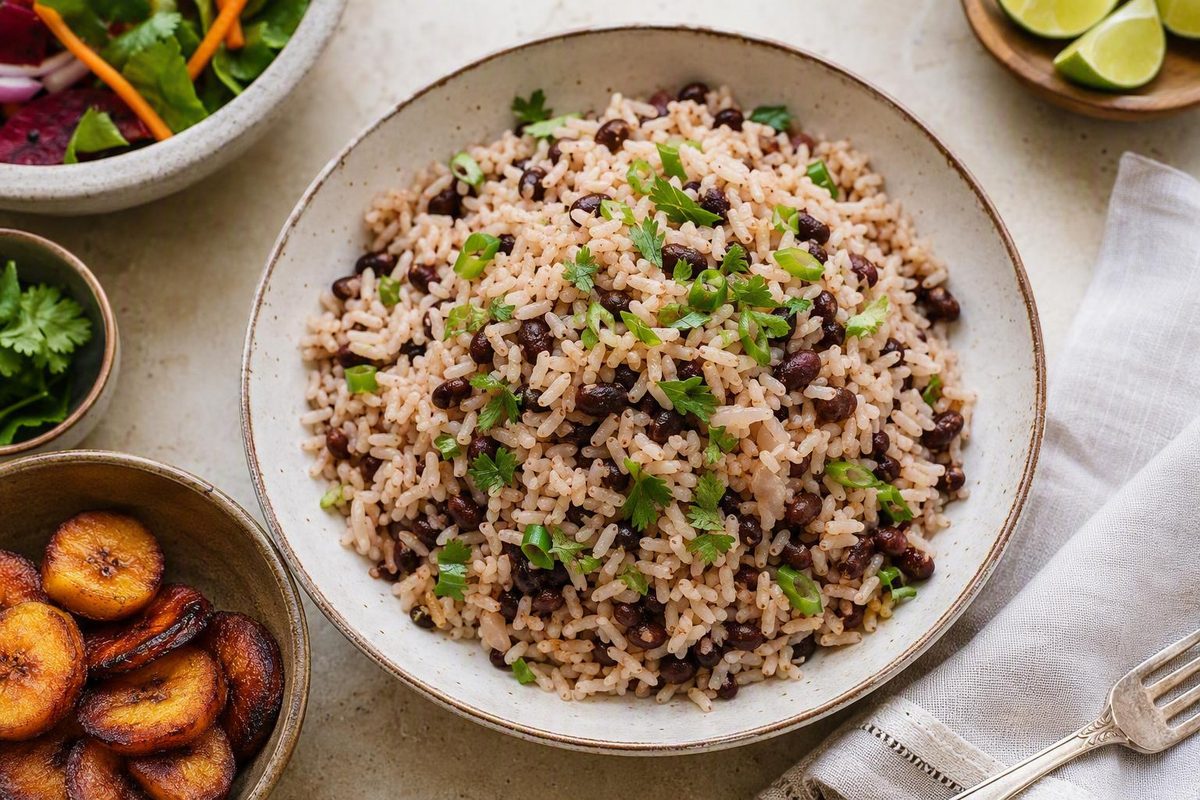
Documented versions use black or red kidney beans. One black-bean version adds coconut milk, and rice, liquid and cooking sequence differ by formula.
Haitian rice and beans is not one rigid formula. It is better understood as a family of related preparations built around a dependable method: cook the beans first, preserve their flavorful broth, then finish rinsed long-grain rice and beans together with aromatics, herbs, seasonings, and, in many versions, hot pepper.
Within that structure, cooks make meaningful choices. Some preparations use black beans; others use red kidney beans. Coconut milk enriches certain versions but is absent from others. One cook may build flavor with epis, while another uses onion, garlic, bell pepper, thyme, and black pepper. Commercial seasonings appear in some published recipes, but they are conveniences within those particular formulas rather than universal requirements.
The methods below synthesize documented household-style recipes.
What Haitian rice and beans is called
Two Haitian Creole names appear in the supplied recipes: diri kole ak pwa and diri ak pwa. Those sources use the names for preparations in which rice and beans finish cooking together in seasoned bean liquid.
When the bean is specified, the name can become more precise. A black-bean version may be identified as diri kole ak pwa nwa, with pwa nwa referring to black beans. Other recipes use the broader names for black-bean or red-kidney-bean preparations.
That distinction matters for anyone searching for the “correct” bean. The documented methods include both black beans and red kidney beans, so the evidence does not support declaring either one universally correct.
Nor should every ingredient in one recipe be elevated into a rule. Coconut milk, epis, proprietary seasoning blends, cloves, allspice, tomato paste, and dried shrimp all appear in particular versions, yet none occurs consistently across every documented method.
The most useful approach is therefore to choose the version you want and follow its internal proportions. Preserve the shared structure—beans first, broth reserved, rice finished with the beans—while treating bean choice and seasoning as features of the selected preparation.
Choose your version: black beans, red beans, or coconut milk
The three paths below are represented in Haitian-specific recipe sources. Choose according to the flavor you want, the equipment available, and the time you can devote to the bean stage rather than trying to rank the versions by authenticity.
| Documented path | Beans and rice | Cooking liquid | Method and character |
|---|---|---|---|
| Red kidney beans, stovetop | 1 cup dried red kidney beans; 2 cups long-grain white rice | About 3 cups reserved bean liquid | Beans are soaked and simmered before the rice stage; onion, bell pepper, garlic, thyme, black pepper, and a whole Scotch bonnet provide the principal flavoring. Food Faith Fitness documents these quantities and the complete schedule. |
| Black beans, pressure cooker | 1½ cups dried black beans; 2½ cups jasmine or basmati rice | 3 cups reserved bean liquid | The source pressure-cooks the beans before combining them with the rice; the dark broth gives the grains bean flavor and color. Savory Thoughts provides the pressure-cooker formula. |
| Black beans with coconut milk | 1 cup dried black beans; 2 cups jasmine rice | 1 cup coconut milk plus 2 cups reserved bean liquid | A coconut-enriched version with herbs, warm spices, prepared seasonings, and optional dried shrimp. Sendy Nervil’s recipe gives the listed proportions. |
The red-bean path has the longest stated schedule because it includes soaking and stovetop bean cooking. It is a useful option for cooks who want kidney beans and a relatively direct aromatic mixture rather than a long list of prepared seasoning blends.
The pressure-cooked black-bean path shortens the documented bean-cooking stage when appropriate equipment is available. It suits cooks who want the earthy flavor and dark cooking liquid of black beans without simmering them on the stove for an extended period.
The coconut black-bean path is richer and more elaborately seasoned. Coconut milk contributes both flavor and cooking liquid, so it should be chosen deliberately rather than added automatically to another recipe.
These are not interchangeable formulas. The coconut version, for example, counts both coconut milk and reserved bean broth toward the rice liquid.
Rice variety, cookware, burner output, evaporation, and lid fit can all affect the result. Select one path and keep its rice, liquid, and method together rather than lifting one ratio from the table and applying it to every long-grain rice.
The recurring ingredients and what each one does
Although the seasoning lists vary, the documented recipes share a recognizable foundation.
Long-grain white rice provides the grain base. Standard long-grain white rice appears in the red-bean preparation, while jasmine and basmati are named in black-bean versions.
Cooked beans provide body, color, and earthy flavor. Black beans create a dark cooking liquid that colors the rice, while red kidney beans provide larger, distinctly colored bites. In either case, the beans are cooked before the rice is added but are not reduced to a puree.
Bean broth connects the two stages. It carries bean flavor and color into the rice while supplying cooking moisture. Because it forms part of the total rice liquid, it should be reserved and measured rather than poured into the final pot without regard to quantity.
Garlic, onion, and bell pepper build the aromatic base. The exact combination and sequence differ, but these ingredients recur across the recipes. Some methods briefly cook the aromatics in oil before the liquid is added; some also sauté the cooked beans at this point.
Thyme, black pepper, and hot pepper provide herbal depth, background pungency, and heat. Thyme may enter during bean cooking, during the combined rice stage, or both.
From there, the formulas branch. One recipe uses epis, a Haitian seasoning base, alongside garlic, onion, thyme, and powdered seasonings. The supplied evidence does not establish one standard epis formula, so it would be misleading to prescribe one here.
Version-specific ingredients include parsley, bouillon, adobo, sazón, Creole seasoning, bay leaves, cloves, allspice, tomato paste, red-pepper flakes, garlic powder, onion powder, and proprietary seasoning blends. Their presence shows how an individual recipe is seasoned, not what every pot of diri kole ak pwa must contain.
Branded blends should be treated as shortcuts within the recipes that specify them. If you have the named blend and want to reproduce that version, use it as directed. If not, the dish’s broader structure still rests on beans, bean liquid, rice, aromatics, herbs, and seasoning rather than on one commercial product.
Dietary restrictions require label checks. A vegetable-based broth or seasoning can fill the savory role in an adaptation, but its salt concentration and flavor may differ.
Cocoa and baking soda appear in the coconut recipe’s ingredient list without directions explaining their use. They should not be carried into a practical method when the source does not establish where or how they belong.
The shared cooking method: beans first, rice second
The recurring technique can be organized into four stages. Thinking in stages is more reliable than treating the dish as a dump-and-simmer formula.
1. Cook the dried beans
Prepare the beans by the method specified for your chosen recipe: soaked and simmered red kidney beans, stovetop black beans, or pressure-cooked black beans. Depending on the version, garlic, thyme, oil, or bouillon may be added to the bean pot.
Stop when the beans are tender but still hold their shape. They should no longer be hard at the center, but they should not be disintegrating throughout the liquid. They will be exposed to more heat once they join the rice.
Overcooking the beans at this stage creates the opposite problem: later stirring and simmering can split or mash them.
2. Separate the beans and reserve the broth
Strain or lift out the cooked beans while retaining their cooking liquid. Measure the quantity specified by the selected recipe. Keep any remainder until you know the measured amount is sufficient, but do not assume every drop belongs in the rice pot.
Separating the beans and broth provides control. The beans can be combined with aromatics without flooding the pan, while the broth can be returned in a defined quantity rather than according to however much water happens to remain after bean cooking.
3. Build the seasoned base
Heat the specified oil or cooking fat, then cook the onion, bell pepper, garlic, or other aromatics used in your version. Some methods briefly sauté the cooked beans at this point. Add herbs and seasonings in the order directed, remembering that bouillon and prepared blends may already contain salt.
Add the measured bean broth and any other designated liquid, such as coconut milk. The rinsed rice then cooks in this seasoned mixture according to the selected recipe.
Seasoning is easier to assess while liquid remains in the pot. Once the rice has absorbed most of it, vigorous mixing can damage both the grains and the already-tender beans.
4. Reduce, cover, and finish gently
After the rice and beans are combined with the seasoned liquid, let the visible liquid recede as the recipe directs. Some methods keep the pot uncovered during this stage; another uses a partially covered pot.
Once the liquid has largely reduced, cover the pot and lower the heat. The documented methods include a final rice stage of approximately 15–20 minutes, though the exact sequence and heat setting vary by recipe. Good Eats and Epis documents a reduction stage followed by covered cooking.
The beans are already tender, and a stable low-heat stage allows the rice to cook without unnecessary disruption.
This sequence is more transferable than any supposed universal liquid ratio: cook the beans, preserve and measure the broth, build the seasoned base, reduce the visible liquid, and finish the rice gently. The actual quantities must still come from the version being followed.
Documented red-kidney-bean stovetop method
This walkthrough summarizes one published red-kidney-bean version of diri kole ak pwa. It is a source overview, not a definitive formula for every Haitian household.
Soak and simmer the beans
The method starts with 1 cup of dried red kidney beans and 2 cups of rinsed long-grain white rice. Soak the beans for at least 1 hour, then simmer them with thyme for about 45 minutes. Separate the tender beans from their liquid and reserve approximately 3 cups of broth. After the combined mixture reaches a boil, the rice and beans cook covered over low heat for 18–20 minutes. The published schedule is about 15 minutes of preparation, 1 hour of soaking, and 1 hour 10 minutes of cooking, for 2 hours 25 minutes total. The complete red-bean recipe supplies these quantities and times.
The beans should be tender enough to eat but firm enough to withstand the rice stage. Their broth becomes the principal rice liquid and carries the beans’ flavor and color through the finished pot.
Build the aromatic mixture
This version uses onion, bell pepper, garlic, thyme, and black pepper. Tomato paste is optional and is included for color. Because the supplied evidence does not establish all the aromatic quantities, use the amounts on the source recipe card rather than treating an improvised measurement as authoritative.
Cook the aromatics as directed, then combine them with the prepared beans, measured broth, and rinsed rice. Bring the mixture to a boil before lowering the heat for the covered finish.
Add the Scotch bonnet carefully
Place one whole, uncut Scotch bonnet in the pot during the rice stage. Keep it intact and avoid pressing it against the side of the pot while stirring. Remove the pepper before serving.
Treat the schedule as a planning guide rather than a substitute for observation. The beans should be tender without collapsing, and the rice should be cooked without being churned into the legumes.
Documented black-bean methods, with and without coconut
The two black-bean paths differ in equipment, seasoning, rice quantity, and liquid composition. Keep each method intact rather than combining its measurements casually with the other.
Pressure-cooker black beans without coconut
In the published pressure-cooker route, 1½ cups of dried black beans cook in 8 cups of water for 25 minutes. The beans are strained and their liquid reserved. Onion, bell pepper, and garlic are briefly cooked in oil before the beans, 2½ cups of jasmine or basmati rice, seasonings, herbs, and 3 cups of reserved bean liquid are added. The stated schedule is 10 minutes of preparation and 55 minutes of cooking, or 1 hour 5 minutes total. Savory Thoughts provides the full source method and schedule.
The rice finish occurs in two phases. First, the pot cooks partially covered while the visible liquid evaporates or reduces. It is then covered fully and finished over low heat. “One pot” does not mean one unchanging heat setting from beginning to end.
The source does not provide the pressure setting or release procedure in the supplied evidence. For that reason, the summary above should not be treated as a complete pressure-cooker operating guide. Follow the full recipe and the safety and operating instructions for your specific appliance, including its pressure-release requirements.
This version also includes a proprietary seasoning blend. That is part of the individual recipe, not evidence that a commercial blend is essential to Haitian black beans and rice.
Black beans with coconut milk
A separate Haitian-authored version uses 1 cup of dried black beans, 2 cups of jasmine rice, 1 cup of coconut milk, and 2 cups of reserved black-bean liquid. The beans are boiled first in 6 cups of water, then combined with the seasonings, coconut milk, and measured broth before the rice is added. After the liquid reduces, the rice finishes over low heat for another 15–20 minutes. Although the recipe card displays a 15-minute cooking time, its written directions require prolonged dried-bean cooking followed by the rice stage, so the total elapsed cooking time is clearly much longer. Sendy Nervil’s coconut rice-and-beans method supplies the ingredients and written sequence.
The seasoning profile is extensive: garlic, sofrito, sazón, adobo, chicken bouillon, thyme, parsley, bell pepper, bay leaves, freshly ground black peppercorns, allspice, cloves, and either a habanero or Scotch bonnet. Dried shrimp is optional. The recipe is attributed to Sendy Nervil, who describes herself as born and raised in Saint Louis du Nord, Haiti.
The coconut milk and bean broth work together as the rice liquid. The coconut milk is not poured on top of another recipe’s already complete broth allowance.
This method demonstrates that coconut milk can belong in a Haitian-authored version. It does not establish coconut milk, sofrito, pressure cooking, sazón, adobo, or a particular bouillon as universal Haitian practice.
Heat control, shortcuts, and dietary adaptations
Hot pepper can perfume the pot, provide pronounced heat, or be omitted. The result depends on the pepper, whether it remains intact, how long it cooks, and how fully it is incorporated.
For the documented whole-pepper approach, add one whole, uncut Scotch bonnet during rice cooking and remove it before serving. An intact pepper still does not guarantee a mild result. The whole-pepper method is documented in the Haitian rice-and-beans recipe from Good Eats and Epis.
For a pepper-free preparation, omit it. No method permits an exact heat promise because individual peppers and diners differ.
The coconut recipe allows either a habanero or a Scotch bonnet. They should be treated as source-approved alternatives for that recipe, not described as identical peppers.
Using canned beans
The recipes from Good Eats and Epis, Savory Thoughts, and Sendy Nervil all discuss canned beans as a convenience, even though their featured methods center on dried beans. Canned beans remove soaking and most of the bean-cooking stage, but they also remove the freshly prepared bean broth on which the documented dried-bean formulas rely.
That creates two practical questions: what liquid will cook the rice, and when should the already-soft beans enter the pot? The sources do not supply one tested canned-bean formula that applies across all the featured rice varieties and methods, so there is no responsible universal replacement ratio.
As a cautious practical synthesis—not a tested Miami Finder formula—use a suitable broth or water as the rice liquid and consider adding drained, already-soft canned beans later than dried beans would enter. The liquid amount must still match the rice, cookware, and method being used.
Do not replace dried beans with canned beans while leaving every other dried-bean instruction unchanged. Canned beans are already cooked, and the liquid in the can is not automatically equivalent in quantity, seasoning, or character to a measured pot of freshly prepared bean broth.
Making the dish vegetarian or vegan
A simple version can be built with rice, beans, oil, aromatics, herbs, pepper, and plant-based cooking liquid. Depending on the selected recipe, omit:
- chicken bouillon or chicken-flavored seasoning;
- optional dried shrimp;
- butter or other animal-derived cooking fats;
- meat-based broth.
Use vegetable broth, vegetable bouillon, oil, or appropriately seasoned bean liquid instead. A general Caribbean rice-and-beans recipe documents vegetable broth and vegetable bouillon as vegan substitutions, although that source should not be used to define a specifically Haitian formula. Immaculate Bites provides the plant-based substitution guidance.
Season gradually when replacing bouillon or prepared blends. Products vary in salt and concentration, so equal spoonfuls from different brands may not produce the same result.
Timing, texture cues, and what to serve with the finished pot
Diri kole ak pwa is easier to schedule when its stages are considered separately rather than compressed into one optimistic cook-time estimate.
Plan the stages separately
- Inactive soaking: The documented red-kidney-bean route includes at least an hour of soaking. The featured pressure-cooker route does not build its schedule around soaking.
- Bean cooking: The red-bean method uses a stovetop simmer, the pressure-cooker version shortens this stage, and stovetop black-bean preparations can require an extended simmer.
- Flavor-base preparation: Aromatics, beans, herbs, and seasonings need time to cook and combine before or around the liquid addition.
- Liquid reduction: The rice mixture cooks until excess visible liquid recedes. Pot width, heat, and whether the pot is open or partly covered affect this stage.
- Covered rice finish: The rice then completes cooking over gentler heat.
The detailed schedules above show why a dried-bean preparation is not a 15-minute dish. Pressure cooking can shorten the bean stage, but it does not eliminate preparation, appliance operation, liquid reduction, or the rice finish.
Watch texture rather than only the clock
Three cues are especially useful:
- The beans are tender but still hold their shape before the rice enters.
- The rice has been rinsed before cooking.
- Most excess visible liquid has receded before the final covered stage.
These observations help prevent timing problems. If the rice is added while the beans are still hard, the grains may finish before the legumes. If the beans are already collapsing, another round of simmering and stirring can create a mushier pot.
Covering the rice while substantial liquid remains may produce a wetter result than intended. Waiting too long over high heat creates the opposite risk. The aim is to let the visible liquid reduce and then move to a gentle covered finish, not to drive the pot dry aggressively.
For that reason, one recipe’s liquid amount should not become a universal troubleshooting rule. Assess the pot’s actual texture rather than adding a fixed amount of water or an arbitrary number of extra minutes.
Build a plate around it
Haitian rice and beans can function as a substantial side or as the foundation of a larger meal. The documented accompaniments include:
- pikliz;
- fried plantains;
- Haitian salad;
- grilled chicken;
- Haitian beef stew;
- poulet en sauce;
- seafood;
- tofu;
- vegetables;
- potatoes.
For a complete plate, pair diri kole ak pwa with bright pikliz, fried plantains, and a sauced protein or vegetable preparation. The acidity, contrasting texture, and added sauce can balance the rice and beans, but that arrangement is a serving suggestion rather than a mandatory formula.
Frequently asked questions
What is Haitian rice and beans called?
The supplied recipes commonly identify it as diri kole ak pwa or diri ak pwa. A black-bean version may be called diri kole ak pwa nwa. These names appear across related preparations rather than one immutable ingredient list.
Should Haitian rice and beans use black beans or red kidney beans?
Either can be used in a documented Haitian-specific preparation. Choose black beans when following a black-bean formula or red kidney beans when following a red-bean formula. Keep the chosen recipe’s bean, rice, liquid, and cooking sequence together.
Is coconut milk required in Haitian rice and beans?
No. Coconut milk appears in one Haitian-authored black-bean version, while other Haitian-specific black- and red-bean recipes rely on reserved bean liquid without it. In the coconut version, the coconut milk counts as part of the rice’s cooking liquid.
Can canned beans replace dried beans?
Some of the featured recipe authors permit canned beans for convenience, but the substitution changes the method. Canned beans are already soft and do not produce the same pot of reserved bean broth. Use another suitable cooking liquid and consider adding the beans later, but do not assume there is one universal liquid adjustment.
How can Haitian rice and beans be made vegetarian or vegan?
Choose plant-based cooking fat and liquid, then omit chicken bouillon, dried shrimp, meat broth, and butter where they appear. Replace them with vegetable broth, vegetable bouillon, oil, or properly seasoned bean liquid, checking product labels and adjusting salt as needed.
The dependable pattern matters more than declaring one version the winner. Select a documented black- or red-bean path, cook the beans until tender but shape-holding, save and measure their broth, build the aromatic base, let the rice mixture reduce, and finish it gently. Coconut milk, commercial seasoning blends, bean choice, and accompaniments can remain what the recipes show them to be: version-specific decisions resting on the shared structure of diri kole ak pwa.