
How to Tell Where Your Tequila Was Actually Produced
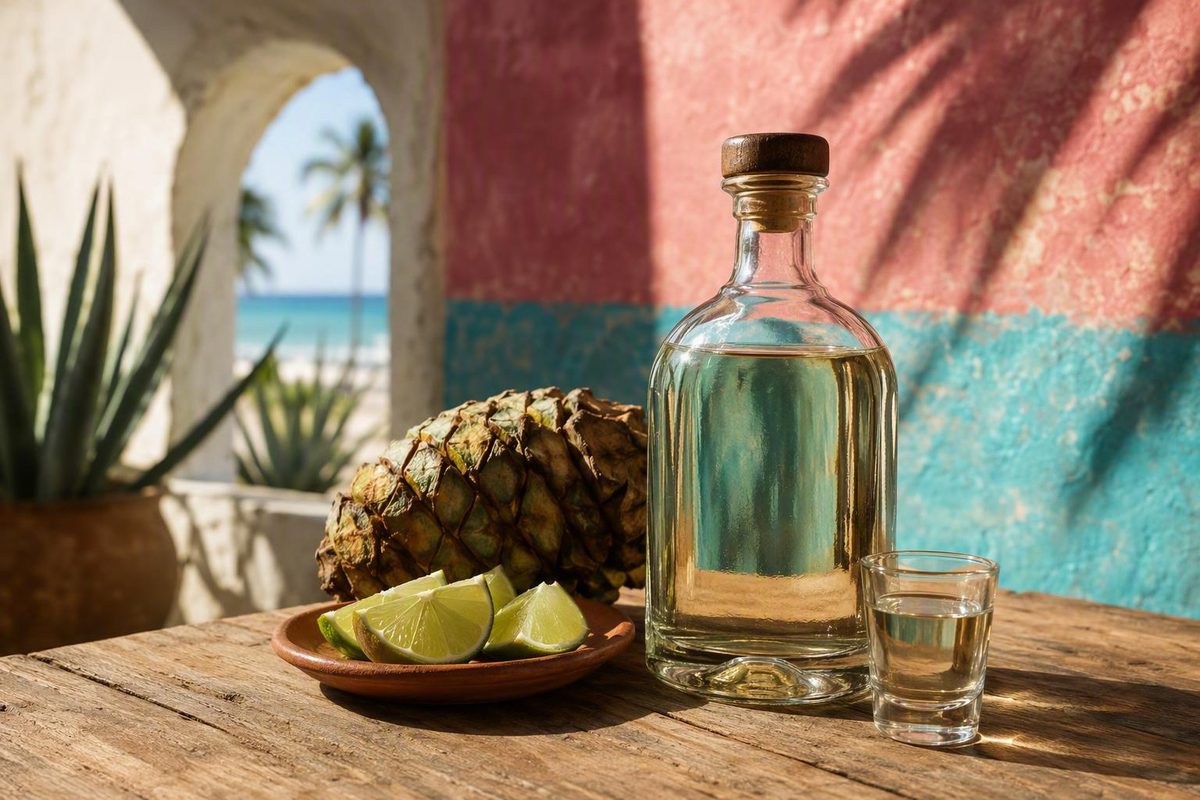
Identify the exact expression, read the NOM and accompanying label cues, and confirm the facility through current official records.
A tequila label can provide useful clues about where a bottle was produced, but those clues have limits.
Treat those details as the beginning of an investigation—not as automatic proof of ownership, agave origin, production methods, formulation, or quality. Current official records are needed to confirm the facility association shown on a particular bottle.
The practical rule is simple: verify production origin first, then investigate ownership, formulation, methods, and quality as separate questions.
What “tequila made in Mexico” means—and what this guide can verify
The supplied secondary sources consistently describe tequila as a regulated Mexican product associated with an authorized denomination-of-origin territory. A brand-owned educational resource explains that four-digit NOM identifiers are used to trace tequila to the Mexican distiller responsible for production (Academia Patrón).
Jalisco is presented as tequila’s principal production center, but “made in Jalisco” and “made in Mexico” are not interchangeable. A personal travel guide reports that authorized production areas extend across five Mexican states and that only specified municipalities are included in some states. That source does not establish the complete, current official territory, so the precise status of a state or municipality must be checked against current Mexican government or CRT documentation.
This distinction prevents two common mistakes:
- Assuming all tequila must come from Jalisco.
- Assuming any agave spirit made anywhere in Mexico qualifies as tequila.
Neither follows from the available evidence. Tequila is tied to an authorized production territory and certification framework; Mexican imagery, an agave ingredient, or a Mexican business address is not enough by itself.
Production origin must also be separated from related geographic and commercial claims:
- Production origin asks where the tequila was made.
- Bottling location asks where the spirit was placed in its retail container.
- Brand headquarters identifies a business address, not necessarily a production site.
- Corporate ownership identifies who controls a brand or company.
- Brand heritage describes a history or identity that may not document current production.
- Sales market tells you where a bottle is offered.
- Retailer category tells you how a seller organized a listing.
Conversely, describing a company as Mexican-owned does not identify the facility associated with a particular bottle. A bottle sold in Mexico is not necessarily a Mexico-exclusive release, just as a bottle sold in Miami was not necessarily produced in Florida.
Evidence limitation: This is a secondary-source label-reading framework, not an independent certification or legal-compliance guide. The supplied evidence consists predominantly of retailer pages, producer publications, commercial blogs, a lifestyle article, and a personal travel guide. It does not include the current governing regulation, official denomination-of-origin documents, current label rules, or a verified public CRT search interface. Use the steps below to organize an investigation, then confirm legal and registry questions through current CRT or Mexican government materials.
A five-part bottle check for production origin
Do not rely on one decorative phrase or front-label design. Inspect the bottle as a set of separate clues.
-
Locate the four-digit NOM identifier. Look for “NOM” followed by four digits. Commercial label guides commonly place it on the back or side label near the barcode, warning text, CRT mark, or origin wording, although layouts vary.
-
Look for the CRT mark. Secondary commercial sources describe this as a certification-related label cue associated with the Consejo Regulador del Tequila. Do not treat it as a quality award or assume that its appearance alone completes a current certification check.
-
Read the origin wording exactly. Look for wording such as “Hecho en México.” Photograph or transcribe what the bottle actually says instead of paraphrasing it from memory.
-
Identify the agave-category statement. Record whether the label says “100% agave,” “100% de agave,” or uses the broader tequila category without that statement. This is a category clue, not a complete description of ingredients or methods.
-
Record the exact expression, ABV, and size. “Brand X Blanco” and “Brand X Reposado” are not interchangeable. Note the full expression name, alcohol by volume, proof if shown, bottle size, and market.
A commercial label overview reports that the NOM is usually printed near “Hecho en México” and the CRT seal, while emphasizing that the code identifies a production facility rather than a brand’s marketing office (León Y Sol).
Proposed annotated-label graphic
The following is an editorial brief for a future rights-cleared graphic, not a representation of a mandatory label layout:
FRONT LABEL                         BACK OR SIDE LABEL
┌──────────────────────┐           ┌────────────────────────┐
│ 1. Brand name        │           │ 4. Origin wording      │
│ 2. Exact expression  │           │ 5. NOM ####            │
│    Blanco, etc.      │           │ 6. CRT mark            │
│ 3. Agave statement   │           │ 7. ABV / proof         │
│    “100% agave”      │           │ 8. Bottle size         │
│                      │           │ 9. Bottler/importer     │
└──────────────────────┘           │10. Barcode/warnings    │
                                   └────────────────────────┘
Suggested alt text: “Illustrative front and back tequila labels showing where a shopper might find the brand, expression, agave statement, origin wording, four-digit NOM, CRT mark, ABV, bottle size, and importer or bottler information.”
Suggested caption: “Illustrative only. Actual label placement varies, and each callout should be checked against current official labeling guidance before the graphic is published.”
Photograph both sides of the physical bottle whenever possible. Capture:
- Full brand and expression name
- NOM
- CRT mark
- Origin wording
- Agave-category statement
- ABV or proof
- Bottle size
- Lot or batch information, if visible
- Bottler or importer wording
- Date and place observed
Several mutually consistent cues provide more useful initial evidence than Mexico-themed packaging alone. Even so, a current official record connecting the NOM, producer, and brand would be stronger than the label’s visual presentation.
If a NOM is damaged, hidden by a store sticker, covered by a presentation box, or unreadable in an online photograph, do not immediately declare the bottle counterfeit. Pause the purchase or investigation, inspect another bottle of the same expression, and ask the seller or producer for a clear current back-label image and supporting documentation.
What a tequila NOM number tells you
NOM means Norma Oficial Mexicana, a general term for an official Mexican standard. In everyday tequila discussions, however, “NOM number” commonly refers to the four-digit facility identifier printed after the letters NOM.
The defensible use of that number is facility research. Brand and retailer explainers describe it as identifying the Mexican production facility associated with a tequila—not the brand’s headquarters, importer, marketing agency, or corporate owner. A brand-owned guide also notes that one facility can produce multiple brands (Inspiro Tequila).
Because the supplied evidence does not contain a verified current CRT lookup URL or a documented official search interface, this article cannot provide a reproducible official lookup walkthrough. It would be misleading to invent navigation steps or imply that an untested commercial database is an official registry.
How to research a NOM
Use the following workflow while recognizing that the official-record step must be completed outside this evidence pack:
-
Copy the number from the physical bottle. Record all four digits. Do not substitute a number found through a brand-name search.
-
Record the exact product. Include the brand, expression, edition, ABV, bottle size, market, lot information, and observation date.
-
Find the current official record. Search current CRT or Mexican government materials for a record connecting the NOM with the producer or facility and, where available, the brand or expression. Confirm that the page is official, current, and applicable to the bottle’s market.
-
Record the formal facility information. Note the registered producer or facility name, municipality, and state. Do not rely only on a familiar distillery nickname.
-
Compare the result with the bottle. The NOM, brand, expression, and origin information should form a coherent record. A mismatch may reflect a transcription error, an older bottle, a production move, or incomplete information; it should prompt further research rather than an immediate accusation.
-
Use third-party databases only as supplements. Commercial databases and brand pages may help with historical associations, photographs, or production claims. They should not overrule a current official record without additional evidence.
-
Date the result. Write “checked on” followed by the date. A current facility association may not describe a bottle produced before a move, and an old association may not apply to new inventory.
If no public official search tool is available when you check, request documentation through the CRT, the producer, or the seller rather than treating a commercial search result as official confirmation. Ask specifically for the registered producer, NOM, municipality, and the brand or expression covered by the record.
A distillery can produce multiple brands. When two current bottles display the same NOM, the bounded conclusion is that both are associated with the same identified production facility. The number does not establish that they contain the same liquid.
NOM proves / NOM does not prove
Because current official records are not included here, “can support” is more accurate than “proves” for this secondary-source framework.
| A NOM can support, subject to current confirmation | A NOM does not establish |
|---|---|
| Identification of the associated production facility | Sensory quality |
| Research into where in Mexico production occurred | A particular recipe |
| Comparison of the label with current records | Where all agave was grown |
| Identification of other brands associated with a facility | Extraction or fermentation method |
| Investigation of a brand’s facility history | Distillation specifications |
| A dated origin and facility check | Aging program or barrel treatment |
| Distinguishing the factory from the marketing office | Additive status |
| Evidence that several brands use one facility | Corporate ownership |
| Brand ownership of the distillery |
The NOM is an identifier, not a score. A lower number, older number, or number associated with fewer brands is not inherently better.
Production affiliations also require dates. Commercial guides report that a brand’s NOM may change when production moves. An old bottle photograph, article, or database entry can therefore be accurate for one period but irrelevant to current stock.
Made in Mexico, Mexican-owned, and 100% agave are different claims
Shoppers often compress several unrelated ideas into the word “authentic.” A better approach is to turn that broad question into smaller, answerable questions.
| Claim or cue | What it may tell you | What it does not independently prove |
|---|---|---|
| Made in Mexico | A production-origin claim to compare with label and facility information | Mexican ownership, quality, or traditional methods |
| Bottled in Mexico | The stated bottling location | The exact production facility or production method |
| Mexican-owned | A claim about ownership or control | The production site of a particular bottle |
| NOM-identified facility | The facility associated with production, subject to current confirmation | Recipe, quality, ownership, or ownership of the facility |
| CRT mark | A certification-related cue according to secondary commercial guides | Premium quality or a flavor profile |
| “100% agave” | The stated agave-sugar category | Additive-free status, traditional methods, or Mexican ownership |
| Retailer country filter | How a seller categorized a listing | Independent manufacturing verification |
| Retailer heritage collection | A seller’s thematic or ownership-oriented grouping | Documentary proof for every listed product |
The current rules governing bulk export, bottling outside Mexico, and corresponding origin disclosures are not established by the supplied evidence. Consequently, this guide cannot tell readers that a particular phrase definitively resolves both production and bottling history. Record production and bottling statements separately and verify each through current official guidance.
A retailer’s country filter is useful for discovering candidates, not for completing an origin investigation. One retailer page groups recognizable expressions under a Mexico filter and supplies commercial information such as styles, sizes, prices, and stock. That demonstrates how the seller organized its inventory, not independent proof of each bottle’s production facility (San Francisco Wine Trading Co.).
Ownership-themed collections need the same scrutiny. One “Mexican-Owned Tequila & Mezcal” collection combines tequila with other mezcal products and does not supply ownership or production documentation for every listing. It can generate a shopping list, but it cannot complete a bottle-level investigation (Graham Wine Co.).
“100% agave” must also remain in its lane. It should not be translated into “highest quality,” “traditionally made,” “Mexican-owned,” or “additive-free.”
Secondary commercial sources describe additive and labeling rules inconsistently. One retailer guide distinguishes “100% agave” from additive-free status, but it also contains conflicting formulations about permitted thresholds and does not replace the governing regulation (Sip Tequila). The supplied evidence therefore does not support a current additive percentage, a categorical rule for blanco, or a claim that “additive-free” is an official certification.
Use this decision rule:
Verify the production origin of the exact bottle first. Then investigate ownership, agave sourcing, formulation, methods, and quality as separate questions.
Source-reported Jalisco tequila examples by NOM and municipality
The following table is illustrative, not a ranking or a list of current recommendations. Every association comes from a personal travel and buying article rather than a current official registry result. The source reports the listed brand, NOM, and municipality combinations, but each exact bottle should be rechecked before purchase (Playas y Plazas).
| Brand | Source-reported NOM | Municipality | State | What the source establishes | What to recheck before purchase |
|---|---|---|---|---|---|
| Cascahuín | 1123 | El Arenal | Jalisco | The travel article reports this brand, NOM, and municipality association | Current bottle NOM, exact expression, registered producer, ABV, size, and date |
| Siete Leguas | 1120 | Atotonilco el Alto | Jalisco | The article reports the stated facility-location association | Current label and official record match |
| Tapatío | 1139 | Arandas | Jalisco | The article associates Tapatío with this NOM and municipality | Whether the shelf bottle still carries NOM 1139 |
| Los Abuelos | 1493 | Tequila | Jalisco | The article reports production under this NOM in Tequila municipality | Market name, expression, NOM, ABV, size, and current producer |
| Calle 23 | 1545 | San José de Gracia | Jalisco | The article reports this NOM and location | Current facility association and bottle details |
| Siembra Valles | 1123 | El Arenal | Jalisco | The article reports the brand under the same NOM as Cascahuín | Current association and expression-specific production information |
These are best understood as historical or source-reported research leads. None has been independently confirmed here against a current physical label and official record.
The shared NOM reported for Cascahuín and Siembra Valles illustrates the limits of the identifier. It suggests association with the same facility at the time described; it does not establish identical recipes, ingredients, maturation, specifications, or liquid.
Arette, Tapatío, and Siete Leguas also appear in retailer collections. Those appearances can show that sellers listed or categorized the products at a particular time. They do not independently confirm a current NOM, producer, municipality, or expression-level production history.
Styles, expressions, and market-specific bottles
After investigating origin, compare bottles by exact expression rather than by brand reputation alone. The supplied retailer listings use style labels including:
- Blanco
- Reposado
- Añejo
- Extra añejo
This guide does not provide official aging definitions because the evidence pack lacks the current governing provisions needed to do so authoritatively. The practical point is that these labels describe different expressions and should not be treated as interchangeable.
Representative retailer listings include Arette Blanco, LALO Blanco, Clase Azul Reposado, Don Julio 1942 Añejo, Tequila Ocho expressions, and Tapatío Añejo. These examples demonstrate the variety of styles, sizes, and market positioning a shopper may encounter; they do not form a best-of list.
Use consistent comparison fields:
| Field | Why it matters |
|---|---|
| Brand | Establishes the product family |
| Exact expression | Separates styles, editions, and releases |
| NOM | Connects the bottle with its reported facility |
| Bottle size | Prevents misleading price comparisons |
| ABV or proof | Identifies the strength of the specific bottling |
| Market | Helps distinguish domestic and export packaging |
| Label language | May provide origin, bottling, or importer clues |
| Lot or batch | May distinguish production runs |
| Date observed | Accounts for packaging, facility, price, and availability changes |
Price, stock notices, bestseller badges, and limited-quantity labels are commercial details. They may help answer whether a seller has a bottle available, but they do not establish origin, authenticity, production quality, or sensory merit.
Market-specific names require caution as well. The travel source presents Los Abuelos as Mexican-market branding associated with tequila sold as Fortaleza in the United States. Treat that as a lead for expression-level research, not proof that every bottle under the two names is identical across all batches, sizes, ABVs, and markets.
A consumer lifestyle article reports that bottles sold in Mexico may appear at lower ABVs than some U.S. releases and suggests that lower strength could affect perceived intensity. It does not provide primary legal materials or controlled tasting evidence, so the useful takeaway is simply to inspect the bottle-specific ABV rather than generalize about an entire country’s inventory (Mashed).
Before comparing a Mexican-market bottle with a U.S. bottle, match:
- Exact expression
- NOM
- Bottle size
- ABV
- Market
- Lot or batch, when available
- Observation date
If those fields differ, the products may be related but are not necessarily equivalent.
How to research a bottle before buying it
The same process applies in a U.S. liquor store, a shop in Mexico, or an online marketplace.
The one-minute shelf-side checklist
When time is limited:
- Read the full brand and expression name.
- Turn the bottle around.
- Find and photograph the NOM.
- Look for the CRT mark.
- Record the exact origin wording.
- Note the agave-category statement.
- Record ABV and bottle size.
- Check whether packaging or a sticker hides relevant information.
- Do not infer ownership or quality from these cues.
If the back label is unreadable, inspect another bottle of the same expression or ask the seller for help. An unreadable code is a reason to pause, not a sufficient basis for alleging fraud.
The longer pre-purchase research checklist
For an expensive, unusual, online, or travel purchase:
-
Create a bottle record. Save clear front-, side-, and back-label photographs with the date and store or website.
-
Transcribe the label. Record the exact expression, NOM, CRT mark, origin wording, agave statement, ABV, size, and visible lot information.
-
Find current official documentation. Look for a current CRT or Mexican government record covering the NOM and producer. Confirm that the source is official rather than a commercial database with similar branding.
-
Record the facility. Note the formal producer name, municipality, state, and access date.
-
Check the brand-expression match. Make sure the result concerns the product in front of you, not merely another expression from the same brand.
-
Investigate discrepancies. A different NOM in an older article may indicate a production move, a stale database, an old bottle, or a different market release.
-
Review supplemental production claims. Use producer materials, third-party databases, and reputable reporting for methods and history. Keep company assertions clearly labeled as company assertions.
-
Investigate ownership separately. Look for corporate disclosures or credible business reporting. Do not derive ownership from the NOM.
-
Compare like with like. Match expression, size, ABV, taxes, currency, location, and date before comparing prices.
-
Retain a dated note. A note such as “Bottle photographed and facility association checked on August 14, 2026” makes later comparisons more meaningful.
For online shopping, a product title or promotional front image is insufficient. Look for a legible photograph of the current back label. If none is available, request one showing the exact expression, NOM, ABV, and bottle size.
For travel purchases, the independent travel source used above personally favors Jalisco distillery or producer shops over airports. That is the author’s recommendation, not evidence that producer shops are always cheaper or that airport bottles are inferior.
Old price lists are particularly weak comparison tools. A price becomes meaningful only when the expression, bottle size, ABV, taxes, currency, location, and date are comparable. A one-liter Mexican-market bottle should not be compared with a 750 mL U.S. bottle by sticker price alone.
Do not assume that a hard-to-find bottle is exclusive to Mexico. Distribution can vary by country, state, city, importer, retailer, and date. Scarcity in one market does not establish exclusivity in another.
This is an adult alcohol-purchasing guide. Follow the laws governing the purchase, transportation, and consumption of alcohol where you are. Plan transportation in advance and consume responsibly.
Common myths about Mexican-made tequila
Myth: Every Mexico-themed bottle is verified tequila
Fact: Flags, agave illustrations, Spanish phrases, rustic paper, ceramic containers, and references to Mexican places are packaging cues. They cannot independently establish the production facility.
Use the exact label information and current records rather than treating design as verification.
Myth: A lower or older NOM means better tequila
Fact: The four-digit number identifies an associated facility; it is not a ranking, age statement, review score, or quality grade. A facility’s methods may be worth investigating, but they cannot be inferred from whether its number appears early, late, rare, or familiar.
Myth: Brands with the same NOM contain the same tequila
Fact: A shared NOM supports a shared-facility conclusion, subject to current confirmation. Brands produced at one facility may still differ in recipes, agave sourcing, fermentation, distillation, maturation, blending, formulation, and quality targets.
Myth: “100% agave” automatically means additive-free, traditionally made, or high quality
Fact: “100% agave” is an agave-category statement. It does not independently document every ingredient, process, ownership fact, or sensory characteristic.
Current additive questions require primary regulatory materials and well-documented product-specific evidence. The supplied commercial sources are too inconsistent to establish a current percentage, a universal blanco rule, or an official additive-free certification.
Myth: Mexican-owned and made in Mexico are interchangeable
Fact: Ownership and production location answer different questions. A bottle can be associated with a Mexican production facility while the brand is owned elsewhere. A retailer’s Mexican-owned classification does not independently document where a particular expression was produced.
Myth: Expensive or scarce bottles are inherently more authentic
Fact: Neither proves origin, production methods, or quality.
Myth: All tequila sold in Mexico has the same lower proof or tastes smoother
Fact: ABV is bottle-specific, and perceived smoothness is not determined by the country of purchase alone. Compare otherwise equivalent expressions before attributing a difference to the market.
Myth: A NOM tells you everything important about the tequila
Fact: The NOM provides a bounded facility clue. It does not substitute for evidence about ownership, agave sourcing, extraction, fermentation, distillation, maturation, formulation, or batch history.
Label literacy can establish useful facts about a bottle. Production philosophy requires additional documentation, while sensory quality ultimately requires evaluation beyond a four-digit identifier.
Frequently asked questions
Must tequila be made in Mexico?
The supplied secondary sources consistently describe tequila as a regulated Mexican product tied to an authorized denomination-of-origin territory. They also describe NOM identifiers as a way to trace bottles to Mexican production facilities.
That does not mean every agave spirit made in Mexico is tequila, nor does it mean all tequila comes only from Jalisco. The complete current territory and applicable legal requirements should be confirmed through current Mexican government or CRT materials.
Where can I find the NOM number on a tequila bottle?
Look on the back or side label for “NOM” followed by four digits. Commercial guides commonly report that it appears near the CRT mark, origin wording, warning text, or barcode, but label layouts vary.
Photograph the entire bottle rather than only the code. If it is hidden or unreadable, seek a clearer image or current documentation instead of immediately concluding that the bottle is counterfeit.
Does the same NOM mean two brands sell the same tequila?
No. It associates the brands with the same identified production facility, subject to current confirmation. It does not establish that the bottles share an identical recipe, source material, fermentation method, aging program, formulation, or liquid.
Does “100% agave” mean a tequila is additive-free?
No. The statement describes the agave-sugar category and should not be extended into a claim about every ingredient or production choice. It also does not prove traditional methods, premium quality, or Mexican ownership.
Because the supplied secondary sources describe additive rules inconsistently, product-specific questions should be checked against current primary Mexican regulatory materials.
Is Mexican-owned tequila necessarily made in Mexico?
Ownership alone does not identify the production site. “Mexican-owned” describes control of a company or brand; “made in Mexico” describes production origin. Each requires different evidence.
For a particular bottle, record the exact expression and label cues, then seek a current official facility record. Investigate ownership separately through appropriate corporate documentation.
The final verification rule is straightforward: identify the exact expression, read the NOM and accompanying label cues, and confirm the facility through current official records. Keep origin separate from ownership, formulation, method, and quality. No single number, marketing phrase, price, or retailer category answers every question about what is inside the bottle.