
What One Espresso Shot Actually Means
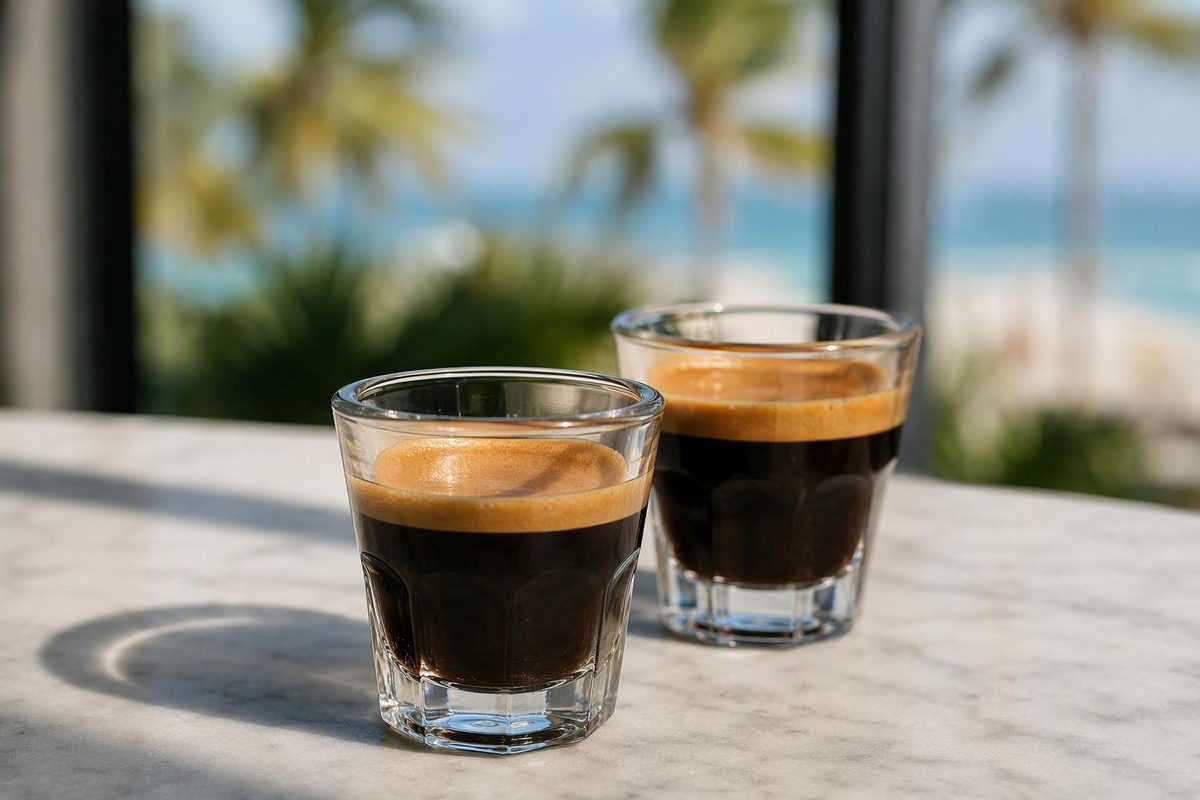
A traditional single is about 1 fl oz (30 mL), while a double is about 2 fl oz (60 mL). Brewing recipes distinguish serving volume from dose and yield.
The quick answer: espresso shot size at a glance
A traditional single espresso is approximately 1 fluid ounce or 30 mL, while a traditional double is approximately 2 fluid ounces or 60 mL. These are common serving conventions, not mandatory standards for every café, machine, or recipe. A traditional single commonly uses about 7–9 g of ground coffee, and a double commonly uses about 14–18 g (OutIn’s espresso-size guide).
| Serving | Traditional fluid volume | Typical dry coffee dose | Example weight-based beverage yield |
|---|---|---|---|
| Single espresso | About 1 fl oz or 30 mL | About 7–9 g | About 14–18 g at a 1:2 ratio |
| Double espresso | About 2 fl oz or 60 mL | About 14–18 g | 36 g from an 18 g dose at a 1:2 ratio |
The last column is an example of brewed yield by weight, not a conversion from fluid ounces or milliliters. An 18 g dry dose producing 36 g of espresso is a 1:2 recipe, but it is not the universal definition of a double shot.
That distinction produces two useful answers to “how much is a shot of espresso”:
- For a quick serving conversion: one traditional shot is about 1 fluid ounce or 30 mL.
- For repeatable brewing: describe the shot by its dry coffee dose and brewed yield, both measured in grams.
Fluid ounces and milliliters measure volume—the space occupied by the drink. Grams measure mass. Those units are not interchangeable, especially when crema adds visible volume to espresso.
Espresso prices depend on the café, location, menu, taxes, and current pricing. This article addresses how much espresso is in a shot rather than what a café charges for it.
Why “one shot” does not always mean one exact measurement
The familiar single and double measurements are useful because customers, cafés, and recipe writers need simple serving language. They do not establish one fixed recipe for every espresso machine.
Shot size can vary with the café’s recipe, local coffee culture, machine, basket, dry dose, coffee, desired taste, and chosen shot style. Equipment manufacturers and coffee guides consequently present traditional shot sizes as general references while acknowledging that actual café and brewing practices differ (HiBREW’s guide to espresso measurements).
The word shot can therefore mean different things in different contexts:
- one serving of espresso;
- one extraction from a machine;
- the output from a particular basket;
- one portion added to a latte or Americano;
- a traditional volume-based serving; or
- a café’s own recipe-defined unit.
For a customer ordering a drink, “one shot” may be sufficiently clear. For a barista trying to reproduce an extraction, it is incomplete. A brewing recipe is described more precisely through four variables:
- Dose: the mass of dry ground coffee placed in the basket.
- Yield: the mass of brewed espresso collected in the cup.
- Ratio: the relationship between dose and yield.
- Time: the duration of the extraction.
Two drinks described as single espressos can therefore use different doses or produce different yields. The same applies to two doubles. One café may use traditional volume as its reference, while another may use “double” to describe the output from a particular basket. The label alone does not reveal the exact beverage mass.
This ambiguity matters when following written recipes. If a recipe says “add one shot of espresso,” check whether it gives a more precise amount elsewhere. It might mean a stated fluid volume, a milliliter amount, one café-style serving, or a particular brewed yield in grams.
Context determines how important that difference is. A small variation may have little effect in a large iced latte. It can matter more in a small cocktail, custard, icing, syrup, or concentrated coffee drink, where extra liquid changes both flavor and dilution.
The same principle applies when ordering at a café. If espresso quantity or caffeine matters, ask:
- How many shots are in this drink?
- Is that a single or double extraction?
- How does this café define its standard shot?
That is more reliable than assuming every menu uses identical terminology. It is also more useful than inferring espresso quantity from the finished cup size. A latte may be larger because it contains more milk, while an Americano may be larger because it contains more water.
Volume, dose, and yield are three different measurements
Understanding espresso becomes much easier once volume, dose, and yield are kept separate. They describe different parts of preparation and should not be substituted for one another.
Volume: how much space the finished drink occupies
Volume is the space occupied by the finished espresso. It is commonly expressed in:
- fluid ounces;
- milliliters; or
- fractions of a cup in written food and drink recipes.
“An ounce of espresso” should be written as one fluid ounce when volume is intended. An ounce by weight measures mass, while a fluid ounce measures volume. Omitting the word “fluid” can create confusion in recipes containing both liquid and dry ingredients.
A volume measurement does not reveal the exact dry dose or beverage mass. It simply describes how much space the drink occupies, including any visible crema when the measurement is read from the top of the shot.
Dose: how much dry coffee goes into the basket
Dose is the mass of dry ground coffee placed in the portafilter basket. It is normally recorded in grams.
Traditional guidelines associate a single with approximately 7–9 g of coffee and a double with approximately 14–18 g, although the appropriate dose depends partly on the basket and machine (Espresso & Coffee Guide’s measurement overview).
Dose is an input measurement. It does not describe:
- the machine’s total water input;
- the amount of water moving through or around the coffee;
- the visible volume in the cup; or
- the mass of the finished beverage.
These quantities are related through brewing, but they are not the same measurement.
Yield: how much brewed espresso reaches the cup
Yield is the mass of brewed espresso collected in the cup. It is also normally measured in grams.
A scale makes yield straightforward to track: place the cup on the scale, tare it to zero, begin the extraction, and stop when the selected output weight is reached. The shot can then be described as a relationship between coffee in and espresso out.
For example:
18 g in, 36 g out
This means:
- 18 g in: the dry coffee dose weighed 18 g.
- 36 g out: the espresso collected in the cup weighed 36 g.
- 1:2 ratio: the beverage yield was twice the dry dose.
It does not mean 36 mL, and it certainly does not mean 36 fluid ounces. Espresso recipes are more reproducible when dose, yield, and time are stated explicitly rather than inferred from cup markings (Clive Coffee’s espresso workflow).
This distinction resolves an apparent mismatch: How can a traditional shot be described as 30 mL while a modern recipe produces a different number of grams?
The figures come from different measurement systems. The traditional reference describes finished beverage volume, potentially including crema. A modern gram-based recipe describes beverage mass in relation to the dry coffee dose. Because crema contributes visible volume and grams are not automatically equivalent to milliliters, the figures do not need to match.
Clear labeling prevents confusion:
- 30 mL: finished beverage volume.
- 18 g dry coffee: dose.
- 36 g brewed espresso: yield.
- 1:2: dose-to-yield relationship.
None of these figures represents the machine’s total input water, and none should be silently converted into another measurement.
Why baristas weigh espresso instead of trusting the cup markings
Fluid ounces and milliliters remain useful for describing a traditional serving. If a drink or dessert recipe simply needs an approximate serving of espresso, a volume measurement may be adequate. When the goal is to repeat a brewing result, however, grams are more informative.
The main complication is crema, the foamy layer on freshly extracted espresso. Crema contains carbon-dioxide bubbles and coffee oils. It adds visible height to a shot without contributing an equivalent amount of liquid beverage mass, and it changes as bubbles dissipate after brewing (OutIn’s explanation of crema and shot volume).
Crema also varies. Coffee age is one factor: a coffee brewed soon after roasting may produce a different amount of crema from the same coffee brewed later. Preparation and the coffee itself can also affect what appears in the cup.
Imagine two extractions that both reach the same line on a marked shot glass:
- Shot A has a thick, airy crema layer.
- Shot B has less crema and more liquid beneath the surface.
The shots appear equal by volume, but they need not have the same beverage mass. If you stop every extraction only when it reaches a glass marking, changing crema can lead you to stop at different actual yields.
A scale avoids that ambiguity. A practical process is:
- Select a dry dose appropriate for the basket.
- Grind the coffee and weigh the dose.
- Prepare the coffee in the portafilter.
- Place the cup on the scale.
- Tare the scale with the empty cup in place.
- Begin the extraction.
- Stop at the selected beverage yield.
- Record the dose, yield, and extraction time.
- Taste the espresso before deciding what to adjust.
A common starting point is a 1:2 ratio by weight, meaning approximately two grams of brewed espresso for every gram of dry coffee. With an 18 g dose, that produces a target yield of 36 g:
18 g dose × 2 = 36 g yield
The resulting recipe is 18 g in and 36 g out. This is a useful starting example, not a mandatory target or a universal definition of a double shot. The ideal dose and yield can change with basket size, machine design, coffee, roast, and desired style (Achilles Coffee Roasters’ guide to weighing espresso).
A different ratio may be reasonable because of:
- the basket’s intended capacity;
- the machine’s behavior;
- the coffee’s roast and solubility;
- the desired strength, texture, or flavor;
- the grinder setting; or
- the way the finished espresso tastes.
Weighing does not replace judgment. It gives judgment a stable reference. If a shot tastes better at a different yield, you can record that result and reproduce it rather than trying to remember where the crema reached on a glass.
Single, double, ristretto, and lungo compared
Espresso labels can describe a serving size, a brewing style, or both. Dose-to-yield ratio usually communicates the recipe more clearly than cup volume alone.
Single espresso or solo
A single, also called a solo, is traditionally about 1 fluid ounce or 30 mL and commonly uses approximately 7–9 g of dry coffee.
That remains a useful consumer reference. In a precise brewing context, however, the recipe may be stated as a gram-based yield that does not correspond directly to the traditional milliliter figure.
Double espresso or doppio
A double, or doppio, is traditionally about 2 fluid ounces or 60 mL, commonly associated with approximately 14–18 g of dry coffee.
A double-basket recipe might use 18 g of coffee and produce 36 g of espresso, but that example does not make 36 g the required yield for every double. Basket capacity and the intended ratio still determine the working recipe.
Ristretto
A ristretto generally produces a lower beverage yield than standard espresso made from a comparable dose. The result is a smaller serving and a tighter dose-to-yield relationship.
Approximate ratio guidance places ristretto around 1:1 to 1:1.5. An 18 g dose would therefore produce roughly 18–27 g of beverage. Volume-oriented references sometimes describe ristretto as approximately 0.5–0.75 fluid ounce, but the ratio is usually more informative than treating that volume as a rigid rule.
Standard espresso
A commonly used espresso guideline is approximately 1:2 to 1:2.5 by weight. With an 18 g dose, those ratios would produce approximately 36–45 g of brewed espresso.
These are flexible brewing references rather than formal boundaries. A café may use a shorter or longer recipe while still calling the result espresso.
Lungo
A lungo generally has a higher beverage yield relative to the dry dose. A reference ratio of approximately 1:3 would turn an 18 g dose into roughly 54 g of espresso.
Volume-oriented guides sometimes place lungo servings around 1.5–3 fluid ounces, but actual recipes vary. A lungo has more output relative to its dose; it does not necessarily use more dry coffee. The cited volume ranges and traditional serving figures are summarized in OutIn’s shot-size guide, while the flexible 1:1–1:1.5, 1:2–1:2.5, and around 1:3 relationships are explained in Flair’s guide to espresso brew ratios.
| Style | Approximate dose-to-yield relationship | What changes |
|---|---|---|
| Ristretto | About 1:1–1:1.5 | Lower yield from a comparable dose |
| Espresso | About 1:2–1:2.5 | Middle reference range |
| Lungo | Around 1:3 | Higher yield from a comparable dose |
These labels are most useful when they communicate the relationship between dry coffee and brewed output. They are less useful when interpreted as universally fixed cup sizes.
A longer espresso should not be confused with a larger dose. If the dose stays constant while the yield increases, the output ratio has changed; the amount of dry coffee has not.
How much caffeine is in an espresso shot?
Caffeine is separate from physical shot size. Two shots with similar volume can contain different amounts of caffeine, and a visually larger shot is not automatically more caffeinated.
A broad reference range is approximately:
- 40–63 mg of caffeine for a single shot
- 80–126 mg for a double
The lower estimates come from a comparison listing about 40 mg for a single and 80 mg for a 2-fluid-ounce double (Kicking Horse Coffee’s espresso-versus-drip comparison). The upper estimates use approximately 63 mg for one shot and 126 mg for two comparable shots.
These are reference estimates, not guaranteed nutrition values. Caffeine can vary with:
- the dry coffee dose;
- bean type;
- the blend;
- beverage yield;
- brew ratio; and
- preparation method.
A café’s “double” may describe a basket, an extraction, a serving convention, or two comparable shots. It is therefore unsafe to assume that every double contains exactly twice as much caffeine as every single.
Espresso generally contains more caffeine per fluid ounce than drip coffee. That does not mean a normal espresso serving necessarily contains more caffeine overall. A serving of drip coffee is much larger, so the complete cup may contain more total caffeine despite being less concentrated by volume.
Adding milk, foam, ice, or water does not remove caffeine already extracted into the espresso. Those additions increase the finished drink’s volume and reduce its concentration, but the caffeine contributed by the espresso remains.
For espresso-based drinks, shot count is therefore more informative than cup size:
- A latte may contain one or more shots, depending on the café’s recipe.
- A larger latte can contain more milk without containing more espresso.
- An Americano can become larger because additional water was added.
- Cappuccino foam increases visible volume without proving that another shot was used.
If caffeine matters, ask how many shots the drink contains and how the café defines them. Even then, the answer remains an estimate unless the specific drink has reliable nutrition information or has been tested.
A practical guide for recipes, café orders, and home brewing
The best measurement depends on the task. A café customer, a cook following a dessert recipe, and a home barista dialing in an extraction need different levels of precision.
For everyday conversions
Use traditional serving shorthand when an approximate liquid amount is all you need:
- One shot: about 1 fluid ounce or 30 mL.
- Two shots: about 2 fluid ounces or 60 mL.
Do not convert those fluid measurements directly into grams and assume the result defines the brewing recipe. Crema and the distinction between volume and mass make that shortcut unreliable.
For written drink and food recipes
When a recipe calls for “one shot,” look for additional information such as:
- a stated fluid-ounce amount;
- a milliliter quantity;
- a brewed yield in grams;
- a note specifying single or double espresso; or
- a machine- or brand-specific instruction.
If no further measurement is given, the traditional single-serving interpretation is reasonable. Still, consider the recipe’s context. Minor variation may not matter in a large blended drink, but it may affect both texture and flavor in a small cocktail, custard, icing, or syrup.
If the recipe specifies grams, follow the gram amount rather than replacing it with a volume assumption. A request for a particular mass of brewed espresso is not another way of stating the same number of milliliters.
For home espresso
Record at least three variables:
- dry coffee dose;
- brewed beverage yield;
- extraction time.
Do not judge the result only by how full the cup looks. A changing crema layer can make the same glass line represent different beverage masses.
Begin with a dose suited to the basket instead of forcing one amount into every machine. Basket capacities differ, and the intended basket dose should guide the starting recipe. Espresso workflows built around dose, yield, and time likewise treat basket size as a key constraint (Clive Coffee’s dose-and-yield guidance).
A bounded starting workflow is:
- Choose a basket-appropriate dose.
- Weigh the dry coffee.
- Prepare the puck consistently.
- Tare the cup on the scale.
- Begin near a 1:2 dose-to-yield ratio.
- Stop at the target output weight.
- Record the extraction time.
- Taste the result.
- Adjust one variable at a time.
For a basket suited to an 18 g dose, a 1:2 starting recipe would target 36 g of brewed espresso:
18 × 2 = 36
The arithmetic can be adapted to another suitable dose:
- Multiply the dose by the desired ratio to calculate target yield.
- Divide the yield by the dose to calculate the resulting ratio.
- Divide the target yield by the ratio to calculate the required dose.
For example, a 15 g dose at 1:2 would target 30 g of beverage. The calculation does not mean every basket should contain 15 g, nor does it justify scaling a recipe beyond the machine or basket’s capacity. Equipment limits come first.
For café orders
Ask how many shots are in the drink if espresso quantity or caffeine matters. Do not assume the overall cup size provides the answer.
A large latte may be large because it contains more milk. A large Americano may contain more water. An iced drink may devote substantial cup volume to ice. None of those additions reveals whether the café used one shot, two shots, or another recipe.
A concise question—“Does this contain one shot or two?”—is usually more informative than asking how many ounces the complete drink contains. If greater precision matters, ask whether the café considers that serving a single or double extraction.
Which measurement should you use?
Use this decision guide:
- Use fluid ounces or milliliters for a convenient serving conversion.
- Use grams for a repeatable brewing recipe.
- Use dose and yield together to describe an extraction accurately.
- Use shot count plus the café’s recipe information for a rough caffeine estimate.
- Use current local menu information if “how much” means price.
Frequently asked questions
Is a shot of espresso 1 ounce or 2 ounces?
A traditional single is approximately 1 fluid ounce, while a traditional double is approximately 2 fluid ounces. The figures are serving conventions rather than rules that every café must follow (HiBREW’s single-and-double guide).
Confusion arises because “shot” is sometimes used loosely for any espresso serving or extraction. Check whether the speaker, café, or recipe means a single or a double.
How many milliliters are in a single and double espresso?
A traditional single is approximately 30 mL, and a traditional double is approximately 60 mL (Presto Coffee Roasters’ measurement guide).
These are volume measurements. A gram-based espresso recipe describes beverage mass and should not be treated as a direct milliliter conversion.
How many grams of coffee are used for one espresso shot?
A traditional single commonly uses approximately 7–9 g of dry ground coffee, while a traditional double commonly uses approximately 14–18 g (Espresso & Coffee Guide).
The appropriate dose depends on the basket, machine, coffee, and intended recipe. Use a dose suitable for the equipment rather than assuming one amount works for every setup.
What does an 18 g in, 36 g out espresso recipe mean?
It means 18 g of dry ground coffee goes into the portafilter and the extraction produces 36 g of brewed espresso in the cup. Because the output is twice the input, it is a 1:2 dose-to-yield ratio (Achilles Coffee Roasters’ weighing guide).
It does not mean 36 mL or 36 fluid ounces. It is a practical example, not a universal definition of a double espresso.
How much caffeine is in one or two shots of espresso?
A broad estimate is approximately 40–63 mg for one shot and 80–126 mg for two shots. The figures are reference ranges rather than guaranteed amounts; coffee dose, bean type, beverage yield, and preparation can all change the result (Cortadito Coffee House’s espresso overview).
Use shot count as a starting point when estimating caffeine in a latte, cappuccino, or Americano, but consult the café’s recipe or published nutrition information when available.
The bottom line
For an everyday conversion, a traditional single espresso is about 1 fluid ounce or 30 mL, and a traditional double is about 2 fluid ounces or 60 mL. Those figures describe common serving conventions, not universal brewing requirements.
For repeatable espresso, use a scale. Record the dry dose, brewed yield, and extraction time, begin with a basket-appropriate recipe, and adjust according to the coffee and taste. Use volume for quick serving conversions, grams and dose-to-yield ratio for home brewing, and café-specific shot information when estimating espresso quantity or caffeine.