
Plan a Miami Beach Sunrise Without Guessing the Time
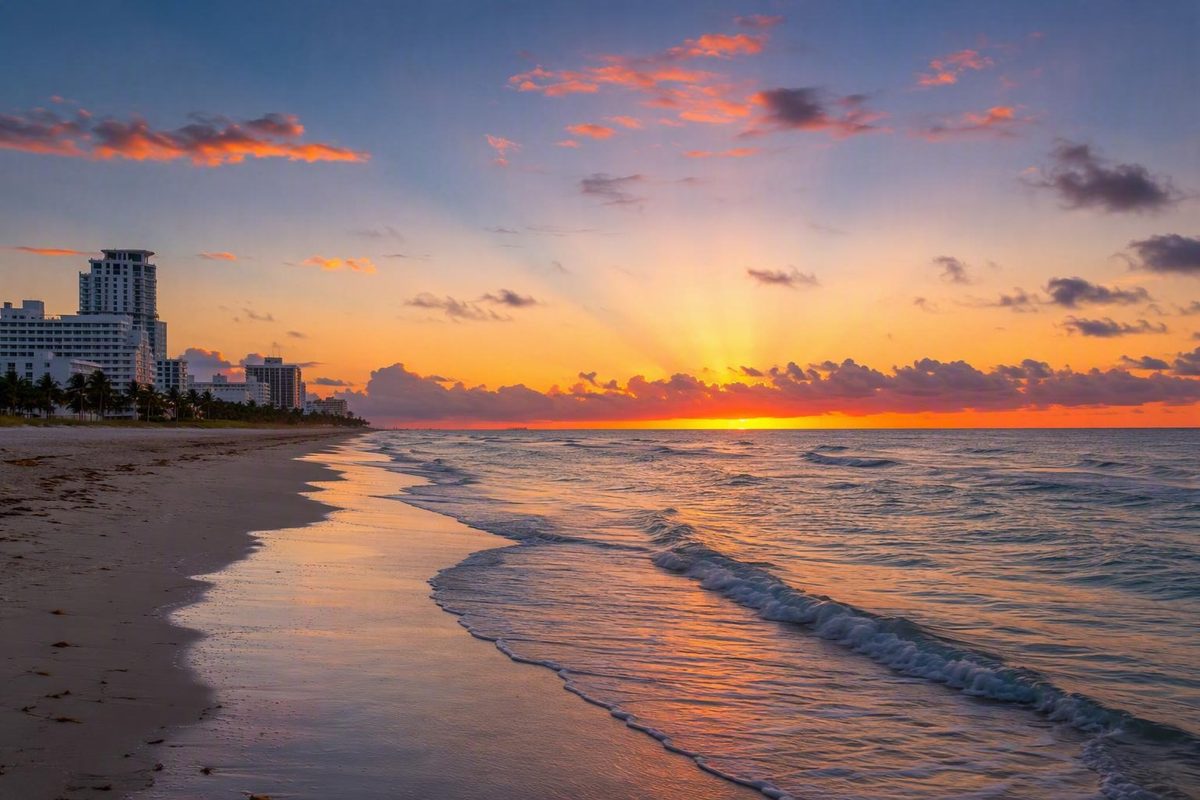
Choose the exact date, use local Eastern time, arrive during civil twilight, face the Atlantic horizon, and verify weather and access.
Miami Beach sunrise does not occur at one fixed time. The useful answer depends on the calendar date, local Eastern time designation, twilight, viewing direction, weather, access, and the time needed to reach an unobstructed horizon.
This guide uses September 2, 2026 as a historical worked example. It is not a current or year-round sunrise answer. For another morning, select the relevant month and year in a Miami Beach-specific solar table, find the row for your date, and record the sunrise, civil-twilight start, and applicable local time designation before planning your route.
Related: South Pointe Park Miami: Hours, Things to Do & Visitor Guide.
Miami Beach sunrise time: the date matters
If you want to know what time sunrise is in Miami Beach, begin with the exact date. An undated answer—or a time copied from another week—can make you late.
Worked example: September 2, 2026
| Planning detail | Miami Beach result |
|---|---|
| Date | Wednesday, September 2, 2026 |
| Local time designation | Eastern Daylight Time |
| Civil twilight begins | About 6:37–6:38 AM |
| Sunrise | About 7:01 AM |
| Sunset | About 7:38 PM |
| Daylight | About 12 hours 37 minutes |
| Sunrise heading | About 81°, slightly north of east |
The dated Miami Beach solar table for September 2026 lists sunrise at 7:01 AM, sunset at 7:38 PM, and 12 hours, 37 minutes, and 19 seconds of daylight on September 2. It also identifies an 81-degree sunrise heading and a 6:37 AM civil-twilight start.
For practical plans, use times to the nearest minute. The supplied calculators do not agree at second-level precision, and conditions at the actual viewing point can matter more than a difference of several seconds.
The time designation matters as much as the date. The September 2 example uses Eastern Daylight Time, but a date at another point in the year may use standard time. Record the local Eastern designation displayed for the selected morning rather than copying an unlabeled clock time.
Be cautious with calculator labels such as “today” and “tomorrow.” Those labels reflect when a page was generated or viewed. A saved result can continue to show historical snapshot language after the date has passed. The calendar date—not a relative label—is the reliable field.
For a different date:
- Open a Miami Beach-specific daily or monthly solar table.
- Select the correct month and year.
- Find the row for your calendar date.
- Confirm that the location is Miami Beach rather than Miami or another nearby point.
- Record sunrise and civil twilight in local Eastern time.
- Round to the nearest minute for ordinary outing plans.
- Recheck the calculation if the trip date changes.
A useful shared note should keep the context together:
September 2, 2026 — Miami Beach, Florida — Eastern Daylight Time — sunrise approximately 7:01 AM
Sending only “7:01” leaves room for errors involving the date, location, or time zone.
How sunrise shifts through September
Sunrise is not at 7:01 AM throughout September. The Miami Beach table shows sunrise becoming progressively later during September 2026 while sunset moves earlier.
| Date | Sunrise | Sunset |
|---|---|---|
| September 1, 2026 | About 7:00 AM | About 7:39 PM |
| September 2, 2026 | About 7:01 AM | About 7:38 PM |
| September 30, 2026 | About 7:12 AM | About 7:08 PM |
These endpoints come from the date-by-date Miami Beach sun table. Across the month, the listed sunrise moves later by about 12 minutes, while sunset moves earlier by about 31 minutes.
That change is large enough to matter for photography, a timed walk, transport planning, or meeting another person at the shore. Someone visiting at the end of September should not set an alarm from an early-month example merely because both dates fall in the same month.
A daily calculation is therefore more useful than a broad seasonal window. “Around 7 AM in September” may be adequate in casual conversation, but it is not precise enough for deciding when to leave, when to set up equipment, or when the best predawn color may begin.
When saving or sharing a later result, preserve the full context:
September 30, 2026 — Miami Beach — local Eastern time — sunrise approximately 7:12 AM
Always calculate the actual date instead of estimating from the month or season.
First light, civil twilight and when to arrive
Official sunrise is not the moment when the sky first begins to brighten. Increasing light develops through astronomical, nautical, and civil twilight before the sun crosses the modeled horizon.
For the September 2 worked example, the morning sequence is:
| Stage | Approximate local time |
|---|---|
| Astronomical twilight begins | 5:42 AM |
| Nautical twilight begins | 6:10 AM |
| Civil twilight begins | 6:37–6:38 AM |
| Sunrise | 7:01 AM |
The Almanac’s Miami Beach twilight reference defines these stages by the position of the sun’s center below the horizon: astronomical twilight begins at 18 degrees below, nautical twilight at 12 degrees below, and civil twilight at 6 degrees below. The dated Miami Beach table establishes the September 2 timing used in the worked example.
What the twilight stages mean
Astronomical twilight is the earliest listed stage. The sun remains well below the horizon, and conditions are still comparatively dark. This period may interest photographers preparing long before dawn, but most casual viewers do not need to arrive this early.
Nautical twilight begins when the sun’s center reaches 12 degrees below the horizon. The horizon and larger landscape forms become easier to distinguish, although the scene remains dim.
Civil twilight begins when the sun’s center reaches 6 degrees below the horizon. For many visitors, this is the most useful arrival marker: the sky is brightening noticeably, but the sun has not yet crossed the horizon.
On the example date, civil twilight begins about 23–24 minutes before sunrise.
A practical arrival time
For September 2, a reasonable target is to be in position around 6:35–6:40 AM EDT. That window is editorial planning guidance based on the start of civil twilight; it is not a separate astronomical event.
“Arrive” should mean that you are already at the horizon-facing viewing spot—not entering a parking area, waiting for a ride, or starting a substantial walk. Add separate time for:
- leaving your accommodation;
- walking to the shore or viewing point;
- waiting for transit or a hired ride;
- locating the intended entrance;
- handling parking, where relevant;
- finding an unobstructed position;
- setting up a camera or tripod.
The required margin depends on the route and viewing point. The supplied evidence does not establish current predawn access, parking, facilities, or transport service for a particular entrance, so verify those details close to the visit.
Where to face and why calculators differ
For the September 2 example, the calculated sunrise heading is about 81 degrees. Due east is 90 degrees, so this places the sun slightly north of due east. A nearby Miami calculation also reports the rounded 7:01 AM time and 81-degree heading in its daily sun-position data.
In practical terms, choose an open Atlantic-facing horizon and look generally east with a slight turn toward the northeast. You do not need to hold a compass at exactly 81 degrees. The important task is to avoid a blocked horizon and position yourself where the ocean-facing sky is visible.
Do not generalize the 81-degree heading to every date. The point where the sun rises along the horizon changes during the year. Check the heading for the selected morning if composition matters—for example, if you want the sun aligned with a pier, palm, building, lifeguard tower, or another foreground feature.
Why one calculator may say 7:01 and another 7:02
The Miami Beach references round the worked-example sunrise to 7:01 AM. A coordinate-based page for South Beach instead reports 7:02:15 AM EDT for September 2, using a point near latitude 25.7826 and longitude −80.1341, as shown in the South Beach calculation.
That discrepancy does not automatically make either result useless. Small differences can arise from:
- the latitude and longitude selected;
- whether the location represents Miami, Miami Beach, or a specific South Beach point;
- rounding to whole minutes;
- the precision displayed;
- atmospheric-refraction assumptions;
- assumed elevation and horizon conditions;
- the mathematical method used.
A second-level result may look more authoritative, but it is not necessarily definitive for every point in Miami Beach. Clouds and physical obstructions can also delay the moment when the sun becomes visible, even though the calculated crossing time has passed.
Miami is nearby, but it is not Miami Beach
Miami, Miami Beach, and South Beach are different calculation points. A Miami result may serve as a general area approximation, but it should not be presented as a Miami Beach-specific calculation.
One Miami calculator identifies its coordinates and Eastern Daylight Time zone while noting that nearby Miami Beach results may differ by seconds to a couple of minutes in its location details.
For an ordinary outing:
- Use one reputable Miami Beach-specific source consistently.
- Work to the nearest minute.
- Treat a one- or two-minute discrepancy as normal planning variance.
- Arrive during civil twilight rather than targeting a second-level time.
If precise photographic alignment matters, choose coordinates close to the intended shooting position, check the date-specific heading, and still arrive early enough to adjust.
Supported places to watch sunrise in Miami Beach
The basic location test is whether the viewing point offers an open east-facing or east-northeast view toward the Atlantic. Access, foreground, walking distance, and the kind of setting you prefer will determine which area is most practical.
It is important to distinguish Miami Beach locations from alternatives elsewhere in Miami-Dade County. Key Biscayne may appear in broader Miami sunrise lists, but it is not part of Miami Beach.
South Beach
South Beach is a straightforward option for an Atlantic-facing sunrise. A 2022 commercial local-interest article recommends both South Beach and Bal Harbour for ocean sunrise views in its Miami-area location roundup. That supports the existence of the recommendation, not a claim that either area is objectively the best.
For a South Beach morning, choose a viewing area based on where you are staying and the current access conditions. If an appropriate ocean-facing stretch is within a practical walk, a longer predawn transfer may add complexity without improving the basic horizon view.
The 2022 article does not establish present entrance conditions, parking rules, lighting, facilities, or crowd levels. Verify those separately before leaving.
South Pointe Park
It is listed as a park, pier, and boardwalk attraction at 1 Washington Avenue, Miami Beach, Florida 33139. Individual visitor reports from 2018 described it as a good sunrise location, and one reviewer reported encountering relatively few people at dawn, according to the South Pointe Park review page.
Those comments are anecdotal snapshots from 2018. They do not establish current crowd levels, parking policy, access, cleanliness, lighting, facilities, or operating conditions.
The park setting may appeal to visitors who want a pier, boardwalk, or landscaped foreground rather than only an open stretch of sand. Confirm which parts of the park and surrounding routes are available at the intended arrival time.
Bal Harbour
Bal Harbour, at the northern end of Miami Beach, is another third-party recommendation for an ocean sunrise. It may be a practical area to consider if your accommodation is already in the northern part of the city.
As with South Beach, the recommendation supports the general viewing concept rather than current operational details. “Bal Harbour” describes an area; it does not guarantee that every path or entrance will be accessible before dawn.
Nearby alternatives are not Miami Beach locations
Broader Miami-area lists may include Bill Baggs Cape Florida State Park and Crandon Park on Key Biscayne, as well as places elsewhere in Miami-Dade County. They can be considered separate regional alternatives, but they should not be described as Miami Beach viewing points.
That distinction affects both travel and timing. Do not pair a Miami Beach sunrise calculation automatically with a location on another island or elsewhere in the county. Recheck the coordinates, access requirements, route, and departure time for the actual destination.
Verify before choosing a viewing point
Because operational details can change, use current official city, park, parking, transit, and local-alert channels to confirm:
- Access hours: Is the intended beach entrance, park, pier, or boardwalk available at the planned time?
- Parking regulations: What rates, restrictions, and enforcement periods apply?
- Temporary closures: Are maintenance, construction, events, weather damage, or emergency measures affecting the area?
- Accessibility: Does the route from the arrival point to the viewing position meet your mobility needs?
- Facilities: Will any needed restrooms or other facilities be available before sunrise?
- Transport: Does the intended service operate early enough on that day?
- Horizon: Does the exact position provide an unobstructed eastern view?
Do not rely on an old review for free parking, quiet conditions, or guaranteed access.
Weather and horizon checks before leaving
It does not guarantee that you will see the solar disk at that minute.
Clouds near the eastern horizon are an obvious complication. The sky overhead may look clear while a low offshore cloud bank hides the sun. Rain or fog can also reduce visibility, while buildings, vegetation, dunes, temporary structures, or parts of a pier can obstruct the horizon from a specific position.
A 2022 promotional location article suggests that clear skies, lower rain chances, and limited fog favor viewing. That is reasonable as broad planning guidance, but the article is not a weather authority and should not replace a current forecast.
Check more than the daily weather icon
On the morning of the outing, consult a current recognized weather service and review:
- hourly cloud cover near civil twilight and sunrise;
- precipitation timing and probability;
- fog or reduced-visibility information;
- severe-weather or marine alerts relevant to the shoreline;
- wind conditions that may affect comfort or equipment;
- current beach, park, or emergency notices;
- temporary restrictions at the selected access point.
A daily “sunny” or “cloudy” icon may not reveal whether the eastern horizon will be clear at the relevant minute. Hourly conditions are more useful when available.
No forecast can promise a visible sunrise. Thin or broken clouds may add color, while a narrow offshore cloud bank may conceal the sun despite otherwise pleasant weather. Treat the forecast as a decision aid, not a guarantee.
If the outlook is poor, crossing the city to another beach may not solve the problem. Widespread cloud or rain may affect the broader area, and the extra journey can consume the part of the morning you intended to enjoy. A nearby fallback is generally simpler.
Check access alerts along with the forecast. Clear weather is not enough if a temporary restriction prevents you from reaching the selected viewpoint.
A simple dawn plan for car-free visitors
A sunrise outing without a rental car is easiest when it begins close to your Miami Beach base. Avoid unnecessary movement across the city before dawn unless a particular composition or destination justifies the additional travel.
Miami Finder’s car-free Miami planning approach recommends selecting a base, grouping activities by neighborhood, and combining walking, transit, and short hired rides. Applied to sunrise, that means choosing a nearby Atlantic-facing area and keeping breakfast or the next activity in the same part of Miami Beach.
Sample sequence for September 2, 2026
The night before
- Confirm the selected calendar date.
- Use the worked-example result of approximately 7:01 AM EDT for sunrise.
- Note that civil twilight begins at approximately 6:37–6:38 AM.
- Choose an Atlantic-facing viewing area near your accommodation.
- Verify current access and local alerts.
- Check the operating schedule for any transport you intend to use.
- Review the hourly weather outlook.
- Estimate travel time and add a margin instead of aiming for the exact twilight minute.
On the morning
- Recheck clouds, rain, fog, wind, and local alerts before leaving.
- Walk, use scheduled transit, or take a short hired ride according to the actual route and operating conditions.
- Aim to reach the viewing position around 6:35–6:40 AM.
- Find an open horizon rather than stopping at the first convenient point.
- Face generally east, slightly north of east for this date.
- Watch the sky brighten through civil twilight.
- Expect the calculated sunrise near 7:01 AM, while allowing for clouds or obstructions to delay when it becomes visible.
Do not assume that a bus, trolley, or other service operates early enough. Check the provider’s schedule for the relevant day. If no suitable service is available, compare walking with a short hired ride based on distance, conditions, and personal comfort.
Keep the rest of the morning local
After sunrise, avoid creating a schedule that immediately requires a long cross-city transfer. A walk, breakfast, or indoor stop near the viewing area reduces backtracking and keeps the morning flexible.
This neighborhood-based structure is especially useful when the forecast is uncertain. If the horizon is obscured, you have invested in a short local outing rather than a long trip to another district.
Miami Finder’s rainy-day planning guidance recommends keeping indoor anchors near the base and using short outdoor windows when conditions improve. For a sunrise morning, that can mean moving to a nearby indoor stop if the weather is poor and returning outdoors later instead of crossing Miami in search of uncertain visibility.
Reusable Miami Beach sunrise checklist
Before any sunrise outing, confirm:
- [ ] Exact calendar date
- [ ] Miami Beach-specific sunrise time
- [ ] Civil-twilight start time
- [ ] Applicable Eastern time designation
- [ ] Date-specific sunrise direction, if framing matters
- [ ] Current hourly weather
- [ ] Weather and local alerts
- [ ] Current access hours or restrictions
- [ ] Parking or transport arrangements
- [ ] Extra travel margin
- [ ] Unobstructed east-facing viewing point
- [ ] Nearby weather fallback
Frequently asked questions
What time was sunrise in Miami Beach on September 2, 2026?
The dated Miami Beach table calculated sunrise at approximately 7:01 AM Eastern Daylight Time. Sunset was near 7:38 PM, with approximately 12 hours 37 minutes of daylight. Those figures apply to the historical worked-example date, not to Miami Beach throughout September or the rest of the year.
How long before sunrise does civil twilight begin in Miami Beach?
For the September 2 example, civil twilight began around 6:37–6:38 AM, approximately 23–24 minutes before the 7:01 AM sunrise. The interval changes with the date, and displayed times may vary by about a minute because of rounding or calculation methods.
Is the Miami sunrise time the same as the Miami Beach sunrise time?
Not necessarily. Miami and Miami Beach are close enough that rounded results may sometimes match, but they are different calculation points. Coordinates, precision, atmospheric assumptions, and methodology can produce differences of seconds or a few minutes. Use a Miami Beach-specific result when that is where you will be watching.
Is South Pointe Park a supported place to watch sunrise?
Yes, with qualifications. South Pointe Park is listed at 1 Washington Avenue as a Miami Beach park, pier, and boardwalk setting, and individual visitors in 2018 recommended it for sunrise. Those reviews are anecdotal and do not establish present access, parking, facilities, safety, lighting, or crowd conditions.
Why do Miami Beach sunrise calculators differ by a minute or two?
Some calculate for Miami, others for Miami Beach, and others for a specific South Beach coordinate.
For practical planning, use one Miami Beach-specific source consistently, work to the nearest minute, and arrive during civil twilight rather than trying to reach the shore at a second-level sunrise time.
The reliable sequence is straightforward: choose the exact date, use a Miami Beach-specific calculation in local Eastern time, arrive around civil twilight, face the Atlantic-side horizon, and verify weather and access before leaving. In the historical September 2, 2026 example, that meant civil twilight near 6:37–6:38 AM EDT and sunrise near 7:01 AM EDT—not a permanent Miami Beach sunrise schedule.