
6 Historic Miami Landmarks to Visit, With Day Plans
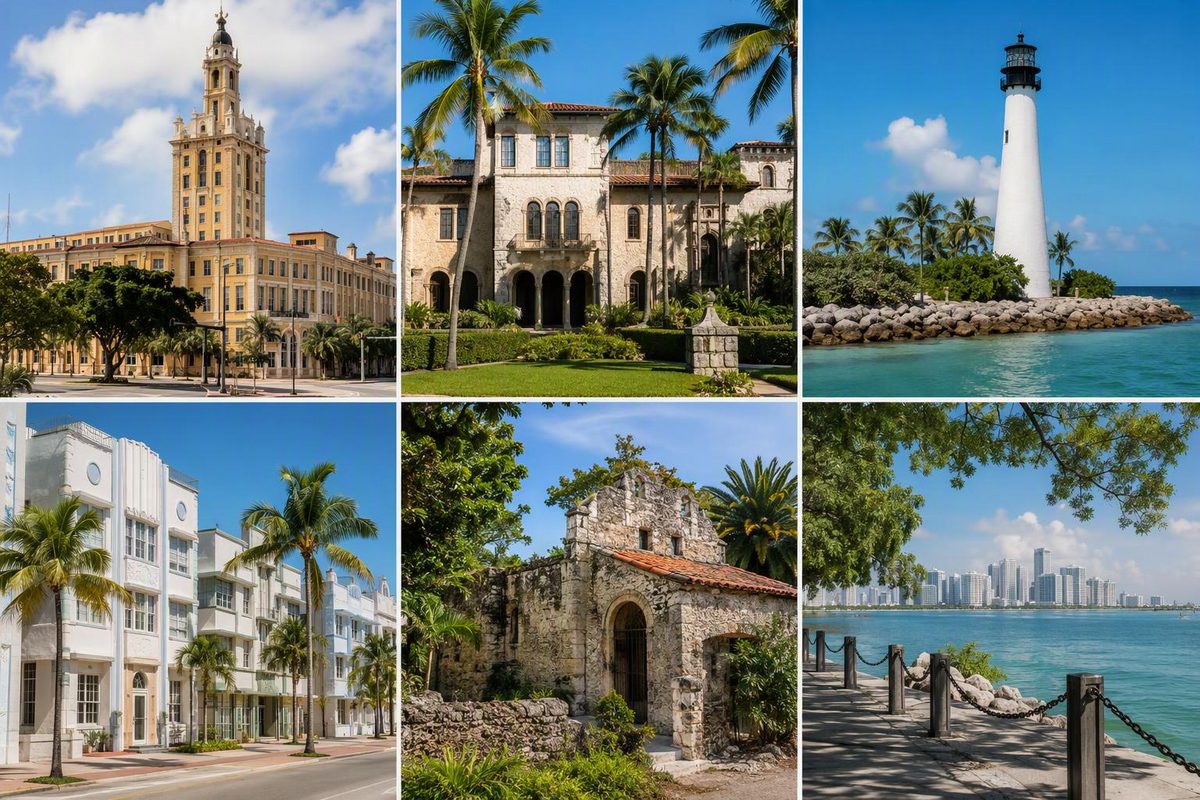
Choose six historic Miami landmarks, from Freedom Tower to Cape Florida Lighthouse, with admission details, access checks and practical day plans.
Choose Ocean Drive for recognizable architecture, Freedom Tower for Miami’s Cuban refugee history, or Vizcaya for a longer house-and-garden outing. Add the Lyric Theater, the Barnacle or Cape Florida Lighthouse according to where you’re staying and how much traveling you want to do.
These picks focus on historic landmarks across Greater Miami, not just the City of Miami: Ocean Drive is in Miami Beach, and Cape Florida Lighthouse is on Key Biscayne. Treat them as separate outings rather than stops on one continuous walk. For a broader mix of museums, street art and neighborhood sights, see our places to see in Miami guide.
Admission and access details below were checked October 11, 2026. Suggested visit lengths are planning allowances, not official tour durations.
1. Freedom Tower: Miami’s history beyond the skyline
Where: 600 Biscayne Boulevard, Downtown Miami Allow: 1–2 hours for the museum
Built in 1925 as the headquarters of The Miami News, Freedom Tower served as the Cuban Refugee Center from 1962 to 1974. It became a National Historic Landmark in 2008 and reopened after restoration in 2025. That history makes it more than a building to photograph from the sidewalk. Miami Dade College’s history explains its significance.
The museum is open Wednesday–Sunday, 10 a.m.–6 p.m., subject to college holidays and events. General admission is $18, with discounted and free-admission categories listed on the official ticket page. Check the visit schedule before setting off.
This is a straightforward car-free landmark: take the free Metromover to Freedom Tower station on the Omni Loop, as the museum’s directions page recommends. It is also the strongest indoor anchor on this list when rain interrupts an outdoor day.
2. Ocean Drive’s Art Deco hotels: the classic Miami Beach streetscape
Where: South Beach, Miami Beach Allow: 45–90 minutes independently, or two hours guided
This landmark is a streetscape rather than one building. Focus on Ocean Drive between 5th and 15th streets, where the Colony, Breakwater and former McAlpin hotels are recognizable examples. Look for geometric ornament, nautical details, window-shading “eyebrows” and neon signs—not just pastel paint. The tourism bureau’s Art Deco introduction identifies the main stretch and its characteristic features.
Viewing façades from public sidewalks does not require an attraction ticket. For interpretation and selected interior stops, the Miami Design Preservation League offers a two-hour, approximately 1.5-mile guided walk from 1001 Ocean Drive. Its standard adult price, for ages 18–64, is $50. Reserve through the official tour page.
Keep this outing on your Miami Beach day. Start with a shorter walk if heat is draining, and use our Art Deco District walking guide to build a self-guided route.
3. Vizcaya Museum and Gardens: a waterfront estate, with a restoration trade-off
Where: 3251 South Miami Avenue, Miami Allow: 2–3 hours
Industrialist James Deering first took up winter residence here on Christmas Day in 1916. The Mediterranean-style Main House, formal gardens and monumental boat-shaped Barge on Biscayne Bay make Vizcaya a substantial architectural visit, not a quick photo stop. See the museum’s Main House overview for the estate’s design and history.
Restoration changes the current experience. Vizcaya’s 2026 notice lists some closed interior spaces and garden areas, plus scaffolding on two Main House façades and over the Swimming Pool Grotto. Read the construction notice if unobstructed architecture photographs are your main reason for going.
During restoration, admission is $20 for ages 13 and over, $10 for ages 6–12, and free for children five and under, according to the admission page. The estate has steps and uneven surfaces; visitors with mobility needs should also review its accessibility guidance.
For a car-free visit, take Metrorail to Vizcaya station, then use the pedestrian overpass across US 1. The museum estimates a 10-minute walk to its entrance and supplies step-by-step directions.
4. Historic Lyric Theater: an anchor of Black Miami
Where: 819 NW Second Avenue, Overtown Allow: 20–30 minutes for the exterior and marker; longer for confirmed programming
Geder Walker built the Lyric Theater in 1913. It became a major entertainment venue for Miami’s Black community and an anchor of the district known as “Little Broadway.” A historic marker unveiled in March 2025 recognizes that legacy. The Black Archives documents both on its historic-marker page.
For an interior visit, arrange access rather than assuming you can wander in. The operator offers group tours by request; its contact page lists weekday business hours, weekends by appointment and federal-holiday closures. Business hours are not a promise of a public theater tour.
Pair it with Freedom Tower for a history-focused Downtown–Overtown outing. Our Overtown history and landmarks guide provides broader neighborhood context.
5. The Barnacle: a smaller historic-house visit
Where: 3485 Main Highway, Coconut Grove Allow: 1–1.5 hours with a house tour
Built in 1891, the Barnacle was the home of Ralph Middleton Munroe. Its wooded grounds and Biscayne Bay setting offer a different scale of history from Vizcaya’s grand estate.
The park opens Thursday–Monday, 9 a.m.–5 p.m.; the house interior is accessible only by guided tour, scheduled at 10 a.m., 11:30 a.m., 1 p.m. and 2:30 p.m. Park entry is $2 per person, with a $3 house-tour charge for ages 13 and over—$5 total for an adult visiting both. The state park page lists holiday closures and children’s fees.
Choose it for a lower-cost visit within a Coconut Grove day. If combining it with Vizcaya, plan a separate transfer between the two rather than assuming both entrances sit beside the same rail station.
6. Cape Florida Lighthouse: plan around the climb
Where: Bill Baggs Cape Florida State Park, Key Biscayne Allow: Half a day with the surrounding park
First erected in 1825, Cape Florida Lighthouse suits visitors who want coastal history and elevated views. The practical distinction is between entering the park and entering the tower.
Tower tours currently run Thursday–Monday, 10 a.m.–noon, and are free with park admission. The climb involves 109 spiral steps and narrow spaces. Children climbing the stairs must be at least 42 inches tall and able to climb independently; the park separately permits infants carried in a harness, with the adult’s arms free to use the handrail. Check the lighthouse access details before promising a climb to your group.
The park opens at 8 a.m. and closes at sundown. Entry costs $8 per vehicle carrying two to eight people, $4 for a single-occupant vehicle, or $2 per person arriving on foot, by bicycle or by ride-service drop-off. See the official fees.
Make this a separate Key Biscayne outing and arrive before the tower’s short opening window. If adding swimming, note that the park’s beach has no lifeguards, according to its amenities page.
Turn the shortlist into a workable day
- Staying in Downtown or Brickell: Start with Freedom Tower. Add the Lyric Theater after confirming access, or keep it as an exterior-and-marker stop. Wednesday–Friday offers overlap between the museum’s opening days and the Black Archives’ business days, excluding holidays and other closures.
- Staying in South Beach: Make Ocean Drive your main landmark walk rather than crossing the bay repeatedly. Use the cooler part of your day for walking and leave time for an indoor break.
- Choosing historic houses: Combine Vizcaya and the Barnacle only with a transfer and a Barnacle tour time in mind. Check both venues’ schedules for your chosen date.
For connections between your base and these areas, use our car-free Miami planning guide.