
How to Explore One of Miami's Most Important Black Heritage Neighborhoods
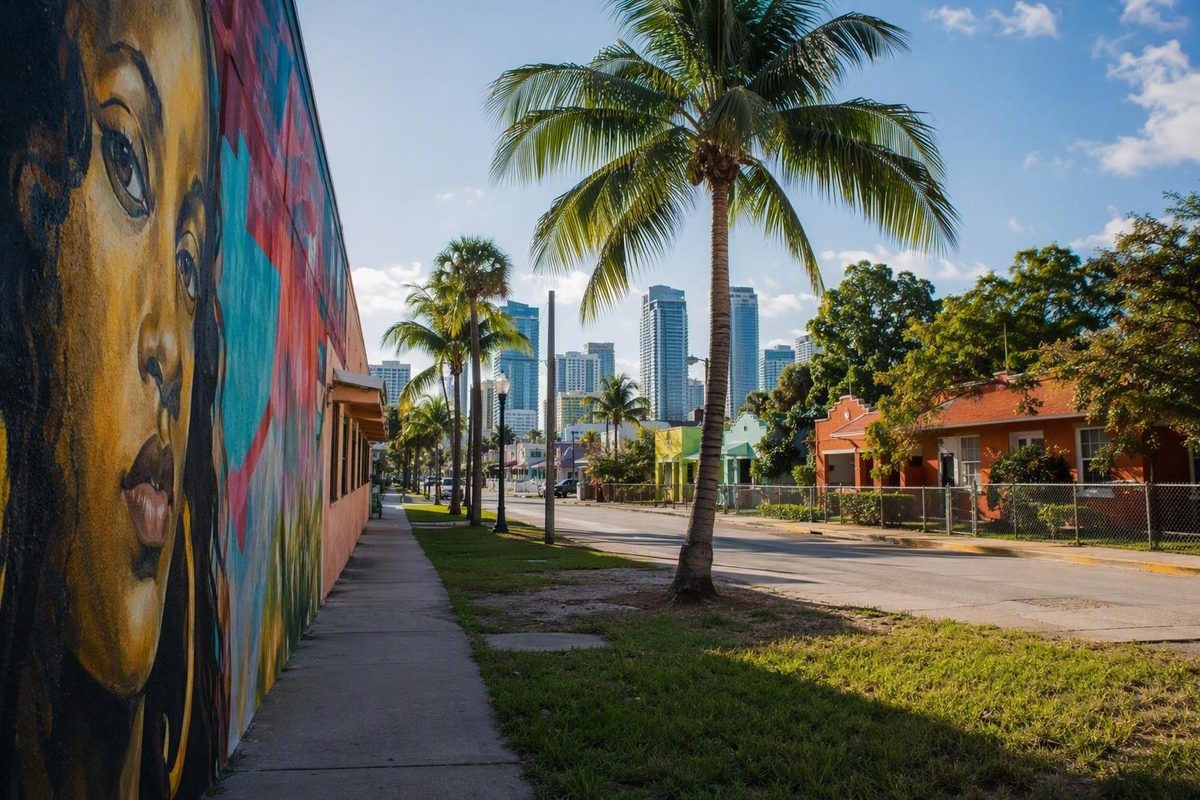
See how construction of I-95 and I-395 removed homes, displaced thousands and divided streets. Then plan a car-free visit with access checks.
Overtown is more than a cluster of historic sites near Downtown Miami. It is a living neighborhood where Black residents, workers, entrepreneurs, educators, clergy, artists, performers, and organizers helped shape the city—and where highways and redevelopment later disrupted homes, businesses, and community networks.
A thoughtful visit therefore begins with context. The Historic Lyric Theatre and Northwest Second Avenue are useful entry points, but they tell only part of a larger story involving segregation, Black enterprise, worship, education, lodging, civic institutions, displacement, preservation, and continuing community life.
This guide offers a history-led framework rather than a route-tested itinerary. It introduces Overtown’s principal heritage landmarks, suggests flexible ways to explore without a car, and explains which time-sensitive details to confirm before arriving.
Overtown at a glance: location, identity, and what this guide covers
Overtown is a historically Black neighborhood immediately northwest of Downtown Miami. For practical orientation, look to the Historic Overtown/Lyric Theatre Metrorail station, Northwest Second Avenue, nearby MiamiCentral, and the I-95 and I-395 corridors. The neighborhood’s general position relative to Downtown is reflected in the Apple Maps listing for Overtown.
One commonly cited definition places Northwest 20th Street to the north and Northwest Fifth Street to the south, with the Miami River, Dolphin Expressway, and I-95 on the west and the Florida East Coast Railway and Northwest First Avenue on the east. Treat this as a general description, not an uncontested official boundary used by every resident, agency, preservation district, or map provider. The boundary set appears in a tertiary historical overview of Overtown.
Four reference points are especially useful for visitors:
- Downtown Miami lies immediately southeast of Overtown.
- Historic Overtown/Lyric Theatre station is the main local rail anchor for the heritage area.
- MiamiCentral provides a nearby regional-rail reference point on the downtown side.
- I-95 and I-395 visibly mark the infrastructure that fragmented earlier residential and commercial streets.
Overtown should not be approached as an open-air museum, a self-contained entertainment district, or a collection of photogenic remnants. People live, work, worship, study, gather, and operate organizations here. Some historic sites may admit visitors only during exhibitions, scheduled programs, or confirmed appointments. Others are meaningful to view from public space but may not offer regular interior access.
A first visit is most rewarding when you focus on relationships rather than the number of stops completed. Ask how theaters connected to nearby hotels and restaurants, how churches and schools supported community life, how rooming houses accommodated Black travelers, and how highways interrupted once-continuous residential and business streets.
This guide covers:
- Overtown’s development under segregation;
- the rise of Northwest Second Avenue as a commercial and entertainment corridor;
- the effects of highway construction and urban renewal;
- surviving heritage institutions and public art;
- compact and expanded visit formats;
- car-free access from Downtown and Miami International Airport;
- and responsible conduct in an active residential neighborhood.
Current population figures are intentionally omitted. Older census totals should not be presented as measurements of Overtown today.
From Colored Town to a center of Black Miami
Overtown’s origins are tied to Miami’s incorporation in 1896 and the racial segregation governing the young city. The district assigned to Black residents became known as Colored Town—a historical name reflecting the racial language and order of the period, not a term visitors should casually apply today. Black participation was essential to Miami’s incorporation and development, even as Jim Crow restrictions sharply constrained where Black Miamians could live, stay, shop, and gather.
The community included migrants from the American South and immigrants from the Bahamas, the wider Caribbean, Latin America, and South America.
That history should not be romanticized. Segregation was not beneficial because a strong Black district emerged under it. Overtown’s businesses and institutions represented community achievement in response to exclusion—not evidence that exclusion produced fair opportunity.
Residents developed a concentrated network of homes, schools, churches, shops, professional offices, restaurants, rooming houses, social organizations, entertainment venues, and civic institutions. That concentration allowed many everyday needs to be met within the community, but it also resulted partly from restrictions on housing, commerce, and mobility elsewhere.
By the neighborhood’s commercial peak, historical accounts describe hundreds of mostly Black-owned businesses operating there. This is an estimate of an earlier business ecosystem, not a count of businesses or ownership patterns in Overtown today.
Famous musicians form only one part of that history. A performance district could not function without the surrounding residential and commercial community.
Entrepreneurs provided goods and professional services within a city that restricted Black opportunity. Churches created durable spaces for worship and community gathering.
Education was another pillar of neighborhood life. Booker T. Washington High School became an important institution for Black students in segregated South Florida. Its place in Overtown’s history is a reminder that the neighborhood was never simply a nightlife destination. It was where families built lives and institutions across generations.
Overtown’s importance comes from the density of these relationships. Commerce, education, lodging, worship, entertainment, employment, and civic life reinforced one another. Northwest Second Avenue became the most famous expression of that ecosystem, but the surrounding community sustained it.
Why Second Avenue became Little Broadway
Northwest Second Avenue developed into Overtown’s most prominent business and entertainment corridor. Theaters, clubs, restaurants, shops, professional services, and lodging establishments created a concentration of activity often described as Little Broadway or the Broadway of the South. Some accounts also call Overtown the Harlem of the South.
Sources use these names somewhat interchangeably. They do not establish one definitive label, a clear sequence in which the names appeared, or universal agreement about which streets and years each term covered. It is safest to understand them as historical descriptions of Overtown’s commercial and cultural importance rather than formal districts with fixed boundaries.
The corridor’s reputation rested on more than performances. During its peak years, visitors encountered a broader Black commercial environment: places to eat, sleep, shop, meet friends, obtain services, attend church, and conduct business. Nightlife flourished because a functioning neighborhood surrounded it.
Segregation also shaped Overtown’s connection to Miami Beach. Black performers could appear at prominent beach venues but were prevented from staying at many of the resorts where they worked. Overtown offered accommodation, food, social life, and additional stages. Performers associated with the neighborhood include Ella Fitzgerald, Billie Holiday, Count Basie, Cab Calloway, Josephine Baker, Louis Armstrong, and Nat King Cole. Miami’s destination guide describes the role Overtown played for Black performers excluded from Miami Beach lodging in its overview of Historic Overtown.
This history complicates the glamour associated with Little Broadway. The concentration of talent was real, but so was the discrimination that redirected Black performers across the bay after their shows. Celebrating the music without acknowledging that contradiction turns a history of exclusion and community response into a simple nightlife story.
Black travel history adds another dimension. Overtown hotels appeared in the Green Book, which helped Black motorists identify accommodations and services during segregation. The historical connection is documented, but it does not support a complete present-day inventory of former Green Book properties. The Green Book is best used as context for understanding mobility and lodging discrimination rather than as a basis for unsupported claims about individual buildings. The connection is discussed in the Segregation by Design history of Overtown.
Completed in 1913, it became an anchor on Second Avenue and remains central to public interpretation of the neighborhood’s history. Its construction date and later association with the Black Archives are summarized in an Overtown neighborhood guide.
The Lyric is best understood as part of a network. Its audiences needed transportation, meals, lodging, and places to gather. Performers worked within a district supported by venue owners, employees, musicians, residents, and neighboring businesses.
Standing near the theater today, consider not only who appeared onstage but also what kind of community was required to make that cultural life possible. Little Broadway describes both visibility and density: a corridor where performance, enterprise, travel, and social life intersected under profoundly unequal conditions.
How highways and urban renewal remade Overtown
One of the most important historical lessons in present-day Overtown is visible outside its museums: the relationship between the remaining streets and the massive highway infrastructure overhead and around them.
Beginning in the late 1950s and continuing through the 1960s, highway construction and related urban-renewal projects removed homes and businesses, displaced thousands of residents, and fractured Overtown’s physical and commercial continuity. I-95 and I-395 were not the only interventions. Institutional expansion, redevelopment projects, property clearance, and parking also transformed the neighborhood.
Government authorities used eminent domain to acquire property for highways and associated projects. Former residential and commercial land was converted to transportation infrastructure, institutional uses, redevelopment sites, and parking. Buildings disappeared, blocks were divided, and familiar routes between homes, businesses, churches, schools, and social spaces became difficult or ceased to exist.
Segregation by Design, an advocacy-oriented historical project, estimates that I-95 construction directly relocated more than 12,000 Overtown residents. It also reports a broader population decline from roughly 50,000 people to around 10,000 after highway construction. These are approximate historical estimates, and the project does not provide a complete parcel-level explanation of how every total was calculated. Its account also documents the use of eminent domain during the 1960s.
The two figures should not be treated as interchangeable. The direct-relocation estimate concerns people reportedly removed for a particular highway project. The broader population decline may reflect formal relocation, demolished housing, reduced residential capacity, business loss, departure following neighborhood disruption, and other changes over time. Subtracting one population estimate from another does not establish how many people were formally displaced through eminent domain.
The historical record presented by that project also does not identify where every affected family went. That gap should not be filled with assumptions.
Compensation requires similar care. Former residents’ testimony and the advocacy account criticize the treatment of owners and renters, but they do not provide a comprehensive acquisition record for every property. It would therefore be too broad to say that all owners received identical compensation or that every renter had exactly the same experience.
Historian N.D.B. Connolly has interpreted the displacement associated with highway construction, urban renewal, and clearance as intentional rather than an accidental planning failure. That is an attributed historical interpretation. Visitors should distinguish it from the physical outcomes documented across accounts: property acquisition, demolition, displacement, highways, institutional projects, and parking.
Even without reducing the history to one exact number or motive, the consequences are clear. Neighborhoods depend on proximity and repetition: customers walking to familiar businesses, congregants reaching churches, children attending nearby schools, workers finding jobs, and relatives or neighbors supporting one another. Removing buildings and cutting through the street network damages those relationships as well as the structures themselves.
Commercial continuity was particularly vulnerable. A business corridor cannot function in the same way when its customer base is dispersed, nearby housing disappears, parcels are cleared, and pedestrian connections are interrupted. Overtown’s commercial decline cannot be explained solely by changing entertainment tastes or individual business decisions.
When visiting, look beyond surviving facades. Notice highway structures, parking areas, changes in block scale, gaps between landmarks, and land no longer used for housing or neighborhood commerce. What remains and what was removed must be considered together.
Heritage landmarks that connect the past to the present
Overtown’s landmarks make more sense when organized by the roles they played in community life. Rather than treating them as an attractions checklist, use each place to investigate a different aspect of the neighborhood’s history.
Performance, archives, and public memory
The Historic Lyric Theatre is the natural starting point. The 1913 venue represents Overtown’s history as a performance and business district. It is also associated with the Black Archives History & Research Foundation, connecting entertainment history with archival preservation and public interpretation.
The theater’s survival raises useful questions:
- Who built and operated cultural venues under segregation?
- Who made up their audiences?
- Which surrounding businesses supported a night at the theater?
- What did preservation require after highways and economic disruption altered the surrounding district?
The Black Archives History & Research Foundation preserves and presents Black history in South Florida. Its association with the restored Lyric means the building is not merely an architectural remnant; it also serves as a place through which the neighborhood’s history is interpreted.
Do not assume that seeing the exterior means every part of the building or archive is open. Performances, exhibitions, tours, and research access may follow different arrangements.
Law enforcement and segregated civic institutions
The Black Police Precinct and Courthouse Museum addresses the history of Black police officers and the segregated institution in which they served. Its subject is not simply individual achievement. It also concerns the unequal civic structure that produced a separate precinct and courthouse.
Consider:
- Why did segregation create a separate civic institution?
- What responsibilities did Black officers hold?
- How did they serve residents while operating inside an unequal system?
- What records and objects can a museum preserve that the streetscape cannot?
Allow the museum’s interpretation to guide the visit rather than arriving with a simplified celebration-or-condemnation narrative.
Lodging, travel, and adaptive reuse
The Ward Rooming House represents the importance of lodging in Overtown’s social and economic history. Rooming houses accommodated residents and travelers who faced restricted access elsewhere. Current neighborhood and tourism guides identify the building as a gallery space, making it an example of adaptive reuse rather than a return to its original lodging function.
That transition invites further questions:
- What survives when a historic building changes use?
- How can current exhibitions connect with earlier residents and travelers?
- Who decides which parts of the building’s history receive emphasis?
The Dorsey House, built in 1915 and associated with the Black Archives, provides another connection to Overtown’s residential and institutional history. Its construction date and Black Archives association are reported in the same commercial neighborhood overview of Overtown landmarks. Do not presume routine public access; include it in a plan only after confirming whether visits or programs are available.
Churches, education, and civic life
Historic churches demonstrate that Overtown’s community infrastructure extended beyond entertainment. Mount Zion Missionary Baptist Church and St. John Baptist Church are among the institutions associated with the neighborhood’s spiritual and civic landscape.
A church is not automatically a tourist attraction because it is historically important. It remains a place of worship and community gathering. Visitors should not interrupt services, enter restricted spaces, or photograph congregants without permission.
Booker T. Washington High School likewise belongs in Overtown’s historical frame even though it is not a conventional visitor stop. Schools reveal how Black Miamians built educational institutions within a segregated system. School grounds, students, and daily activities should be respected rather than treated as sightseeing subjects.
Murals and cultural landscape
Overtown’s public art includes work associated with Purvis Young, whose imagery became closely connected to the neighborhood.
Public art is not merely decoration between museum stops. It can serve as social commentary, neighborhood memory, and an assertion of presence. Look at where an artwork sits in relation to highways, vacant land, housing, businesses, and cultural institutions. The setting may be as important as the image.
Other murals and newer artworks also contribute to the neighborhood’s cultural landscape, but attribution and condition can change. Do not identify an artist from visual style alone. Check a plaque, institution description, or current community art guide.
Pre-visit verification checklist
Confirm opening hours, admission, exhibitions, reservations, tour availability, accessibility, and interior public access directly with each institution. Use an institution’s current page or contact channel rather than relying on an undated article, map pin, or social-media post. Active churches and schools should be treated as community institutions, not assumed visitor interiors.
A flexible, history-led way to visit Overtown
A meaningful visit does not require a rigid route or a promise that every landmark can be covered within a fixed number of hours. Access, weather, events, exhibitions, and individual mobility needs can all change the plan.
Begin by choosing one historical question you want the visit to answer. You might focus on Black enterprise, segregated travel, performance history, civic institutions, highway displacement, preservation, or adaptive reuse. A clear theme can make even a compact visit coherent.
Start around the Lyric Theatre and Second Avenue
Use the Historic Lyric Theatre as an orientation point whether or not an interior visit is available. Read the surrounding blocks as the remains of a larger commercial ecosystem rather than as empty space around one famous building.
Ask:
- What businesses once enabled this entertainment corridor to function?
- How did segregation bring performers and travelers to Overtown?
- What is preserved when a theater survives but much of its surrounding business environment does not?
- How can archives and cultural programs give an old venue a continuing role?
Observe the relationship among Second Avenue, the theater, neighboring buildings, rail infrastructure, and highway corridors. The value lies in reading the landscape, not rushing to the next map pin.
Add the Ward Rooming House if access is confirmed
If the Ward Rooming House has an exhibition or public program, use it to explore lodging history and adaptive reuse.
Ask:
- Who needed rooming houses, and why?
- How did lodging connect travelers with restaurants, clubs, theaters, and local businesses?
- What changes when a building associated with accommodation becomes a gallery?
If it is closed, an exterior view from public space may still provide context. Do not enter private or restricted areas.
Continue to the Black Police Precinct and Courthouse Museum
If the museum is open, it can broaden the visit beyond arts and entertainment.
Ask:
- Why did segregation produce a separate police precinct and courthouse?
- What responsibilities did Black officers hold?
- How did public service operate inside an unequal civic structure?
- What does the museum preserve that is no longer legible in the streetscape?
Consider the Dorsey House, churches, and public art
The Dorsey House can add residential and archival context if access is available. Historic churches can illustrate Overtown’s spiritual and civic foundations, but they should be approached as active institutions rather than casual interiors to browse.
Public art offers a flexible outdoor component. Instead of treating murals as backdrops, study their subjects and surroundings. Ask what the work communicates about neighborhood identity, movement, confinement, faith, or survival.
For current programs and community listings, consult the Going Overtown directory and calendar. Events, participating places, and listing totals can change, so confirm a program with its organizer before building a visit around it.
Include food with careful verification
Food can connect a visit with Overtown’s commercial history, but restaurant information is especially time-sensitive. Jackson Soul Food and Red Rooster Overtown have appeared in supplied destination guides, but an editorial listing does not establish current hours, reservations, menu, ownership, or operating status.
Before recommending or visiting either business, check its direct website, current contact details, and recent operating notices. Do not describe a restaurant as Black-owned or locally owned unless that status has been verified through a current, direct source.
A meal can complement the historical visit, but one operating restaurant should not be treated as evidence that Overtown’s earlier commercial ecosystem has been restored.
Two useful planning formats
Compact heritage visit
Center the visit on the Lyric Theatre and Northwest Second Avenue. Add the surrounding streetscape, nearby public art, and one institution with confirmed access.
The central question is: How did performance, commerce, lodging, and segregation combine to create Little Broadway?
Expanded neighborhood visit
Begin with the Lyric and Second Avenue, then add one or more institutions such as the Ward Rooming House or Black Police Precinct and Courthouse Museum. Depending on confirmed access, incorporate the Dorsey House, a historic church, public art, a meal, or a scheduled cultural program.
The central question is: How have Overtown’s residents and institutions responded to segregation, displacement, physical fragmentation, and the work of preservation?
Neither format requires a fixed duration. Build around confirmed openings, allow time for observation, and avoid plans that depend on unsupported walking times or guaranteed interior access.
Getting to Overtown without a car
Historic Overtown can fit into a car-free Miami trip because the neighborhood has a Metrorail station and sits near Downtown’s broader transit network. The main rail anchor for the heritage area is Historic Overtown/Lyric Theatre station, which places visitors near the Lyric Theatre area and Northwest Second Avenue.
MiamiCentral is nearby and serves Brightline and Tri-Rail connections. Proximity does not guarantee that every transfer will be direct, intuitive, sheltered, or effortless, particularly when carrying luggage or traveling during construction or service changes.
Metrorail connects with Metromover at Government Center and Brickell, supporting broader circulation through Downtown and Brickell. The relationship among Historic Overtown/Lyric Theatre station, MiamiCentral, Metrorail, Metromover, Brightline, and Tri-Rail is summarized in Visit Florida’s Miami transportation guide.
From Miami International Airport, the basic transit concept is to take the MIA Mover to the airport’s ground-transportation connection and then use the Orange Line toward central Miami. Verify the route, station sequence, transfer requirements, and operating status for your travel date.
Other options may include:
- Metrobus;
- City of Miami trolley service;
- rideshare or taxi service for gaps;
- and driving when Overtown is part of a trip that otherwise requires a car.
No route numbers, fares, frequencies, or operating hours are included here because those details can change. Before leaving, check the current information published by:
- Miami-Dade Transit;
- the City of Miami trolley service;
- Brightline;
- Tri-Rail;
- and any institution you plan to visit.
Review service alerts, station entrances, elevator status, weekend or holiday changes, transfer paths, and planned construction. Travelers with mobility needs should verify the complete journey rather than relying on a general statement that a station is accessible. Station access alone does not establish that every sidewalk, crossing, transfer, or venue entrance is step-free.
For broader trip structure, this guide to exploring Miami without renting a car explains how to group destinations by neighborhood and use transit for longer connections.
A car-free Overtown visit works best when the neighborhood is treated as a primary focus rather than one stop in a rapid sequence across Miami. Grouping nearby sites reduces transfers and creates more time to understand the area.
Preservation, investment, and visiting responsibly
Overtown today cannot be described accurately through a simple decline-and-renaissance story. Preservation, cultural programming, economic investment, redevelopment, and gentrification are related, but they are not interchangeable and do not necessarily benefit the same people.
- Preservation may protect a building, archive, artwork, or institutional history.
- Cultural programming may create performances, exhibitions, education, or public gatherings.
- Investment may bring funding, construction, businesses, or services.
- Redevelopment changes land use or the built environment.
A restored theater can preserve history without resolving affordable-housing questions. A new restaurant can attract visitors without showing who benefits from changing land values. A cultural event can bring attention to the neighborhood without guaranteeing durable support for resident-led institutions.
The sources used for this guide do not establish current rent trends, displacement rates, business-ownership patterns, or the effects of individual development projects. It would therefore be misleading to call Overtown’s present moment an uncomplicated renaissance—or to claim that every new investment necessarily harms residents.
What can be recognized is sustained preservation and interpretation involving theaters, archives, museums, galleries, churches, public art, community programs, and other neighborhood institutions. These efforts help maintain cultural memory, but they should not turn the area into a stage on which residents become background scenery.
Responsible visitor conduct is straightforward:
- Photograph buildings and public art thoughtfully.
- Ask permission before photographing identifiable residents.
- Do not intrusively photograph worshippers, students, people receiving services, or private homes.
- Follow museum, gallery, archive, church, and event rules.
- Stay out of restricted or private property, even when a historic building appears vacant.
- Avoid blocking sidewalks, entrances, driveways, or church access.
- Do not use neighborhood hardship as a dramatic social-media backdrop.
- Listen when guides, curators, clergy, artists, or residents explain how a place should be approached.
Spending in the neighborhood can be constructive when done carefully. Patronize businesses whose current operation and ownership you have independently confirmed. Where available, consider admission, donations, memberships, event tickets, or purchases from resident-led cultural organizations.
Use current community calendars and institution pages rather than treating previously announced festivals or events as permanent. Programs move, exhibitions rotate, businesses change hands, and reservation systems evolve.
Most importantly, allow the famous landmarks to lead outward. The Lyric Theatre can introduce performance history, but it should also raise questions about business owners, employees, audiences, and lodging. A police museum can lead to the wider history of segregated civic life. A rooming house can open a discussion about Black travel. A highway underpass can reveal the scale of physical disruption more clearly than a plaque alone.
Frequently asked questions
Where is Overtown in relation to Downtown Miami?
Overtown is immediately northwest of Downtown Miami. Historic Overtown/Lyric Theatre Metrorail station is the most useful transit reference point for the heritage area, while MiamiCentral is nearby on the downtown side.
Boundary descriptions vary. For visitor orientation, focus on Northwest Second Avenue, the Lyric Theatre, MiamiCentral, and the I-95 and I-395 corridors rather than assuming every map or preservation program uses the same outline.
Why is Overtown important to Black history in Miami?
Overtown developed under segregation in the district historically called Colored Town. Black residents built a concentrated center of housing, business, education, worship, lodging, civic activity, music, and nightlife despite restrictions on where they could live and participate in city life.
Its importance extends beyond the performers associated with Little Broadway. Workers, entrepreneurs, hoteliers, cooks, teachers, clergy, police officers, students, audiences, and community organizations sustained the neighborhood. Overtown also demonstrates how highway construction and urban renewal damaged Black communities through property clearance, displacement, and physical fragmentation.
What are the main historic places to see in Overtown?
The Historic Lyric Theatre is the principal starting point. Other significant places include the Black Police Precinct and Courthouse Museum, Ward Rooming House, Dorsey House, Mount Zion Missionary Baptist Church, St. John Baptist Church, and public art associated with Purvis Young.
These places represent different parts of Overtown’s history: entertainment, archives, segregated civic institutions, lodging, residential life, worship, education, and artistic expression. Confirm public access, exhibitions, tours, admission, reservations, and accessibility before visiting.
Can you reach Overtown by public transportation?
Yes. Historic Overtown/Lyric Theatre Metrorail station is the main rail stop for the heritage area. MiamiCentral is nearby for Brightline and Tri-Rail connections, while Metrorail connects with Metromover at Government Center and Brickell.
Metrobus and City of Miami trolley services may provide additional options. From Miami International Airport, the general approach is to use the MIA Mover and Orange Line toward central Miami. Check official operator information for current routes, fares, schedules, elevator status, and service alerts.
How did highway construction affect Overtown?
Construction of I-95, I-395, and related urban-renewal projects removed homes and businesses, displaced thousands of residents, divided streets, and weakened commercial and social networks.
Historical estimates of direct highway relocation and broader population decline measure different effects. Direct relocation refers to people removed for a project; population decline can also reflect demolished housing, reduced residential capacity, business loss, and departure after sustained disruption. The impact was both physical and social because highway infrastructure replaced or separated land that had connected customers, businesses, churches, schools, venues, and neighbors.
Overtown’s dual significance is what makes a visit worthwhile. It is a foundational center of Black Miami history and a living neighborhood shaped by residents today. Arrive with historical context, use transit when practical, verify every time-sensitive detail, spend locally where ownership is confirmed, and treat each landmark as an entry point into a larger story of enterprise, culture, displacement, preservation, and community continuity.