
How a Mask, Air Tube and Fins Let You Explore from the Surface
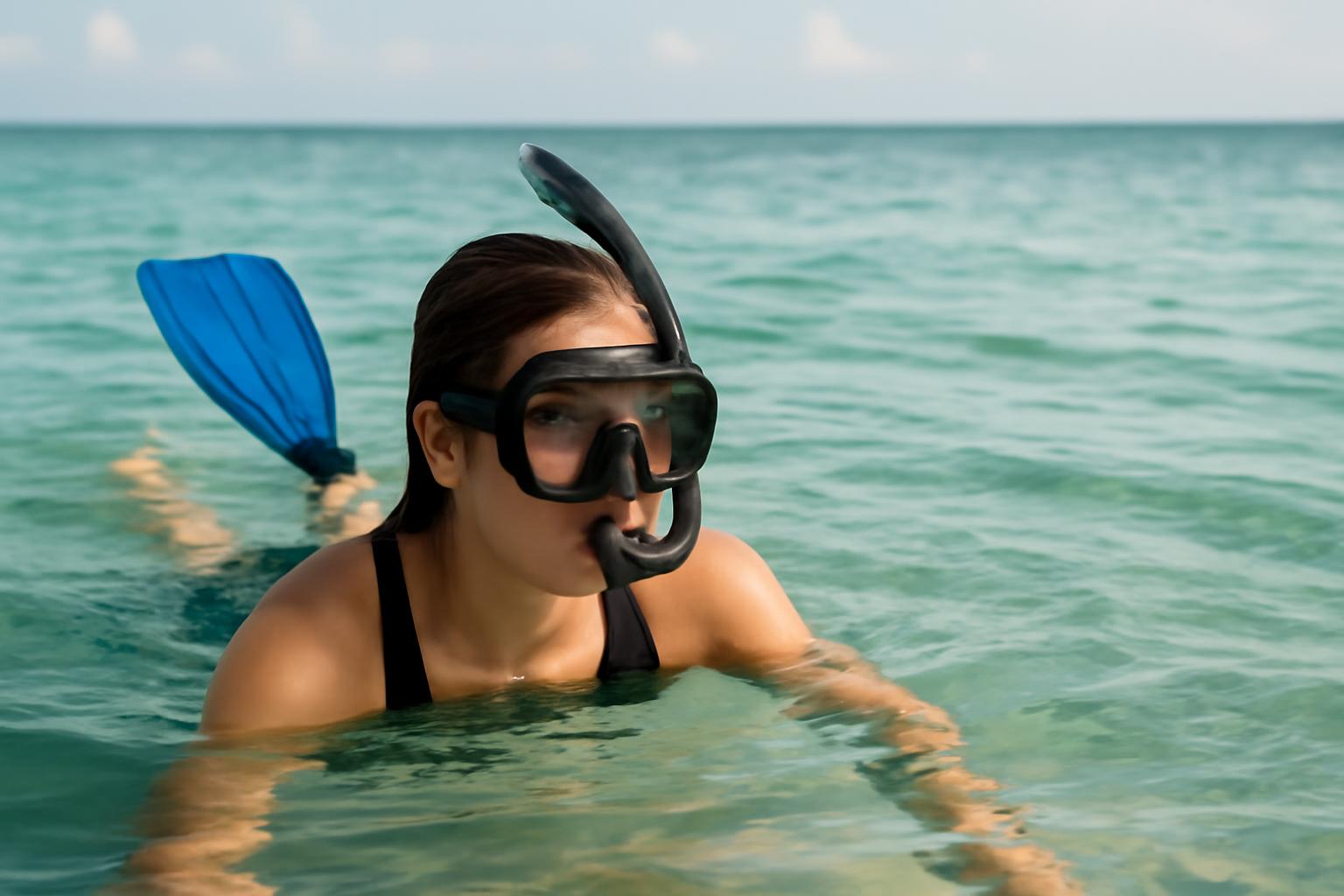
A dry snorkel may use a valve intended to close underwater, stopping both water and incoming air. The same flood protection blocks breathing below the surface.
How a mask, air tube and fins let you explore from the surface
The short answer: snorkeling is surface breathing, not underwater breathing
Snorkeling separates underwater viewing from breathing. The snorkeler floats or swims face-down near the surface, looks through a sealed mask and breathes atmospheric air through a short tube. The mouthpiece stays in the mouth while the snorkel’s inlet projects above the waterline.
The swimmer’s lungs perform all inhalation and exhalation. A snorkel contains no oxygen tank, air pump or pressurized supply; it is a passive airway connecting the mouth to the atmosphere. Continued breathing therefore depends on keeping its opening above the surface. This surface-air mechanism is the defining feature of snorkeling.
If the inlet dips underwater, an open snorkel can fill with water. A dry snorkel may have a valve intended to close when submerged, but that closure stops incoming air as well as water. It limits flooding; it does not create an underwater air supply.
A snorkeler who deliberately descends completely below the surface must hold their breath. Breathing through the snorkel can resume only after the person returns to the surface and restores the inlet to open air. Making the tube longer would not remove this limitation.
Here is a simplified side view:
                    Atmospheric air
                         ↕     ↕
                    [snorkel inlet]
                           |
---------------------------|---------------- waterline
                           |
                     snorkel barrel
                           |
                      [mouthpiece]  ← lungs inhale and exhale
                           \
             mask airspace  \____ body near horizontal
            [eyes and nose]       \____________
                                                  \  fins
                                                   ><  ><
The relationships that matter are:
- The mask airspace lets the eyes look through air rather than directly through water.
- The snorkel inlet remains above the waterline.
- Air moves both into and out of the tube as the snorkeler breathes.
- Buoyancy supports a near-horizontal surface position.
- The fins turn controlled kicks into propulsion.
Snorkeling does not provide unrestricted underwater breathing. It lets the face remain submerged while the airway stays connected to air above the surface.
How the mask, snorkel and fins work as one system
A standard snorkeling setup consists of a mask, snorkel and fins. Flotation or thermal protection may be added when the swimmer, site or water temperature calls for it, but neither is a universal requirement.
The mask creates a viewing airspace
Human eyes do not focus underwater as they do in air. A snorkeling mask addresses that practical problem by sealing around the eyes and nose and trapping an airspace in front of them. The wearer looks through the lens and this pocket of air into the water.
The flexible skirt around the mask must sit evenly against the face. Hair, facial hair, a folded skirt or an unsuitable mask shape can interrupt the seal. Because a conventional mask encloses the nose, the snorkeler can also exhale through the nose to clear a small amount of water from the mask.
The snorkel connects the mouth to surface air
A traditional snorkel is a short hollow barrel. Its upper opening remains in the atmosphere, while its lower end terminates in a mouthpiece held between the lips.
During inhalation, air travels from the open top through the barrel and mouthpiece into the lungs. Exhaled air travels back through the same basic airway. Some designs add a splash guard, dry-top valve or lower purge valve, but the fundamental mechanism remains a short connection to surface air.
The lips, rather than hard biting, form the seal around a conventional mouthpiece.
Fins turn controlled kicks into useful movement
This can reduce the need for large arm movements and helps the snorkeler maintain a quiet, streamlined surface position.
Efficient finning does not mean kicking as hard or as quickly as possible. Small, unhurried leg movements are easier to sustain than frantic splashing. Fins that rub, pinch, slip or contribute to cramping need to be adjusted, exchanged or removed after returning to stable support.
Buoyancy supports the surface position
Buoyancy helps support the body at the surface, but people do not all float in the same position or with the same degree of comfort.
A snorkel vest or another suitable flotation aid can add support, especially during calm, supervised practice. It should not be treated as a way to make rough water, strong currents or an unsuitable site acceptable. Beginner guidance consistently combines flotation with calm conditions, water confidence, close supervision and a nearby companion rather than presenting it as a substitute for them. A practical overview of equipment and buoyancy explains this supporting role.
Colder water may call for thermal protection. The appropriate choice depends on the water temperature, location, exposure time and individual, so a wetsuit should not be treated as automatically necessary or sufficient.
The system is therefore simple: the mask provides the viewing airspace, the snorkel carries surface air, buoyancy supports the body and the fins provide propulsion.
Why breathing through a snorkel feels different
Breathing through a snorkel may feel unfamiliar even when the equipment is functioning normally. Two properties of the tube help explain the difference: airflow resistance and respiratory dead space.
The tube adds resistance
When breathing in open air, there is no snorkel barrel between the mouth and the atmosphere. With a snorkel, air must travel through a relatively narrow passage and around any bends, guards or valves. Moving air through that pathway requires more effort than unobstructed breathing.
Making the barrel extremely wide would not solve every problem because a wider tube holds more air. Making it very narrow reduces its internal volume but increases resistance. Snorkel design must therefore balance retained air against the effort needed to move air through the tube.
Some exhaled air remains inside
After exhalation, some exhaled air remains in the snorkel. This retained volume is called respiratory dead space. At the beginning of the next inhalation, some of the air already inside the barrel may be drawn back before fresh atmospheric air arrives from the opening.
The retained air becomes proportionally more significant when the tube has a larger volume or the user takes relatively small breaths. Lengthening a snorkel would increase the volume of retained air and add resistance rather than making breathing at depth practical. A technical overview of snorkel mechanics describes these tube-length and breathing constraints.
For ordinary surface practice, use relaxed, steady mouth breathing rather than rapid, shallow panting. “Steady breathing” should not be interpreted as advice to hyperventilate or take repeated exaggerated breaths before a breath-hold descent.
If inhalation becomes unusually difficult, airflow appears blocked or breathing through the equipment becomes distressing, lift the face out of the water and breathe in open air. Alert the buddy, inspect the snorkel only from a stable position and end the session if comfortable airflow does not return. Do not remain face-down while repeatedly inhaling against an apparently closed or obstructed airway. Snorkel guidance identifies poor tube position, obstruction, fatigue and water conditions as factors that can make breathing or clearing more difficult.
Open-top, semi-dry, dry and full-face designs compared
Snorkel labels mainly describe how the equipment manages splashes and submersion. No design in this comparison provides a continuing air supply when its inlet is underwater.
| Design | Water-management feature | What happens during submersion | Advantages | Limitations |
|---|---|---|---|---|
| Open-top or wet snorkel | Unobstructed upper opening | Water can enter freely | Simple construction with few moving parts | More exposed to splashes and flooding |
| Semi-dry snorkel | Splash guard redirects some surface water | The opening remains unsealed and can flood | May reduce entry from spray or small waves | Does not guarantee a dry barrel |
| Dry snorkel | Float-operated or similar top valve | Valve is intended to close, stopping water and incoming air | May limit flooding during brief submersion | No breathing path while closed |
| Traditional snorkel with purge valve | Lower one-way drainage valve | Water may still enter through the top | Entered water may be easier to expel | Purge valve is not a dry top or an air source |
| Full-face snorkel mask | Integrated snorkel and design-specific air channels | Top valve commonly closes when submerged | Permits nasal or oral breathing at the surface | Fit and airflow depend on the complete design |
Open-top and semi-dry snorkels
An open-top snorkel is the simplest design: a hollow tube with an unobstructed upper opening. It has few moving parts, but splashes, waves or a submerged inlet can introduce water.
A semi-dry snorkel adds a splash guard intended to redirect some spray or surface chop. The guard does not seal the tube. If the inlet goes underwater, the barrel can still flood.
Dry snorkels
A dry snorkel uses a float or similar mechanism intended to close the upper opening when it submerges and reopen when it returns to the surface. Its purpose is to reduce water entry.
When the valve closes, there is no open path to atmospheric air. The snorkeler must hold their breath, return the inlet to open air and verify that normal airflow has resumed before continuing.
Purge valves
A purge valve is located near the lower part of some traditional snorkels. It gives water inside the barrel a lower drainage route, so exhalation can push water through the valve rather than forcing all of it out through the top.
The two valves perform different jobs:
- A dry-top valve attempts to limit water entering through the upper opening.
- A purge valve helps remove water that is already inside.
Neither supplies air below the surface. If a snorkel does not provide normal airflow, the dependable fallback is to lift the face, remove the mouthpiece if necessary and breathe directly from the atmosphere.
Full-face masks
A full-face snorkeling mask covers the eyes, nose and mouth. Instead of using a separate mouthpiece, the wearer breathes inside the mask through an integrated snorkel. These masks commonly use design-specific intake and exhaust passages, but separate channels should not be assumed to guarantee the same airflow performance in every model.
A full-face model also relies on a seal around the entire face. Hair, incorrect sizing or a mask shape that does not suit the wearer can compromise that seal.
Full-face snorkel masks are generally presented as surface equipment, not as substitutes for scuba gear or as equipment for breathing below the surface. Users should follow the instructions for the particular model and stop if breathing feels restricted or abnormal. A first-time snorkeling guide describes full-face masks as surface-use equipment and emphasizes model fit.
How to fit the gear before entering open water
Fit affects visibility, comfort, airflow and movement. Borrowed or rented equipment should be checked while it can still be adjusted or exchanged.
Fit the mask without crushing it
Place the mask evenly against the face. The skirt should make continuous contact with the skin without painful pressure. Use the strap to secure the seal, not to force the frame into the face.
For a basic dry fit check:
- Move hair away from the sealing surface.
- Hold the mask gently against the face without placing the strap around the head.
- Inhale lightly through the nose.
- See whether the mask remains in place without being held.
This is an initial fit check, not a guarantee that the mask will remain sealed and comfortable in the water. First-time fitting guidance describes the same strap-free nasal-inhalation test.
If the mask does not seal, check for:
- hair trapped beneath the skirt;
- facial hair crossing the sealing surface;
- a folded or twisted skirt;
- an unsuitable mask shape or size;
- eyewear arms passing under the skirt;
- excessive strap tension distorting the seal.
Tightening the strap is not always the solution.
People who need vision correction can consider a prescription snorkeling mask. Ordinary glasses generally cannot pass beneath the skirt without interrupting its seal.
Fit a traditional mouthpiece gently
Place the mouthpiece fully but comfortably in the mouth and close the lips around it. The bite tabs can stabilize the snorkel, but there should be no need to clamp down hard.
Exchange a mouthpiece that immediately strains the jaw, rubs the gums or requires constant force to hold. Check that the snorkel is attached securely to the mask strap and positioned so the inlet remains above water when the head rests naturally face-down.
Before entering the water, breathe through the snorkel in open air. Confirm that the barrel is unobstructed and that any dry-top valve is open.
Fit fins securely, not painfully
Fins should remain on the feet during gentle movement without crushing the toes or creating hard pressure points. Look for:
- heel movement that may allow the fin to slip off;
- rubbing around a strap or foot pocket;
- pinching across the toes or top of the foot;
- a loose or damaged strap;
- sand or debris that may cause abrasion.
How and where the fins should be put on depends on the entry point. Walking in fins can be awkward, while fitting them in moving water can also be difficult. Follow site or supervisor instructions and use stable support rather than improvising near surf, rocks or a boat.
A first-session sequence for learning to snorkel
A first practice should begin in a pool or calm, shallow area where the learner can stand and the exit is obvious. This sequence teaches equipment familiarity; it does not prepare someone automatically for surf, strong currents, deep water, boat traffic or changing weather. Beginner guidance supports starting in calm, shallow water with fitted equipment and a companion.
-
Choose a small practice area. Use calm water with stable footing or pool support and no need to travel far from the exit.
-
Complete a buddy check. Check each other’s mask fit, snorkel attachment, open airflow and fin fit. Confirm that any flotation is secured and agree on the practice boundary and exit.
-
Practice breathing before putting the face in the water. While standing or sitting securely, place the mouthpiece in the mouth, seal the lips around it and breathe in and out through the mouth.
-
Lower only the face. While standing or holding stable support, bend forward and place the face in the water. Keep the snorkel opening above the surface, take several relaxed breaths and then lift the face.
-
Repeat without rushing. The face-down position, mouth breathing and sound of air moving through the barrel may feel strange. If anxiety rises, lift the head and return to ordinary open-air breathing.
-
Move into a supported horizontal float. Once comfortable, extend the body near horizontal while remaining within standing depth or using suitable support. Let buoyancy carry part of the body’s weight instead of continually trying to push down or hold the head up.
-
Continue steady mouth breathing. With a traditional mouthpiece snorkel, normal breathing occurs through the mouth. Exhaling through the nose is primarily a mask-clearing technique, not the ordinary breathing route through the snorkel.
-
Add small fin kicks. Begin with gentle, controlled movements. Avoid frantic splashing, sudden acceleration and large, rapid kicks.
-
Check the surroundings regularly. Lift the head periodically to locate the buddy, check position and conditions, and confirm the distance to the exit. Looking underwater should not replace awareness of what is happening at the surface.
-
Finish before becoming tired. The first session is for familiarity, not endurance. Leave enough energy for a calm return and exit.
If a step feels unstable, return to the previous one or stop. Pool or protected-shallow-water practice does not remove the need for location-specific instruction and supervision in open water.
What to do when water enters the snorkel or mask
Small amounts of water can enter snorkeling equipment. Waves, splashes, poor tube position or briefly dipping an open or semi-dry snorkel may put water into the barrel. A disturbed mask seal may also allow a leak.
The priority is unrestricted breathing, not performing a perfect clearing technique.
Clearing a conventional snorkel
If water enters the tube:
- Stabilize at the surface.
- Make sure the upper opening is above the waterline.
- Exhale sharply through the mouthpiece.
- Allow water to leave through the top or a lower purge valve.
- Take the next inhalation cautiously to confirm that the airway is clear.
A forceful exhalation can often clear a conventional snorkel, but it is not guaranteed during panic, fatigue, rough water, major obstruction or equipment trouble. If clearing does not work promptly, lift the face, remove the mouthpiece and breathe normally before attempting to drain or inspect it. Snorkel-skills guidance describes clearing through the top or purge valve and lifting the head as the simpler fallback.
Responding to a mask leak
Likely causes of a conventional mask leak include trapped hair, facial hair, a folded skirt, poor sizing and excessive strap tension. Lifting the face and reseating the mask is often the simplest response.
A small amount of water may be cleared while the snorkeler is calm and supported:
- Keep the face in the water.
- Press the top of the mask gently against the forehead.
- Look slightly upward if comfortable.
- Exhale through the nose.
- Let the air push water out through the lower edge.
A beginner who finds this confusing or distressing should surface, breathe freely and empty the mask by hand instead.
Responding to a closed dry-top valve
If a dry-top valve closes or normal airflow is not available, do not remain face-down while trying to inhale repeatedly through the blockage. Raise the tube fully out of the water, lift the face and breathe in open air. Confirm that the valve is open and airflow has returned before trying again.
Stop using the snorkel if normal airflow does not return. Equipment inspection should take place from stable support or out of the water.
Quick troubleshooting guide
| Problem | Possible issue | Conservative response |
|---|---|---|
| Flooded tube | Splash, wave or submerged inlet | Raise the inlet and exhale sharply; lift the face and drain the tube if clearing fails |
| Mask leak | Hair, folded skirt, poor fit or excess strap tension | Lift the face, breathe freely, inspect and reseat the mask |
| Difficult inhalation | Closed valve, obstruction or poor tube position | Lift the face immediately and return to open-air breathing |
| Poor fin fit | Loose foot pocket, tight strap or pressure point | Return to stable support and adjust, exchange or remove the fin |
| Fatigue or cramp | Excess effort or insufficient rest | Alert the buddy, use available support and end the session |
| Panic or loss of confidence | Water entry, breathing discomfort or disorientation | Lift the face, establish free breathing and move toward the exit with support |
Safety boundaries: conditions, buddies, fatigue and environmental care
Snorkeling is accessible to many beginners, but it is not risk-free or suitable for every person in every setting. Water confidence, equipment fit, weather, current, visibility, temperature, fatigue and distance from the exit all affect the demands of a session.
Choose conditions that leave room for mistakes
For first practice, favor calm water, good visibility, an obvious exit and a nearby buddy. Keep the boundary small enough that the group does not gradually drift far from shore, a boat or another safe exit.
Before entering, assess:
- weather and the likelihood of change;
- waves and surface chop;
- current or drift;
- boat and personal-watercraft traffic;
- water temperature;
- underwater and surface visibility;
- entry and exit difficulty;
- the distance and effort required to return.
Conditions should be reassessed during the session rather than treated as fixed. Waves, currents, poor visibility, fatigue and distance from the exit are recognized limitations for beginner snorkeling. SSI’s comparison of snorkeling and scuba identifies these environmental and fatigue-related risks.
Stay with a buddy
A buddy should remain close enough to notice separation, distress or equipment trouble. Agree on simple signals and the practice boundary before entering, then check each other’s position regularly.
Two inexperienced participants do not automatically provide competent supervision for each other. Someone with limited swimming confidence should seek instruction or supervised practice in calm, shallow water rather than relying solely on another beginner. Beginner guidance pairs buddy use with protected practice, condition checks and suitable support.
Treat flotation as support
Appropriate flotation may help an uncertain swimmer remain at the surface, pause or conserve energy. It does not make strong currents, rough water, poor visibility or a hazardous entry suitable, and it does not replace water confidence or close supervision.
The appropriate equipment and supervision depend on the person and location. Follow site, operator or instructor requirements rather than assuming that any flotation aid makes every snorkeling setting manageable.
Stop before the situation becomes harder to manage
End the session if breathing becomes unusual or difficult, panic develops, fatigue or cramping interferes with movement, equipment stops functioning normally, conditions worsen, the buddy becomes separated or the return to the exit becomes uncertain. Lift the face, restore open-air breathing, alert the buddy and move toward the exit without rushing. Beginner safety guidance identifies breathing discomfort, fatigue, currents, rough water and dizziness as reasons for caution or leaving the water.
If drift or current begins carrying the group away, signal the buddy or supervisor, use available flotation and avoid turning the response into an exhausting struggle. Follow local or site-specific instructions; a general article cannot provide a universal current-escape or rescue procedure.
People with respiratory, cardiovascular or other health concerns should seek individualized medical advice when appropriate rather than using general snorkeling guidance to decide whether exertion and face-down immersion are suitable for them.
Minimize environmental impact
Observe rather than handle the underwater environment:
- Do not stand on or touch coral.
- Do not handle or remove marine life.
- Keep fins away from coral and the bottom.
- Maintain a respectful distance from animals.
- Follow protected-area rules and local instructions.
First-session checklist
Before entering, confirm:
- Gear: The mask seals, the mouthpiece is comfortable, airflow is unobstructed and the fins fit securely.
- Buddy: You have agreed to remain nearby and know how to attract each other’s attention.
- Conditions: Weather, waves, current, visibility and traffic suit protected beginner practice.
- Boundary: Everyone knows how far the group may travel.
- Exit: The return point is obvious, accessible and nearby.
- Flotation: Any needed support is fitted without being treated as a substitute for suitable conditions or supervision.
- Communication: The response to separation, discomfort or equipment trouble is understood.
- Stop criteria: Everyone agrees to leave if breathing, confidence, equipment or conditions deteriorate.
Frequently asked questions
Can you breathe underwater through a snorkel?
You can breathe through a snorkel while your face is underwater only when the tube’s inlet remains above the waterline. The snorkel connects the mouth to atmospheric air; it does not store oxygen or compressed gas.
If the inlet submerges, an open tube may flood and a dry-top valve may close. A person who descends completely below the surface must hold their breath and return to the surface before breathing through the snorkel again.
Why does breathing through a snorkel sometimes feel difficult?
The tube adds resistance because air must move through a narrow barrel and around bends or valves. It also retains some exhaled air, creating respiratory dead space. Rapid, shallow breathing may make the experience less comfortable.
Use relaxed, steady breaths during easy surface practice. If airflow appears blocked or inhalation becomes unusually difficult, lift the face and return to open-air breathing rather than trying to diagnose the problem while face-down.
Do you need to be a strong swimmer to snorkel?
Advanced swimming ability is not necessarily required for closely supervised practice in calm, shallow water where the learner can stand. Basic water confidence and the ability to remain calm are nevertheless important.
Open water introduces waves, drift, variable visibility, fatigue and distance from the exit. A weak or uncertain swimmer should seek instruction or close supervision and use suitable support where advised. Flotation does not make an unsuitable site safe.
How is snorkeling different from scuba diving?
Snorkeling normally takes place at the surface, with a passive tube connecting the swimmer to atmospheric air. Its inlet must remain above water.
Scuba equipment supplies compressed breathing gas through a regulator while the diver is submerged. It therefore involves different equipment, procedures and training. A brief breath-hold descent by a snorkeler is not scuba diving and does not turn the snorkel into an underwater air supply.
How does a full-face snorkel mask work?
A full-face mask seals around the eyes, nose and mouth. An integrated snorkel connects the enclosed mask to surface air, allowing the wearer to breathe through the nose or mouth. These masks commonly use model-specific intake and exhaust passages and a top valve intended to close when submerged.
Continued breathing still requires the inlet to remain above water. Correct sizing, an intact whole-face seal and adherence to the manufacturer’s instructions matter because the valves and airflow passages are integrated into the mask.
The central mechanism is the same with every snorkeling setup: underwater viewing and breathing remain separate. The mask provides an airspace for vision, the snorkel carries atmospheric air only while its opening remains above the surface, and the fins provide controlled propulsion. Understanding that system is a starting point, not a substitute for practice and judgment. A sensible first experience uses correctly fitted gear, calm shallow water, a nearby buddy, an easy exit and a willingness to lift the face or leave whenever breathing, conditions or comfort deteriorate.