
How Water Shapes Plant Life in Everglades National Park
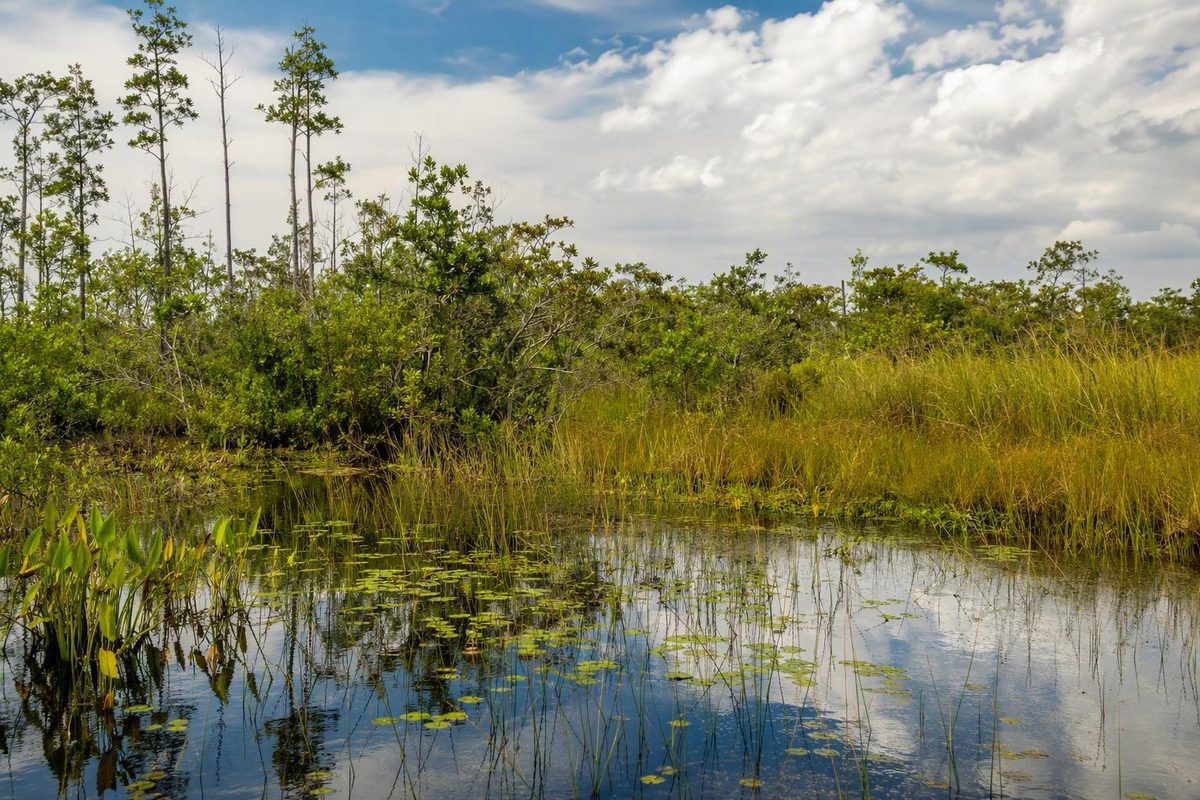
Water depth, flood duration, salinity, soil, elevation and disturbance organize vegetation into a mosaic of overlapping ecosystems.
Everglades National Park supports flora associated with both temperate North America and the tropical Caribbean. Its plant life is not one uniform marsh community: water depth, flood duration, salinity, soil, elevation, and disturbance organize vegetation into a mosaic of overlapping ecosystems.
Everglades plant life at a glance
The National Park Service recognizes nine distinct but overlapping ecosystems within Everglades National Park.
The NPS highlights eight broad groups in its overview of park plants:
| Broad plant group | Scope |
|---|---|
| Bromeliads | One of the groups highlighted in the park overview |
| Cacti and succulents | One of the groups highlighted in the park overview |
| Grasses | One of the groups highlighted in the park overview |
| Lichens | One of the groups highlighted in the park overview |
| Marine plants and algae | One of the groups highlighted in the park overview |
| Orchids | A diverse group within the park |
| Wildflowers | Flowering plants considered collectively |
| Native trees | Woody plants found across varied park settings |
These categories are not eight separate habitats. Instead, they show the breadth of plant and plant-like life found where two major climatic regions meet.
For visitors, the most useful starting point is not to expect one defining type of Everglades vegetation. A change in water conditions, ground elevation, soil, or exposure to disturbance can produce a corresponding change in the surrounding plant community.
The conditions that determine where vegetation grows
It includes the depth of flooding, when flooding occurs, how long it lasts, the quality of the source water, and its salinity.
Surface geology and the soil above it also influence which plants can become established and how abundant they become.
| Condition | Documented influence on vegetation |
|---|---|
| Flooding | Depth, timing, and duration help determine where vegetation can persist |
| Water quality and salinity | Differences in source water influence plant distribution |
| Topography and rainfall | Elevation and rainfall interact with patterns of inundation |
| Coastal proximity | Location relative to the coast helps shape the hydrologic regime |
| Geology and soil | Surface materials influence plant composition and abundance |
| Disturbance | Natural events and human changes alter vegetation patterns |
This matrix identifies controls on distribution rather than predicting a particular species or community. The factors operate together.
The same principle explains why nearby places can look different even when the broader terrain appears similar. To read the landscape, consider how high the ground sits, how long water remains, what kind of source water reaches the area, and whether the setting is inland or coastal. Those relationships are more informative than treating the Everglades as a continuous expanse of identical marsh.
Orchids, periphyton, and the scale of the park’s diversity
Everglades National Park has 39 native orchid species and about 750 other kinds of native seed-bearing plants, according to the National Park Service overview of Everglades plants. The park also contains what the NPS describes as the largest remaining stand of pine rockland forest in South Florida.
These facts illustrate different dimensions of botanical diversity. The orchid total reflects variety within one conspicuous group, while the broader seed-plant count points to the range of native flora across the park. Pine rockland adds another distinctive component, but it should not be treated as representative of the entire Everglades landscape.
Ecological importance also extends beyond visible flowers and trees. The NPS describes periphyton as the smallest building block of the Everglades food chain. Its role shows why an account of park plant life must include algae and other plant-like organisms as well as seed-bearing plants.
Together, orchids, other native seed plants, periphyton, and pine rockland demonstrate diversity at very different scales. Some elements are immediately noticeable in the landscape; others are small but fundamental to how the ecosystem functions. Their presence within the same national park reinforces the central point that “Everglades plants” encompass far more than a single marsh community.
How fire, storms, development, and invasive plants change vegetation
Everglades vegetation is continually shaped by disturbance. Natural disturbances documented by the National Park Service include fire, freezes, and hurricanes. Their effects vary with the ecosystem, timing, intensity, and conditions before and after the event, so none should be characterized as uniformly beneficial or destructive throughout the park.
Human-caused pressures include drainage, development, altered fire regimes, and the introduction of exotic pest plants. These changes can interact with hydrology, soil, and natural disturbance, adding further complexity to vegetation patterns.
The documented concern is with exotic plants that behave as damaging pests, rather than every plant originating outside the ecosystem.
Climate change adds continuing stress to this dynamic system. By the time Everglades National Park was established in 1947, human activity had already transformed its plant community. The vegetation has continued to adapt under overlapping natural and human pressures.
These influences cannot be separated from the water regime. Drainage changes hydrologic conditions, while altered fire patterns change the disturbance environment in which vegetation develops. Storms and freezes can also affect plant communities differently depending on their setting. The outcome is therefore shaped not by disturbance alone but by its interaction with water, soil, and the existing vegetation.
What the conservation numbers mean
Plant-conservation totals depend on the authority and classification system being used. The following figures apply specifically to Everglades National Park, not automatically to the Greater Everglades. They come from the NPS park-level plant summary updated April 23, 2025.
| Classification system | Park-level figure | Meaning |
|---|---|---|
| Florida listings | 164 species | 47 threatened, 113 endangered, and 4 commercially exploited |
| Share of native park flora | 22.5% | Portion represented by the 164 state-listed species |
| Federal listings | 2 native species | One threatened and one endangered |
| Federal candidates | 5 native species | Candidates for listing, not currently listed |
| NPS regional assessment | 66 park-native species | Considered critically imperiled in South Florida |
These figures should not be added together to create one total for “protected Everglades plants.” State listings, federal listings, federal candidacy, and regional assessments are separate systems that use different classifications and may overlap.
A plant listed by Florida is not necessarily federally listed. Likewise, designation as critically imperiled in a regional assessment is not equivalent to a state or federal legal status. Candidate species must also remain distinct from species already listed under federal classifications.
The NPS cautions that the count of 66 park-native species considered critically imperiled in South Florida can change as new information becomes available. That qualification reflects the evolving nature of ecological assessment, not a change in the geographic scope of the figure.
Water and subtle landscape differences ultimately organize Everglades vegetation. The park is best understood as a changing mosaic of freshwater and coastal conditions, higher and lower ground, contrasting soils, and varied disturbance histories—not as one continuous marsh. Its documented diversity and conservation figures apply to Everglades National Park, while scientific assessments may evolve as knowledge improves.