
A Beginner’s Guide to the Birdlife of Everglades National Park
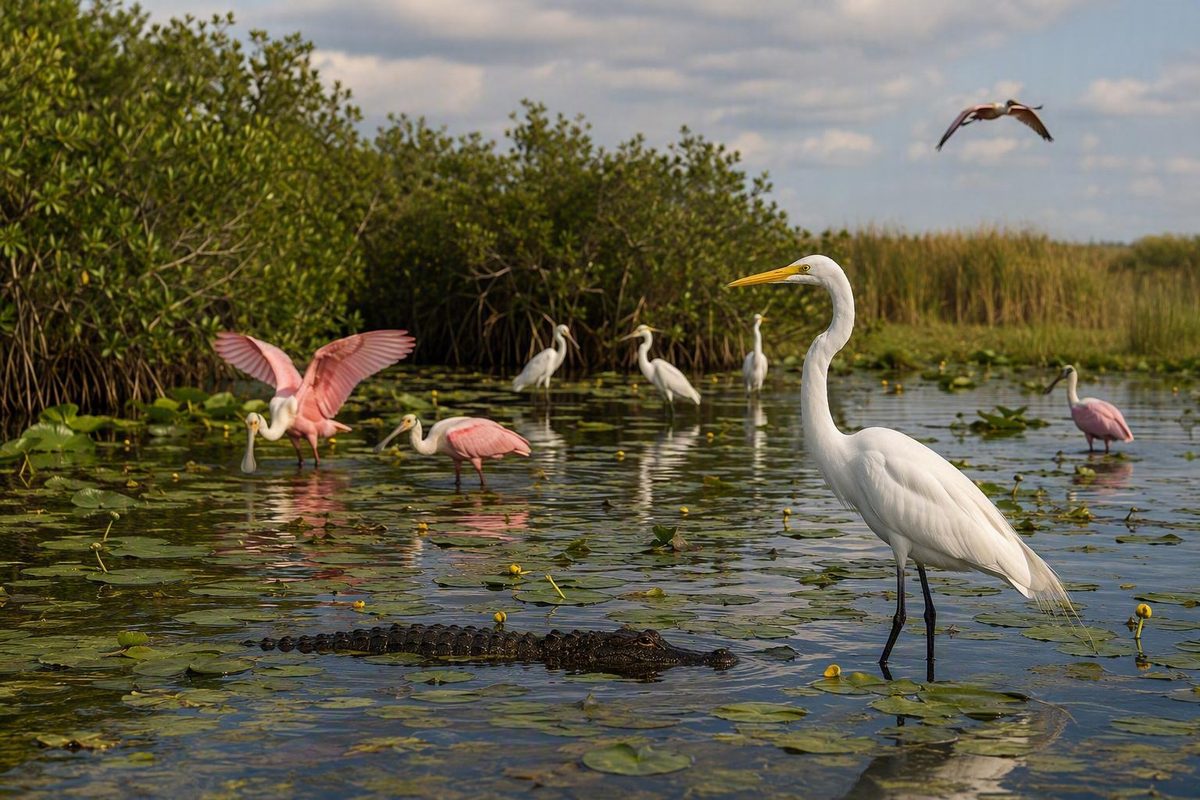
Official park records report more than 360 species, including 16 wading birds, while distinguishing recorded diversity from likely sightings.
Everglades National Park reports that more than 360 bird species have been sighted in the park, including 16 species of wading birds. That total represents the breadth of the park record—not the number of resident, breeding, currently present, or readily seen species. Read the National Park Service overview of Everglades birds.
A separate official checklist says the park has “over 350 bird species.” The two National Park Service figures should be treated as official estimates rather than combined into a supposedly exact count. See the National Park Service bird species checklist.
More Than 360 Bird Species Have Been Recorded in the Park
This guide concerns bird records from Everglades National Park, a defined geographic area within the larger Everglades ecosystem. A bird documented elsewhere in South Florida should not automatically be considered a park record, just as a record from the park does not establish that the species occurs throughout the wider ecosystem.
The distinction between a recorded species and an expected sighting is equally important. A checklist may include birds documented under very different circumstances. Inclusion alone does not show whether a bird breeds in the park, remains there year-round, occurs regularly, is currently present, or is likely to appear during one visit.
For beginners, the official total is therefore best understood as a measure of recorded diversity. It demonstrates the breadth of Everglades birdlife without functioning as a forecast for a particular day or trip.
The Main Groups of Everglades Birds
The National Park Service introduces the park’s birds through three broad groups:
-
Wading birds, including the ibises, storks, herons, egrets, and spoonbills emphasized in the park overview
-
Birds of prey, the third major group in the introductory framework
These two systems serve different purposes. The three-part framework gives a newcomer a simple mental map, while the checklist places birds into taxonomic groups and supplies common names, scientific names, status codes, and short descriptions.
Neither form of organization ranks birds by abundance or visibility. The prominence of wading birds in the introductory material does not establish that every wader is easy to find, and the length of a taxonomic section does not mean all its species occur in the park at the same time.
Notable Birds in the Official Park Materials
The National Park Service gives its most substantial species-level detail to the white ibis and wood stork. Other birds are named in the wading-bird overview or included on the checklist without equally specific information about their behavior or frequency.
| Bird | Group or context | Supported fact | Sighting caveat |
|---|---|---|---|
| White ibis | Wading bird | Described as the park’s most common wading bird; feeds mainly on crayfish | The relative label does not guarantee a sighting |
| Wood stork | Wading bird | Holds its bill in the water and shuffles its feet to disturb prey, feeding by touch | Feeding behavior does not predict when it will be visible |
| Roseate spoonbill | Wading bird | Named in the park’s wading-bird material | No sighting frequency is supplied |
| Great blue heron, great egret, snowy egret, tricolored heron, and little blue heron | Wading birds | Identified among the park’s herons and egrets | The overview does not provide visit-specific forecasts |
| Green-backed heron | Name used in the park overview | Included in the introductory wading-bird material under this name | The wording should not be treated as a current taxonomic determination |
| Limpkin | Checklist entry | Included on the park checklist | Inclusion does not establish occurrence timing |
| White-crowned pigeon | Checklist entry | Included on the park checklist | No season or sighting likelihood is established |
| American flamingo | Checklist entry | Included on the park checklist | It should not be treated as a common or reliable sighting |
The table stays within what the official park materials support. Identification features, preferred habitats, seasons, and viewing locations would require additional current, species-specific evidence.
How to Read the National Park Service Bird Checklist
The checklist is more than a list of common names. It is arranged taxonomically and provides scientific names, coded statuses, and brief informal descriptions. Its published key defines the codes as follows:
| Code | Published meaning |
|---|---|
| E | Federally endangered |
| T | Federally threatened |
| I | Invasive or exotic |
| U | Unknown |
| C | Common |
| X | Extinct |
On the National Park Service checklist page, eastern black rail, piping plover, and roseate tern carry the T label for federally threatened. These are checklist labels, not an independent confirmation of each species’ current federal classification. Legal status can change, so readers should verify it through current official conservation resources before making legal, regulatory, or conservation decisions. Consult the complete National Park Service checklist and its published key.
The checklist also applies the C code to some entries whose descriptions refer to rare visits or rarities. Because the code and accompanying prose do not always point in the same direction, C should not be used on its own to predict a sighting.
Legal conservation status and observation frequency answer separate questions. A federal designation concerns formal protection status; it does not indicate how often visitors encounter the bird. Conversely, a frequency description does not establish what legal protections apply.
The checklist is most useful for exploring the range and taxonomic organization of birds associated with the park. When an individual species matters, consider the full entry and confirm time-sensitive classifications through current official sources rather than relying on one code.
Why Bird Conservation Is Central to Everglades History
Bird conservation is closely connected to the park’s creation. The National Park Service says the plume trade and extensive alteration of the South Florida landscape contributed to historic declines in Everglades bird populations. Concern about those declines became an important catalyst for establishing Everglades National Park, although restoration of historic bird populations has been slow.
The park also quotes John James Audubon describing great flocks of wading birds that appeared to “block out the light from the sun for some time.” His words are a historical observation, not a measurement of modern abundance.
The same park account records that the wood stork’s federal classification changed from endangered to threatened in June 2014. That date belongs to the species’ regulatory history and should not be presented as proof of its current legal classification. Explore the National Park Service account of Everglades bird history and conservation.
Together, these accounts explain why birds are more than a visitor attraction in Everglades history. Their decline helped motivate protection of the landscape, while the slow restoration described by the park shows that legal protection and park establishment did not immediately recreate historic conditions.
Frequently Asked Questions
Does the Everglades bird checklist show which species I am likely to see?
Not reliably. The checklist documents birds associated with Everglades National Park and provides taxonomic information, codes, and short descriptions. It is not a location-specific or visit-specific sighting forecast.
Even the checklist’s “common” code requires caution because some descriptions associated with that code use language suggesting rarity. Estimating the chance of seeing a particular bird would require current observation information beyond the checklist itself.
Are Everglades National Park bird records the same as records for the entire Everglades ecosystem?
No. Everglades National Park is one geographic unit within the broader Everglades ecosystem. Its checklist concerns birds documented for the park and should not be expanded automatically to all of South Florida.
That boundary matters when interpreting a report about a particular species. Confirm whether the record concerns the national park, another part of the Everglades, or a different South Florida location before treating it as evidence of park occurrence.
What to Take From the Park Record
The official records reveal an exceptionally broad range of Everglades birds, from familiar wading-bird examples to waterfowl, rails, pigeons, shorebirds, gulls, and terns. They also provide a starting point for understanding the conservation history that helped shape the park.
Use those records to learn which birds have been documented and how the National Park Service organizes them—not as a promise of what will appear on one visit. For any particular species, consult the complete current park resources and verify time-sensitive conservation labels before planning around its presence or status.