
Meet the Wildlife of Florida’s River of Grass
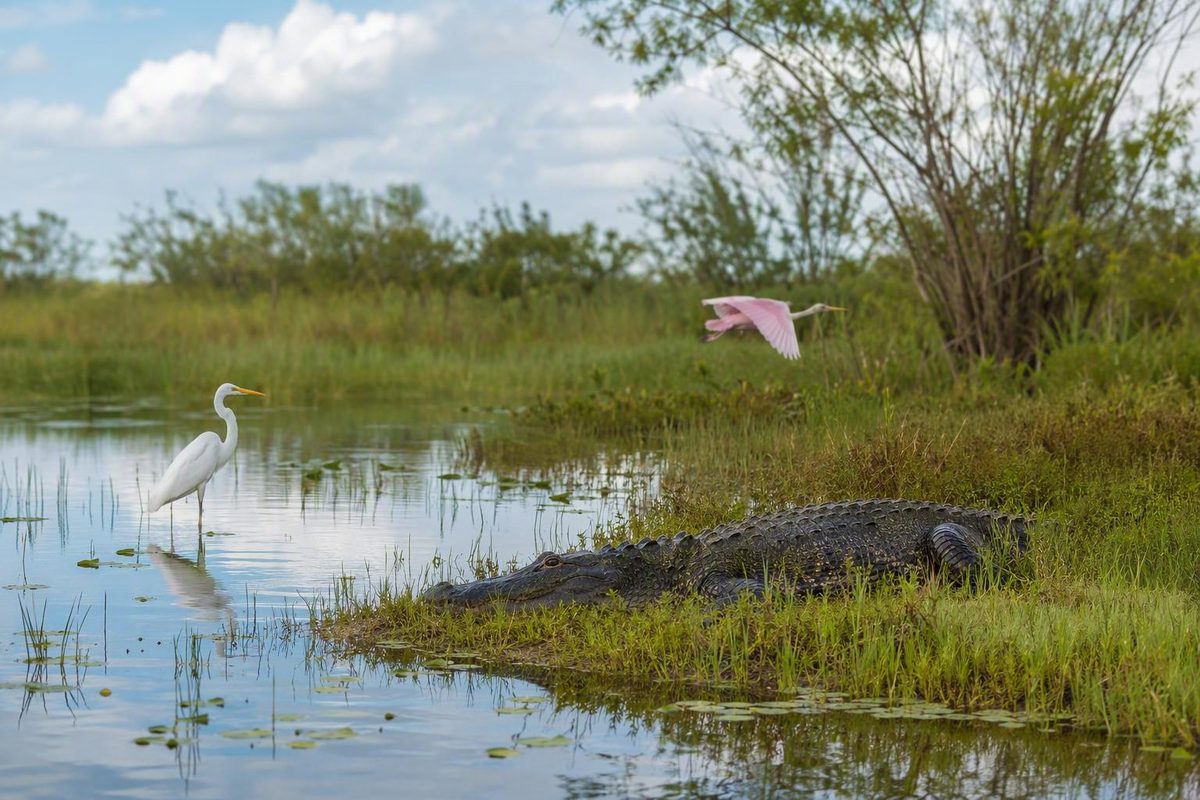
Animals in the Everglades do not all inhabit the same kind of “swamp.” South Florida’s River of Grass is a connected landscape of freshwater marshes, sloughs, wet prairies, pine rocklands, hardwood hammocks, mangrove forests, estuaries, and coastal waters. Each habitat supports a different wildlife community.
That distinction is useful when planning a visit. An American alligator is strongly associated with freshwater routes, while an American crocodile is more closely associated with coastal mangroves and brackish or salt water. A boardwalk may reveal wading birds, turtles, and fish; a coastal boat trip may offer opportunities to observe pelicans, dolphins, or manatees. Florida panthers and river otters belong in a regional wildlife guide, but they are elusive animals rather than expected sightings.
This is a representative, habitat-based introduction to mammals, birds, reptiles, amphibians, fish, insects, and other invertebrates. It is not a complete species checklist, and no wildlife encounter is guaranteed.
What counts as the Everglades—and how diverse is its wildlife?
“The Everglades” can refer to several related but noninterchangeable places.
Everglades National Park is a defined federal park at the southern end of the ecosystem. It protects freshwater wetlands as well as mangrove shorelines, Florida Bay, and Gulf Coast waters.
The Greater Everglades is a much larger ecological system extending through central and South Florida. Historically, water moved south from the Lake Okeechobee region through broad wetlands toward what is now the national park and Florida Bay. Water-control structures, agriculture, roads, and urban development have substantially changed that flow. The National Wildlife Federation’s Everglades overview describes the wider ecosystem as a connected network of sawgrass marsh, wet prairie, cypress habitat, mangroves, and other environments.
Big Cypress National Preserve is a neighboring protected landscape, not a section of Everglades National Park. The Ten Thousand Islands form a maze of mangrove islands and coastal channels along southwest Florida; the area includes park waters as well as neighboring protected lands. A wildlife report from Big Cypress, Everglades City, or the Ten Thousand Islands should not automatically be treated as a park-wide observation.
Within Everglades National Park, the National Park Service reports more than 350 bird species, 40 mammal species, and 36 threatened or endangered species, along with a rich variety of reptiles and fish. Those figures apply to the national park—not the entire Greater Everglades—and legal conservation totals can change with time and jurisdiction. The National Park Service wildlife overview provides the park-specific figures and current viewing guidance.
The landscape’s low elevation helps explain this diversity. Small changes in water depth, salinity, soil, and elevation create distinct habitats. Freshwater marshes suit species with limited salt tolerance. Brackish creeks form transition zones. Mangroves shelter fish and coastal birds, while pine rocklands support specialized terrestrial animals and insects.
Everglades wildlife includes familiar vertebrates—mammals, birds, reptiles, amphibians, and fish—as well as insects, arachnids, crustaceans, snails, and other molluscs. Community observation databases can help visitors explore those less conspicuous groups, but they are not complete inventories or unbiased measures of abundance.
A representative guide to Everglades animals
The table below is a starting point rather than a comprehensive checklist. Its scope column distinguishes Everglades National Park from the Greater Everglades and neighboring coastal areas. “Principal habitat” identifies the habitat most useful for understanding the animal; it does not mean the species occurs nowhere else.
Conservation categories have been omitted from the table because legal labels may differ by agency, jurisdiction, population, and date. Current classifications should be checked with the relevant wildlife agency.
| Animal | Group | Principal habitat or association | Geographic scope | Visitor note |
|---|---|---|---|---|
| American alligator | Reptile | Freshwater marshes, sloughs, wet prairies, ponds, and waterways | Everglades National Park and Greater Everglades | Characteristic freshwater crocodilian; never approach or feed |
| American crocodile | Reptile | Coastal mangroves, estuaries, Florida Bay, and brackish or salt water | Coastal Everglades National Park and South Florida | Less strongly associated with interior freshwater marsh |
| Florida softshell turtle | Reptile | Freshwater ponds, marshes, and waterways | Greater Everglades | Flattened, flexible-looking shell |
| Florida snapping turtle | Reptile | Freshwater aquatic habitat | Greater Everglades | Observe without touching or blocking its path |
| Banded watersnake | Reptile | Freshwater wetland edges | Greater Everglades | Nonvenomous but sometimes confused with a cottonmouth |
| Florida cottonmouth | Reptile | Wetlands and waterways | Greater Everglades | Venomous; never handle or crowd |
| Green sea turtle | Reptile | Marine and coastal water | Ten Thousand Islands and adjacent coastal waters | Coastal possibility, not an interior-marsh animal |
| Loggerhead sea turtle | Reptile | Marine and coastal water | Ten Thousand Islands and adjacent coastal waters | Locally described as migratory |
| Little grass frog | Amphibian | Moist grass near wetlands | Greater Everglades | Small and easily overlooked |
| Oak toad | Amphibian | Pine flatwoods, savannas, sandy uplands, and seasonal wetlands | Greater Everglades and South Florida | Shows that the region includes more than open marsh |
| Roseate spoonbill | Bird | Shallow wetlands, mangrove edges, and coastal shallows | National park and broader coastal region | Sweeps its bill from side to side while feeding |
| White and glossy ibises | Birds | Marshes and shallow wetlands | National park and Greater Everglades | Probe wet ground and shallow water |
| Egrets and herons | Birds | Marshes, ponds, mangrove edges, and shorelines | National park and Greater Everglades | Watch for stalking, waiting, and rapid strikes |
| Wood stork | Bird | Shallow wetlands and feeding pools | National park and Greater Everglades | Feeding opportunities change with water depth |
| Anhinga | Bird | Freshwater waterways and marshes | Everglades National Park | Often swims low or perches with wings spread |
| Osprey | Bird | Inland and coastal waters with fish | National park and coastal region | Often watches water from an exposed perch |
| Brown pelican | Bird | Bays, shorelines, and coastal waters | Florida Bay and Ten Thousand Islands | Primarily coastal |
| Double-crested cormorant | Bird | Fresh and coastal waters | National park and Ten Thousand Islands | Diving bird often seen swimming low |
| Florida panther | Mammal | Connected forests, wetlands, and uplands | South Florida and Greater Everglades | Exceptionally elusive |
| West Indian manatee | Mammal | Estuarine, riverine, coastal, and sheltered waters | Coastal portions of the broader region | Possible but unpredictable |
| Bottlenose dolphin | Mammal | Bays, estuaries, and coastal waters | Ten Thousand Islands and adjacent waters | Relevant mainly to coastal outings |
| White-tailed deer | Mammal | Terrestrial habitats in the regional landscape | Greater Everglades | A regional prey species for Florida panthers |
| North American river otter | Mammal | Freshwater wetlands and waterways | Greater Everglades | Elusive rather than expected |
| Florida black bear | Mammal | Forested and swamp landscapes | Greater Everglades and neighboring protected lands | More relevant regionally than on busy park trails |
| Florida bonneted bat | Mammal | South Florida habitat with suitable roosting and feeding areas | South Florida and Greater Everglades | Nocturnal and not a routine daytime sighting |
| Largemouth bass | Fish | Freshwater | Everglades region | Represents the freshwater fish community |
| Snook | Fish | Estuarine and coastal water | Coastal Everglades | Not an interior-marsh species |
| Tarpon | Fish | Bays, estuaries, and coastal water | Coastal Everglades | Part of the region’s marine connection |
| Goliath grouper | Fish | Mangrove nursery habitat and coastal water | Coastal Everglades | Young fish can use sheltered mangroves |
| Florida leafwing | Insect | Pine rockland | South Florida and Greater Everglades | Highly specialized and unlikely as a casual sighting |
| Burmese python | Reptile | Multiple wetland and terrestrial habitats | Greater Everglades | Nonnative predator; secretive despite ecological importance |
| Cuban tree frog | Amphibian | South Florida habitats | Greater Everglades region | Nonnative predator of smaller native frogs |
| Nile monitor | Reptile | South Florida wetlands and disturbed areas | Regional South Florida context | Nonnative; not representative of every park location |
Turtles are reptiles, not amphibians. Marine mammals, sea turtles, snook, tarpon, and Goliath groupers belong primarily to the coastal side of the story. Panthers, bears, bats, and the Florida leafwing also require regional or habitat-specific qualifications.
Freshwater marshes, sloughs, and wet prairies
The freshwater heart of the Everglades is shallow and seasonally changeable. Sloughs carry slow-moving water through the landscape, wet prairies occupy shallower areas, and sawgrass marshes expand or contract with rainfall. Ponds, canals, and alligator holes may retain water as surrounding areas dry.
The American alligator is the characteristic large reptile of these freshwater environments. It uses marshes, sloughs, wet prairies, ponds, and connected waterways. Its varied prey can include fish, turtles, birds, reptiles, and small mammals. That is normal predator behavior—not a reason to approach, test, or feed the animal.
Alligators may attract the most attention, but turtles are also important members of the freshwater community. Florida softshell turtles are highly aquatic and have flattened, flexible-looking shells. Florida snapping turtles also spend much of their time in water and can be difficult to notice beneath a dark surface. Any turtle should be watched without touching it or obstructing its route.
Snakes use the boundary between water and land. The banded watersnake is nonvenomous, while the Florida cottonmouth is venomous. Because coloration and pattern can vary—and vegetation may conceal much of the body—visitors should never handle or crowd either species. Give the snake an open route and allow it to move away.
Amphibians reveal another scale of Everglades life. The little grass frog inhabits moist grassy areas near wetlands, where its size and camouflage make it easy to overlook. The oak toad is associated with habitats including pine flatwoods, savannas, shrub bogs, and sandy uplands. These animals illustrate how slight changes in elevation create habitat beyond open water and sawgrass.
Freshwater fish and invertebrates help support the visible food web. Fish and other aquatic animals become available to alligators, turtles, snakes, and wading birds, while frogs and fish consume smaller organisms. A productive wildlife stop is therefore often a place where water conditions make prey accessible—not necessarily the most dramatic-looking landscape.
Hydrology continually changes that pattern. As water recedes, aquatic animals can become concentrated in remaining pools and channels, attracting predators and feeding birds. When wet-season water spreads across the landscape, wildlife can disperse over a much larger area. Water level, recent rain, temperature, time of day, and breeding behavior can all make a location productive on one visit and quiet on another.
Mangroves, estuaries, and coastal wildlife
Moving south or west through the Everglades, fresh water gradually mixes with salt. Sawgrass gives way to mangrove-lined creeks, estuaries, mudflats, sheltered bays, and open coastal water. These environments support a different wildlife community from the interior freshwater marsh.
The American crocodile is the clearest example. In South Florida, crocodiles are associated more strongly with coastal mangroves and brackish or saltwater environments than freshwater-oriented alligators. The division is not absolute: crocodiles can enter fresher water, and alligators can tolerate some salinity. Habitat is therefore a clue, not proof of identity.
West Indian manatees and bottlenose dolphins add aquatic mammals to the coastal community. They are associated with suitable bays, channels, estuaries, and coastal waters in the broader Everglades region, including the Ten Thousand Islands. A brief surfacing, breath, or distant back may be the only visible sign, and neither species should be treated as a predictable encounter.
Coastal birds connect mangrove forest, shoreline, and sea. Roseate spoonbills feed in shallow water. Brown pelicans travel over bays and rest near shorelines. Double-crested cormorants dive for fish, while ospreys hunt over the water. Herons and egrets use mangrove edges and tidal flats as well as freshwater wetlands.
Green and loggerhead sea turtles belong to the marine side of this guide. They may occur in coastal waters connected to the Everglades, but they should not be described as widespread freshwater-marsh animals. Local Ten Thousand Islands visitor guidance describes green sea turtles as year-round and loggerheads as migratory; those are local labels rather than park-wide sighting guarantees.
Mangroves also provide sheltered habitat for developing fish. Their tangled roots create cover and feeding space. Young Goliath groupers are one documented example of fish using mangrove nursery habitat before moving into larger coastal waters. Snook and tarpon further illustrate the connection between the Everglades and estuarine or marine systems.
For visitors, Flamingo provides access to mangroves, Florida Bay, and the southern coastal environment of Everglades National Park. The Ten Thousand Islands, approached from southwest Florida, offer boat-based viewing among mangrove islands and coastal channels. Although parts of this landscape lie within park waters, Ten Thousand Islands wildlife should not be used as shorthand for the entire national park.
Birds of the Everglades: waders, hunters, and seasonal visitors
Birds often provide the richest wildlife viewing because different species use open water, mudflats, trees, mangroves, grasslands, and the air above them. The National Park Service reports more than 350 bird species in Everglades National Park.
The classic wading-bird assemblage includes roseate spoonbills, white ibises, glossy ibises, egrets, herons, and wood storks. They share shallow wetlands, but they do not all feed in the same way.
A roseate spoonbill moves its broad bill through shallow water while sweeping its head from side to side. The bill remains slightly open and snaps shut when it detects prey. That differs from the patient, visually directed hunting of a great blue heron, which may stand almost motionless before making a rapid strike.
Egrets may stalk deliberately or use quicker movements to disturb prey. Ibises probe mud and wet ground with curved bills. Wood storks feed in shallow water, so changing water depth strongly affects where feeding opportunities occur. Watching these techniques can make a birding stop more rewarding than identification by color alone.
Other birds broaden the picture:
- Anhingas swim with much of the body submerged and often perch with their wings spread.
- Double-crested cormorants pursue fish underwater and may also sit with open wings.
- Ospreys circle, hover, or watch from exposed perches before diving toward fish.
- Brown pelicans are associated mainly with bays, shorelines, and coastal water.
- Smaller migratory birds and raptors use habitats beyond the open marsh, including mangroves, hammocks, and pine rocklands.
Seasonal labels require care. A bird described as year-round around the Ten Thousand Islands may still be absent from a particular channel on a particular morning. Likewise, “migratory” does not mean a species appears on a fixed visitor timetable. Water levels, storms, temperature, food supply, breeding cycles, and migration patterns all affect what is present.
Nests and rookeries require extra space. A bird that repeatedly watches visitors, calls, changes position, leaves a nest, or interrupts feeding may already be disturbed. Binoculars or a spotting scope provide a better view without forcing the bird to spend energy reacting to people. Never push through vegetation toward a nest or maneuver a boat closer for a photograph.
Alligator or crocodile? How to tell the difference
South Florida’s connected freshwater, brackish, and coastal habitats allow American alligators and American crocodiles to occur within the same broader region. Identification is best based on several characteristics rather than size alone.
| Feature | American alligator | American crocodile |
|---|---|---|
| Snout | Broad and rounded, often described as U-shaped | Narrower and more pointed, often described as V-shaped |
| Typical coloration | Dark gray, brownish, or nearly black | Lighter gray, gray-green, or olive-toned |
| Strongest habitat association | Freshwater marshes, sloughs, ponds, canals, and wet prairies | Coastal mangroves, estuaries, Florida Bay, and brackish or salt water |
| Useful first impression | Dark, broad-headed freshwater crocodilian | Lighter, narrower-headed coastal crocodilian |
| Limitation | Lighting, angle, age, and partial submersion may obscure features | Habitat overlap means location alone cannot confirm identity |
From a safe viewpoint, begin with the snout. An alligator generally has a broad, rounded head, while a crocodile generally has a narrower, tapered snout. Then consider coloration and habitat. A dark animal beside a freshwater route is more likely to be an alligator; a gray-green animal in a mangrove estuary is more likely to be a crocodile.
These are tendencies, not infallible rules. Mud, glare, shadow, algae, distance, and age can change an animal’s appearance. If only the eyes and nostrils are visible, there may not be enough information for a confident identification.
Never approach to settle the question. If the features are not clear through binoculars or a zoom lens, record the sighting as an uncertain crocodilian and move on.
Rare, imperiled, and invasive animals
The Everglades wildlife story includes exceptionally elusive native animals, species under conservation pressure, and introduced predators that disrupt native communities.
It requires large areas of connected habitat and faces pressures including habitat loss, degradation, fragmentation, and vehicle collisions. Population estimates are time-sensitive and differ among sources, so a fixed number would be misleading.
Other animals of conservation concern show how many habitats are involved:
- The Florida leafwing butterfly is closely tied to pine rockland.
- The American crocodile uses South Florida’s coastal, brackish, and saltwater environments.
- The crested caracara is associated with open and semi-open country in the wider regional landscape.
- The leatherback sea turtle faces pressures in marine and nesting environments.
- The Florida bonneted bat occurs in South Florida and depends on suitable feeding and roosting habitat.
The Everglades Foundation’s profiles of imperiled regional species connect these animals with pressures including habitat loss and fragmentation, altered hydrology, vehicle collisions, pesticides, pollution, fishing interactions, marine debris, and climate change. The profiles concern the Greater Everglades and wider South Florida context; they do not establish that every featured species is commonly encountered inside Everglades National Park.
Invasive animals create a different challenge. Burmese pythons are nonnative predators associated with serious declines in some native mammal populations in parts of the Everglades. The effect varies by species, place, and period and should not be reduced to one fixed percentage for the entire ecosystem.
Cuban tree frogs prey on smaller native frogs. Nile monitors have also been reported consuming native wildlife, including eggs. Their regional presence does not mean visitors should expect to encounter them at every park site.
Water management connects many conservation problems. Changes to freshwater flow can alter salinity, the length of seasonal flooding, prey availability, nesting conditions, and habitat connectivity. Habitat protection and improved water movement may support wildlife, but restoration should not be presented as a guarantee of a particular population increase.
Because legal conservation categories are jurisdiction-specific and change over time, travelers, writers, anglers, and boaters should verify current classifications and regulations with the National Park Service, U.S. Fish and Wildlife Service, and Florida Fish and Wildlife Conservation Commission.
Where and when to look for wildlife
There is no single best month for every Everglades species. A more useful principle is to follow the water.
During the dry season, falling water levels often concentrate fish and other aquatic animals in remaining ponds, sloughs, and channels. That can make alligators and wading birds easier to observe. During the wet season, water spreads across more of the landscape and wildlife can disperse. Migratory timing, storms, temperature, local rainfall, and nesting cycles can still outweigh that broad pattern.
Early morning may offer comfortable conditions and active birds or mammals, but it is not a guaranteed “wildlife hour.” Reptiles may become more visible when conditions allow basking, some mammals are active after dark, and tides influence coastal feeding. A flexible schedule is more useful than a narrow promise.
Shark Valley
Within Everglades National Park, Shark Valley is a practical destination for freshwater wildlife viewing. Its paved loop and tram route cross open wetlands where visitors may look for alligators, turtles, snakes, anhingas, herons, egrets, ibises, and other birds.
The open views make it possible to observe wildlife without leaving the route. If an animal occupies the pavement, stop well short. Do not pass closely, crowd it with bicycles, or force it toward the water.
Anhinga Trail
Near Royal Palm in Everglades National Park, Anhinga Trail is a 0.8-mile round-trip route combining pavement and boardwalk. It overlooks freshwater habitat used by birds and aquatic animals, making it a practical option for first-time visitors and families.
Its short length does not make sightings predictable. Water level, weather, and animal movement can make one visit much quieter than another.
Flamingo
Flamingo, at the southern end of the park road, introduces visitors to mangroves, Florida Bay, and coastal waters. The relevant wildlife community can include crocodiles, pelicans, spoonbills, cormorants, ospreys, coastal fish, manatees, dolphins, and sea turtles.
Shoreline viewing reveals only part of the area. Paddling or boating can provide access to mangrove channels and open-water habitat, but visitors should check wind, tides, storms, heat, insects, route difficulty, and current park notices before going onto the water.
Ten Thousand Islands
The Ten Thousand Islands are a southwest Florida mangrove and coastal destination, not a model for the whole national park. Boat-based observation may provide opportunities to see dolphins, manatees, crocodiles, ospreys, pelicans, cormorants, herons, spoonbills, and sea turtles. Wildlife may be distant or hidden, and watercraft should never be used to pursue it.
The best viewing method depends on the habitat:
- Boardwalks provide structured access to marsh edges and ponds.
- Paved loops and trams cover more freshwater habitat with fewer route-finding demands.
- Walking trails enter pine rocklands, hammocks, and prairie edges.
- Paddling routes reach creeks, mangroves, and sheltered water.
- Boat trips provide access to bays, estuaries, and coastal islands.
Before departure, check official park alerts, road and trail conditions, weather, water conditions, and seasonal services. Static wildlife lists cannot predict what a changing wetland will look like on the day of a visit.
How to watch Everglades wildlife safely and ethically
The National Park Service tells visitors to give wildlife plenty of space, preserve an avenue of retreat, stay on designated routes, and use binoculars or a spotting scope instead of moving closer. Those principles apply to alligators and crocodiles as well as birds, turtles, snakes, manatees, dolphins, deer, and insects around nests or host plants.
Possible signs of alarm identified by the park include:
- agitated movement or flapping;
- pacing or repeated repositioning;
- visible muscle tension;
- persistent staring;
- frequent vocalization;
- interruption of normal feeding, resting, or nesting behavior.
If an animal reacts to your presence, stop and back away. Leave it a clear retreat route. If it does not return to normal behavior, leave the area.
Remain on designated trails and boardwalks. Foot traffic can damage fragile wetlands, and leaving a route may bring a visitor unexpectedly close to a concealed snake, nest, or alligator. Rookeries, nests, dens, and nursery areas need additional space because disturbance can separate adults from young or expose eggs and chicks.
Apparently abandoned young animals should be left alone. A parent may be feeding, hidden nearby, or waiting for people to leave. Do not pick up, move, or attempt to rescue wildlife unless a park ranger or wildlife agency provides specific instructions.
Feeding or harassing wildlife is dangerous and illegal in Everglades National Park. Never chase an animal for a photograph or block its path to water, vegetation, a nest, or a den.
Pets are prohibited on most park trails. The National Park Service permits them in specified areas, including parking lots and campgrounds, subject to a six-foot leash requirement. Confirm current rules for the exact road, campground, parking area, or trail before visiting.
For any outing:
- Observe quietly.
- Keep a generous distance.
- Keep children close and calm.
- Follow current pet and leash rules.
- Stay on designated routes.
- Never feed, touch, chase, or block wildlife.
- Pack out food scraps, fishing line, and other waste.
- Accept that every sighting is a matter of conditions and chance.
Frequently asked questions
What animals are visitors most likely to see in the Everglades?
At accessible freshwater sites such as Shark Valley and Anhinga Trail, visitors commonly look for alligators, turtles, anhingas, herons, egrets, ibises, cormorants, and other aquatic birds. What is visible depends on water level, season, weather, time of day, and chance.
Coastal visits around Flamingo or the Ten Thousand Islands add the possibility of pelicans, ospreys, spoonbills, crocodiles, manatees, dolphins, and sea turtles. Panthers, river otters, bears, pythons, and Florida bonneted bats are much more elusive.
Are there both alligators and crocodiles in the Everglades?
Yes. Both occur in South Florida’s broader Everglades region because it contains connected freshwater, brackish, and coastal habitats. Alligators are associated primarily with freshwater marshes, sloughs, ponds, and wet prairies. American crocodiles are more strongly associated with coastal mangroves, estuaries, Florida Bay, and brackish or salt water.
Alligators are generally darker and have broad, rounded snouts. Crocodiles are generally grayer or gray-green and have narrower, V-shaped snouts. Habitat overlap, lighting, distance, and partial submersion can make identification uncertain.
Can visitors expect to see a Florida panther?
No. Florida panthers are exceptionally elusive, wide-ranging animals associated with South Florida and the Greater Everglades. A confirmed sighting should be regarded as highly unusual rather than something around which to plan an itinerary.
Do not leave a trail, approach tracks, or pursue an animal to obtain a photograph. Experiencing panther habitat without seeing a panther is normal.
Is the Florida cottonmouth venomous?
Yes. The Florida cottonmouth is one venomous snake associated with wetland environments. It is not presented here as a complete list of venomous snakes in South Florida. The nonvenomous banded watersnake can sometimes be mistaken for a cottonmouth when only part of the body is visible.
Never handle, corner, or attempt to move a snake. Stop, provide space, and let it leave.
What should I do if an animal reacts to my presence?
Stop moving closer and back away while leaving the animal a clear retreat route. Possible warning signs include agitated movement, pacing, staring, muscle tension, repeated vocalization, or interruption of feeding and resting.
Wait at a greater distance. If the animal does not return to normal behavior, leave. Do not chase it, block it, offer food, or remain close simply to finish a photograph.
Ultimately, the animals visitors encounter depend on the habitat they explore. A freshwater boardwalk, sawgrass marsh, pine rockland, mangrove estuary, and coastal waterway each reveal a different Everglades. Choose a viewing area that matches your interests, check current conditions, bring binoculars, and treat every sighting as an unscripted encounter. The best wildlife experience is one that leaves the animal’s behavior—and its habitat—unchanged.