
How to Build a Crisp, Creamy California-Style Sushi Roll at Home
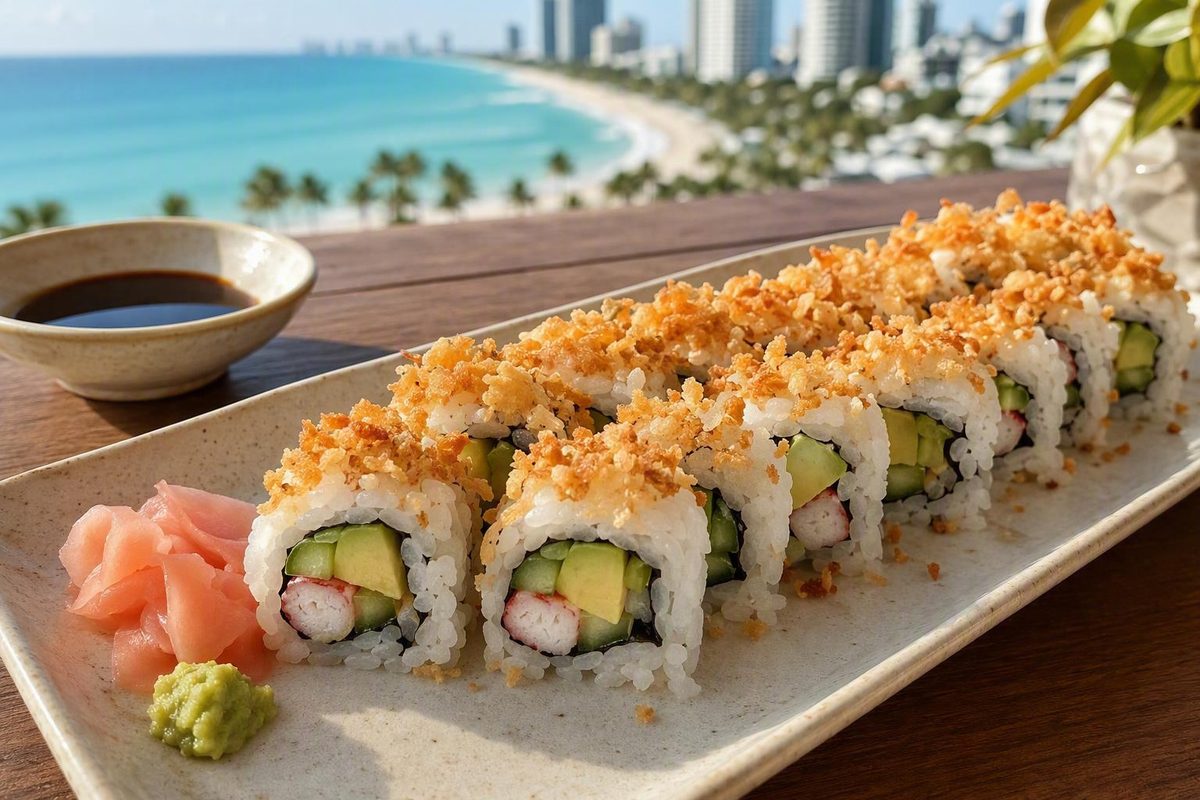
Panko, fried onions, tempura flakes, sesame seeds, or crisp cucumber can add texture without the completed roll being battered or fried.
A crunchy California roll begins with the familiar combination of seasoned sushi rice, nori, crab or imitation crab, avocado, and cucumber. What makes it “crunchy” is less standardized. One cook may coat the rice with toasted panko, another may add fried onions or tempura flakes, and a restaurant may batter and fry the completed roll.
That flexibility works well at home. You can choose a light sesame-and-cucumber crunch, a savory fried-onion topping, or a more substantial panko coating without changing the basic rolling technique. The keys are to control moisture, keep the filling restrained, form the roll with the rice outside, and add the crunchy component close to serving.
This guide compares published preparations rather than presenting a Miami Finder-tested formula. The two measured recipes below remain separate so their quantities, yields, and timing are not mistaken for one tested hybrid.
What Is a Crunchy California Roll?
A crunchy California roll is generally an inside-out roll, or uramaki. Seasoned sushi rice covers the outside of the nori, while crab or imitation crab, avocado, and cucumber sit inside. A crunchy coating, topping, or cooking method distinguishes it from a standard California roll.
There is no universal preparation. Depending on the restaurant, recipe, or packaged product, the crunch may come from:
- Toasted panko breadcrumbs
- Tempura flakes
- Crispy fried onions
- Toasted sesame seeds and crisp cucumber
- A light batter applied to the completed roll before frying
- Heating or air-frying a frozen prepared product
“Crispy California roll” is sometimes used for the same broad family of variations. The name alone does not reveal whether the roll is topped with something crisp, coated in breadcrumbs, battered, or fried. The Japanese Bar’s overview of California-roll variations includes both tempura-flake and fully battered versions while noting that there is no single preparation method.
A crunchy California roll should also be distinguished from a generic crunch roll. A shrimp-tempura crunch roll may contain fried shrimp and avocado, then receive spicy mayonnaise and toasted panko. Its defining filling is shrimp tempura rather than the California-style combination of crab, avocado, and cucumber. For example, Crafty Cookbook’s shrimp-tempura crunch roll uses two pieces of prepared shrimp tempura, avocado, spicy mayonnaise, and a toasted panko exterior.
The most useful approach is to read the menu or package description rather than relying on the name. Look for four details:
- The filling: crab, imitation crab, shrimp tempura, raw fish, or something else
- The orientation: rice outside or nori outside
- The crunch source: panko, onions, tempura flakes, sesame, batter, or heated coating
- The cooking method: assembled cold, topped with a fried ingredient, fully fried, or heated from frozen
For the home versions in this guide, the framework remains a cooked-seafood California-style filling. Fully frying a completed roll is a separate interpretation, not a requirement.
Core Ingredients, Sauces, and Optional Additions
It helps to distinguish the ingredients that establish the roll’s identity from additions that create a particular restaurant or home-cook variation.
Core components
- Seasoned sushi rice: Short- or medium-grain rice prepared so it holds together, then seasoned with rice vinegar, sugar, and salt.
- Nori: The seaweed sheet between the exterior rice and the filling.
- Crab or imitation crab: The primary seafood component.
- Avocado: Adds creamy texture and richness.
- Cucumber: Adds freshness and a crisp contrast to the avocado.
In an inside-out roll, the rice sits on the exterior. The nori faces inward and surrounds the filling.
Imitation crab—also called surimi, kanikama, or kani—is commonly a processed white-fish product made with pollock or another white fish. Formulations vary and may contain crab extract or flavoring, egg, starches, oil, sugar, and other ingredients. Hungry Huy’s California-roll ingredient guide describes kanikama as typically containing Alaska pollock, crab flavoring, egg whites, and cornstarch, illustrating why the package label matters.
Cooked real crab can replace imitation crab. It produces a flakier, less uniform filling and changes the seafood flavor, cost, and potentially the allergen profile. Drain it thoroughly and check for shell fragments before rolling. If the crab is very loose, mix it with only enough mayonnaise to help it hold together.
Crunch coatings and toppings
These additions create the crunchy effect but are not individually required:
- Toasted panko
- Tempura flakes
- Crispy fried onions or shallots
- Toasted sesame seeds
- Furikake
- A battered and fried exterior
Cucumber itself supplies some crunch, especially when it is seeded, cut into narrow strips, and dried. It will not reproduce the brittle or craggy texture of fried onions, panko, or tempura flakes.
Sauces and garnishes
Spicy mayonnaise is common but optional. FlyPeachPie documents a small batch made with 2 tablespoons mayonnaise and 1–2 teaspoons sriracha in its California crunch roll recipe. Begin with the smaller amount for a milder sauce.
Other possible additions include:
- Eel-style sauce or sweet sushi sauce
- Soy sauce
- Sesame seeds
- Green onion
- Furikake
- Tobiko or masago
- Cream cheese
- Pickled ginger
- Wasabi
None is necessary to define the roll. Cream cheese adds considerable volume and softness, so use only a narrow strip if adding it. Sweet sauces and spicy mayonnaise can help a topping adhere, but too much sauce can soften the coating and dominate the crab, avocado, and cucumber.
How much filling should you use?
Use less than you may expect. Avocado, cucumber, and crab each add volume, and an inside-out roll must close around all three while supporting an exterior layer of sticky rice.
Aim for a narrow line rather than a mound:
- A slim row of crab
- One or two narrow cucumber strips
- A restrained line of avocado slices
If you add cream cheese or another optional ingredient, reduce one of the other fillings. A roll that appears slightly underfilled before shaping often becomes properly proportioned once formed into a cylinder.
Choose Your Crunch: Panko, Tempura Flakes, Fried Onions, or Sesame
The best coating depends on whether you want neutral crispness, pronounced savory flavor, minimal cooking, or a lighter unfried result. Allergen concerns are formulation-specific, so the table identifies ingredients to investigate rather than guaranteeing what any product contains.
| Crunch source | Texture | Flavor | Preparation effort | Cooking requirement | Moisture sensitivity | Likely allergen concerns to check |
|---|---|---|---|---|---|---|
| Toasted panko | Fine, even, crisp coating | Mild; added oil may contribute flavor | Low to moderate | Skillet toasting | Softens when exposed to wet sauce | Commonly wheat; check oil and seasonings |
| Tempura flakes | Irregular and craggy | Fried and savory | Low if purchased prepared | Usually already fried; follow package directions | Softens as it absorbs moisture | Commonly wheat; check for egg and cross-contact declarations |
| Crispy fried onions | Brittle, irregular pieces | Strong onion and fried flavor | Very low | Usually ready to use | Softens under sauce | Often wheat; formulation varies |
| Toasted sesame seeds | Small, delicate crunch | Nutty and toasted | Low | Optional toasting | Less coating-like than panko | Sesame |
| Crisp cucumber | Fresh snap rather than a crust | Clean and vegetal | Low | None | Releases water over time | Check the full roll rather than the cucumber alone |
| Fully battered roll | Crisp shell around the roll | Rich, fried exterior | High | Full frying process | Loses crispness as it sits | Commonly wheat and sometimes egg; shared oil may matter |
Toasted panko
Panko gives the rice exterior a relatively even coating without introducing a dominant flavor. It can be toasted in a dry skillet or with a small amount of oil, depending on the complete recipe being followed.
One documented small-batch method combines 3 tablespoons panko with 2 teaspoons toasted sesame oil, then cooks the mixture over medium to medium-low heat for 2–3 minutes, stirring until golden. Those quantities belong to the cited shrimp-roll recipe and should be scaled according to the number and size of rolls rather than assumed to cover every batch.
Tempura flakes
Tempura flakes create an airy, irregular surface associated with many restaurant-style crunch rolls. They produce a more craggy coating than fine breadcrumbs.
Because packaged products and recipes differ, use prepared flakes according to their label or follow a complete tempura-flake recipe. An incomplete description is not enough to establish batter consistency, frying conditions, or safe handling.
Crispy fried onions
Fried onions offer strong flavor with little preparation. Open the package, crush very large pieces, and scatter or press them over the rice exterior.
They can be salty and onion-forward, so begin with a thin layer. A commercial example from Zenshi combines imitation crab, avocado, cucumber, sesame seeds, mayonnaise-based spicy sauce, and wheat-containing crispy fried onion as its topping.
Sesame seeds and cucumber
Toasted sesame seeds and well-dried cucumber create a lighter, unfried version. Sesame seeds add a delicate exterior crunch, while cucumber provides fresh snap within the roll.
This approach is useful when you want textural contrast without a breadcrumb or fried-onion crust. It will not produce the same brittle coating as panko, tempura flakes, or fried onions and may resemble a standard California roll with extra texture.
Fully fried rolls
Some menus use “crispy California roll” for a completed roll that has been battered and fried.
Frying is not required for a crunchy California roll. Do not attempt to infer a deep-frying method from an incomplete menu description or short recipe summary. A reliable procedure would need complete directions for the batter, oil temperature, equipment, and handling.
Make the coating stick without making it soggy
- Seed and dry the cucumber.
- Avoid an excessively wet crab-and-mayonnaise mixture.
- Shape the rice exterior while it is tacky but not dripping wet.
- Use only a thin smear or drizzle of sauce if an adhesive is needed.
- Press the coating on gently rather than squeezing the roll.
- Apply the coating close to serving.
- Keep soy sauce and other dipping sauces separate.
A dry topping may shed a few crumbs during slicing. That is generally preferable to saturating it with sauce and losing the crisp texture.
Two Source-Backed Home Recipe Blueprints
The following formulas come from two separately published recipes. Choose the panko version for an all-over breadcrumb coating or the crispy-onion version for a pronounced ready-to-use topping. Do not combine their quantities and treat the result as a tested recipe.
Blueprint 1: Panko-coated crunchy California roll
Simmer & Sage publishes the following panko-coated formula:
- 4 cups cooked sushi rice
- 7 ounces imitation crab
- 3 nori sheets
- 1 cucumber
- 1 avocado
- 1 cup panko
- 1/2 cup mayonnaise
- 1 teaspoon sriracha
The recipe states a yield of 24 pieces, with 30 minutes of preparation, 20 minutes of cooking, and 50 minutes total.
This blueprint assumes the sushi rice is already cooked and prepared. Its ingredient list does not provide a complete rice-vinegar, sugar, and salt seasoning formula. If your rice is plain, season it with a separate, complete sushi-rice method rather than assuming the mayonnaise or sriracha belongs in the rice.
Its general workflow is:
- Prepare and cool the sushi rice.
- Toast the panko until golden.
- Cut the cucumber, avocado, and imitation crab into manageable strips.
- Mix the mayonnaise and sriracha.
- Form inside-out rolls with rice on the exterior.
- Coat the exterior in panko.
- Slice the rolls into the recipe’s stated total of 24 pieces.
Treat the yield as specific to this formula. Piece size can still vary with nori dimensions and the width of each cut.
Blueprint 2: Crispy-onion crunchy California roll
Knife and Soul publishes a separate crispy-onion formula with the following quantities.
For the rice
- 1.5 cups sushi rice
- 1.5 cups water
- 2 tablespoons rice vinegar
- 1.5 tablespoons sugar
- 1.5 teaspoons salt
For the filling and exterior
- 4 ounces imitation crab
- 1 avocado
- One-quarter cucumber
- One-half cup crunchy onions
- 3–4 nori sheets
The recipe states a yield of four rolls, with 20 minutes of preparation and 20 minutes of cooking.
The source also presents raw salmon or tuna as possible alternatives, but those options are excluded from this primary method. The supplied recipe does not include sufficiently detailed raw-fish sourcing and handling guidance. For a cooked-seafood version, use the listed imitation crab or substitute properly cooked real crab.
A practical workflow for this blueprint is:
- Cook the rice with the listed water.
- Dissolve the vinegar, sugar, and salt, then fold the seasoning into the cooked rice.
- Let the rice cool enough to handle.
- Prepare the imitation crab, avocado, and cucumber.
- Spread rice over each nori sheet and flip it rice-side down.
- Add the filling to the exposed nori side.
- Roll and shape the cylinder.
- Apply the crunchy onions, using sauce sparingly if adhesion is needed.
- Slice and serve.
Do not transfer the four-roll yield to the panko formula or the 24-piece yield to the crispy-onion formula. They use different amounts of rice, nori, filling, and topping.
How to Assemble an Inside-Out Roll
Prepare every component before touching the rice. Once assembly begins, stopping to cut cucumber or find plastic wrap makes the process unnecessarily messy.
Set up your workstation
Arrange:
- Prepared, cooled sushi rice
- Nori sheets
- Crab or imitation crab
- Avocado strips
- Seeded, dried cucumber strips
- Your chosen crunchy coating
- Optional sauce
- A small bowl of water
- Plastic wrap
- A bamboo sushi mat, parchment paper, or flexible silicone baking mat
- A very sharp knife
- A clean damp towel
Plastic wrap is especially useful for inside-out rolls because it keeps sticky rice off the mat and helps contain loose toppings. If you do not own a bamboo mat, parchment paper or a flexible silicone mat can work as an alternative, as demonstrated in this California-roll technique guide.
Prepare the cucumber and avocado
Cut the cucumber lengthwise and remove the watery seed core. Slice the firm outer flesh into narrow strips, then blot them with a clean towel.
Cut the avocado shortly before rolling. Make the slices narrow enough to bend slightly without turning into paste. If the avocado is very soft, use less and handle it gently.
Cover the nori with rice
Place a nori sheet on the wrapped mat or alternative rolling surface. Lightly wet your hands and shake off the excess. Your hands should be damp, not dripping.
Distribute the rice in a thin, even layer over the nori:
- Work from the center toward the edges.
- Fill obvious gaps.
- Avoid piling extra rice in the middle.
- Do not repeatedly mash the grains into a dense paste.
Visual checkpoint: You should still be able to recognize individual rice grains. The layer should cover the nori without becoming a thick cushion.
If sesame seeds will provide the exterior crunch, scatter them over the rice now and press very lightly.
Flip and fill
Turn the rice-covered nori over so the rice faces the mat and the bare nori faces upward. This creates the inside-out orientation.
Place the filling in restrained rows across the nori, slightly below the center or near the edge from which you will begin rolling:
- A narrow row of crab
- One or two cucumber strips
- A small line of avocado
Keep the filling parallel to the rolling edge.
Visual checkpoint: The filling should form a compact line rather than a mound. Open nori should remain visible on both sides.
Roll the cylinder
Lift the near edge of the mat, parchment, or silicone sheet. Use your fingertips to hold the filling in place as you bring the nori over it.
Continue rolling forward while applying even pressure across the full width. Once the first turn encloses the filling, pause and shape the cylinder. Roll forward again to close it.
Do not squeeze as hard as possible. The goal is firm, even contact.
Position the seam underneath.
Visual checkpoints:
- The filling is enclosed.
- The seam stays closed when the mat is lifted.
- The cylinder has a consistent diameter.
- The exterior rice remains intact rather than mashed.
- Little or no filling protrudes from the ends.
Plastic wrap can remain around the roll during final shaping. It may also help hold a heavily coated roll together while cutting, but remove every piece of plastic before serving.
Apply the coating
For panko, spread the cooled crumbs on a plate or shallow tray. Place the formed roll on the crumbs and turn it until the rice exterior is covered. Press gently with the mat or your hands.
For fried onions, crush oversized pieces first. If they do not adhere to the rice, add the thinnest possible smear or drizzle of mayonnaise-based sauce, then press the onions on gently. Do not soak them.
For tempura flakes, handle the roll lightly so the irregular pieces are not pulverized. For sesame seeds, applying them to the rice before flipping is generally the cleanest method.
Final checkpoint: The coating should look dry and distinct. A glossy, saturated, or pasty surface indicates too much sauce.
Clean Slicing and Common Rolling Problems
A well-shaped roll can still fall apart under a dull or sticky knife. Use a very sharp blade, wet it lightly between cuts, and wipe off accumulated rice or sauce.
Cut with a controlled, gentle sawing motion rather than pressing straight down.
For even pieces, cut the roll in half first. Place the halves side by side, then divide them into the intended number of pieces. Let the knife do the work instead of gripping the cylinder tightly.
| Problem | Likely cause | What to do |
|---|---|---|
| Rice sticks to your hands | Hands are dry or the rice is handled too long | Wet your hands lightly and work in short motions; do not flood the rice |
| Rice becomes gummy | It was pressed too aggressively or repeatedly | Spread with your fingertips and preserve the grain structure |
| Roll will not close | Too much rice or filling | Remove some filling, especially thick avocado or cucumber |
| Seam opens | Uneven pressure or an overfilled center | Reduce the filling, reshape evenly, and rest the roll seam-side down |
| Filling slides out | Ingredients are wet, slippery, or loosely arranged | Dry the cucumber, use less sauce, and maintain a compact filling line |
| Coating falls off | Exterior is too dry or pieces are too large | Crush large pieces, add a very thin sauce layer if needed, and press gently |
| Coating becomes soggy | Wet produce, heavy sauce, or early application | Dry the produce, keep dipping sauce separate, and coat near serving |
| Cucumber wets the nori | Seed core remains or strips were not dried | Remove the seeds and blot the strips before assembly |
| Avocado browns | It was cut too early or sat too long | Cut it shortly before rolling and serve promptly |
| Slices look ragged | Knife is dull, dry, or coated with rice | Sharpen, wet, and wipe the blade; use a gentle sawing motion |
| Roll is loose | The first turn did not capture the filling | Hold the filling in place and apply even pressure during the first turn |
| Ingredients are crushed | Excessive squeezing or downward cutting force | Shape firmly but gently and use a sharper knife |
If a loose roll needs correction, remove some filling before trying to solve the problem with more pressure. Squeezing harder may make the cylinder look tighter temporarily, but it can turn avocado into paste and force cucumber or crab outward.
Homemade pieces do not need to be perfectly identical. Better success criteria are:
- The seam remains closed.
- Each piece can be lifted without collapsing.
- The filling is balanced rather than tightly packed.
- The cuts reveal distinct ingredients.
- The topping remains crisp when served.
Is It Cooked? Imitation Crab and Allergen Checks
A conventional California-style roll uses cooked crab or cooked fish-based imitation crab, so that conventional version generally does not contain raw fish. Individual recipes and restaurants can add raw salmon, tuna, fish roe, or other seafood, however. The actual filling should always be confirmed rather than inferred from the name. The distinction between the conventional cooked filling and variable restaurant preparations is also noted in the California-roll guide.
Imitation crab is not automatically shellfish-free. Although it is commonly fish-based, a particular formula may include crab extract, crab flavoring, or an explicit crab declaration. Shared equipment and restaurant preparation introduce separate cross-contact questions.
Product labels demonstrate why broad assumptions are unreliable. Zenshi’s listed imitation crab contains pollock or Pacific whiting along with crab extract, while its fried onions contain wheat flour and its sauces contain egg, soy, and sesame ingredients. Kroger’s frozen product separately declares sesame, wheat, eggs, crab, soy, milk, and pollock among its listed allergens.
Use the following table as a checklist of places to investigate, not as a declaration that every roll contains every allergen:
| Allergen | Components to check |
|---|---|
| Fish | Pollock or another white fish in imitation crab; product-specific sauces or toppings |
| Shellfish | Real crab, crab extract, crab flavoring, seafood toppings, or cross-contact declarations |
| Wheat | Panko, tempura batter, fried onions, sauces, and some imitation-crab formulations |
| Egg | Mayonnaise, spicy mayonnaise, some surimi products, and batters |
| Soy | Product-specific surimi, sauces, mayonnaise, or glazes when the label declares soy |
| Sesame | Seeds, sesame oil, chili oil, furikake, or prepared sauces |
| Milk | Cream cheese and product-specific sauces or frozen preparations |
Anyone managing an allergy should:
- Read the current label on every package.
- Check imitation crab separately rather than treating surimi as one uniform product.
- Verify panko, fried onions, tempura flakes, mayonnaise, and every sauce.
- Ask restaurants about fillings, toppings, shared frying oil, utensils, and preparation surfaces.
- Avoid assuming that “cooked” means allergen-free.
This framework should not be labeled gluten-free based only on a few substitutions. Surimi, sauces, crunchy coatings, and preparation practices can introduce wheat or cross-contact, and formulations differ among products.
Serving, Storage, and Store-Bought Alternatives
Add the crunchy component as close to serving as practical and keep wet dipping sauces in separate dishes.
Optional accompaniments include:
- Soy sauce
- Pickled ginger
- Wasabi
- Miso soup
- A simple salad
- Extra spicy mayonnaise
- Eel-style or sweet sushi sauce
Avoid pouring dipping sauce over the complete roll in advance. Dip individual pieces while eating so the exterior remains crisp.
The appropriate storage approach depends on the seafood, rice, temperature, and preparation conditions. Because the supplied recipe sources do not establish a universal authoritative safety limit, no single refrigeration period is given here. Minimize delays, refrigerate perishable ingredients appropriately, and follow applicable local food-safety guidance.
Homemade, refrigerated, and frozen formats compared
| Format | Main advantage | Texture control | Preparation required | Typical compromises | What to verify |
|---|---|---|---|---|---|
| Homemade roll | Control over filling, coating, and sauce | Highest when served promptly | Rice preparation, cutting, rolling, coating, and slicing | More time and variable appearance | Seafood type, ingredient labels, allergens |
| Refrigerated ready-to-eat tray | Immediate convenience | Limited; coating may soften while chilled | Usually none | Firmer rice and less-crisp topping are possible | Use-by information, refrigeration, filling, allergens, serving unit |
| Frozen product intended for heating | Longer storage and hot crisping | Depends on product and heating method | Must follow package directions | Different texture from freshly rolled sushi; may contain batter, cheese, or sweet sauces | Heating directions, package condition, allergens, nutrition unit |
As a retail illustration reviewed on August 13, 2026, H-E-B listed a 10-piece, fully cooked refrigerated roll containing spicy imitation-crab salad, avocado, and cucumber, topped with spicy mayonnaise, sushi sauce, and fried onion flakes. Its listing stated 500 calories and 1,400 milligrams of sodium per stated serving. The supplied page did not define the serving more clearly than the 10-piece package context, so those figures should remain in the retailer’s original unit rather than being converted into a universal per-roll estimate on the H-E-B product page.
In another retail listing reviewed on August 13, 2026, Kroger described a frozen two-roll, 10-ounce package containing surimi, avocado, cream cheese, panko, tempura batter, sweet soy glaze, and sweet chili aioli. The listing stated 430 calories and 870 milligrams of sodium per package and recommended air frying, but the supplied page did not provide complete settings on the Kroger product listing. Follow the current package directions rather than guessing a temperature or cooking time.
The two nutrition figures are not directly interchangeable. One is presented for a refrigerated 10-piece product’s stated serving, while the other covers a frozen 10-ounce package containing two rolls. Their fillings, sauces, coatings, formats, and serving units also differ.
Retail prices, inventory, ingredients, package sizes, preparation directions, nutrition labels, and availability can change by location and date. Check the physical package or current local listing before buying, heating, or serving a prepared product.
Frequently Asked Questions
Is a crunchy California roll the same as a tempura roll?
Not necessarily. A crunchy California roll may get its texture from panko, fried onions, tempura flakes, sesame seeds, or crisp cucumber without the completed roll being battered or fried.
A California tempura roll more specifically indicates some form of tempura treatment, which may mean the completed roll is battered and fried. Menu language is inconsistent, so check whether “tempura” describes the filling, a topping, or the entire exterior.
Can I make a crunchy California roll without a bamboo mat?
Yes. Cover the roll with plastic wrap and shape it using parchment paper or a flexible silicone baking mat. Lift the near edge, hold the filling in place, and roll forward while applying even pressure across the cylinder.
Plastic wrap helps prevent rice from sticking and supports the roll during final shaping. The alternative surface should bend around the roll without becoming rolled into the food.
Can I use real crab instead of imitation crab?
Yes. Use cooked real crab, drain it thoroughly, check it for shell fragments, and break it into manageable flakes. If necessary, mix it with a small amount of mayonnaise so it holds together.
Real crab changes the flavor, texture, cost, and potentially the allergen profile. Do not assume that either real or imitation crab is suitable for a particular allergy without checking the relevant labels and preparation conditions.
How do I keep the crunchy topping from becoming soggy or falling off?
Dry the cucumber, avoid a watery crab mixture, and apply the coating close to serving. If panko, onions, or tempura flakes will not adhere, use a very thin smear or drizzle of sauce and press the topping on gently.
Do not saturate the coating. Keep soy sauce and other dipping sauces separate, and let toasted panko cool before it touches the rice. A few loose crumbs are preferable to a wet coating that has lost its texture.
How many calories are in a crunchy California roll?
There is no reliable universal number. Calories vary with the amount of rice, piece size, crab choice, mayonnaise, sweet sauces, cream cheese, coating, and whether the roll is fried.
For perspective, the refrigerated H-E-B example above listed 500 calories per stated serving, while the Kroger frozen two-roll, 10-ounce package listed 430 calories per package. Those values belong only to those products and their original serving units.
For a homemade roll, nutrition can be estimated from the quantities actually incorporated into the finished rolls. Account where practical for leftover rice, coating, sauce, and filling before dividing the estimated total by the number of rolls or pieces served. For restaurant sushi, use the establishment’s nutrition information when available rather than applying a retail figure to a differently prepared roll.
Start with the recognizable crab, avocado, and cucumber base, then choose the crunch that fits the result you want: panko for an even coating, fried onions for bold convenience, tempura flakes for a craggy topping, or sesame and cucumber for a lighter texture. Keep the filling modest, roll with the rice outside, and apply the crunchy component shortly before serving.
Above all, remember that the name does not guarantee a particular filling, cooking method, allergen profile, or nutrition value. Check restaurant descriptions and current packaged-product labels to learn what a specific crunchy California roll actually contains.