
Plan a Waterfront-to-Culture Day in Miami’s Urban Core
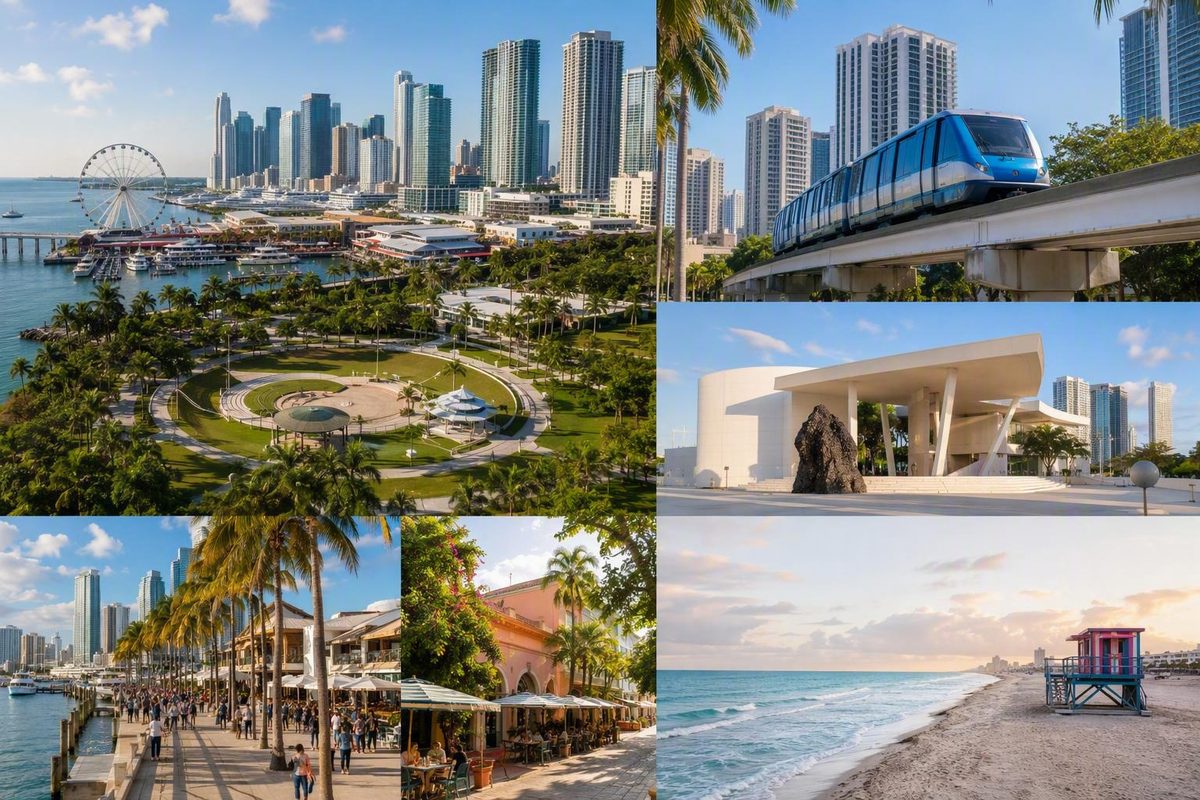
Group Bayfront Park, Bayside and museum stops into compact clusters, use Metromover for longer links, and choose one ticketed anchor.
The most useful shortlist of things to do in Downtown Miami includes Bayfront Park, Bayside Marketplace, Maurice A. Ferré Park, Pérez Art Museum Miami (PAMM), Frost Science, Freedom Tower, Kaseya Center, the Adrienne Arsht Center, and Olympia Theatre. If you want to continue across the Miami River into neighboring Brickell, add Miami Circle as a clearly labeled extension.
Downtown works best as a series of compact waterfront and cultural clusters. Walk within each cluster, use Metromover for longer urban-core connections, and choose one major museum, tour, game, or performance as the day’s ticketed anchor. Keep Brickell and Miami’s more distant neighborhoods for separate outings unless you have deliberately planned the transfer.
Related: Best Boat Tours in Miami by Experience and Boat Size.
Start Here: What Is Actually in Downtown Miami?
This guide focuses on Downtown Miami’s urban core and Biscayne Bay waterfront. Its principal visitor choices fall into four groups:
- Waterfront recreation: Bayfront Park, Bayside Marketplace, Skyviews Miami, sightseeing boats, and Maurice A. Ferré Park
- Museums and family attractions: PAMM, Frost Science, and HistoryMiami Museum
- History and architecture: Freedom Tower, the Alfred I. duPont Building, and Olympia Theatre
- Sports and performing arts: Kaseya Center, the Adrienne Arsht Center, and Olympia Theatre
Downtown and Brickell are neighboring districts separated by the Miami River. If you cross the river to visit Miami Circle or continue through Brickell, describe that portion of the day as a second-district extension.
The same geographic discipline applies to the rest of Miami. **** All may be worthwhile, but adding several of them removes the compact advantage of a downtown-focused day.
One naming detail can prevent map confusion: Maurice A. Ferré Park was formerly called Museum Park. Older guides may still use that name for the bayfront park shared by PAMM and Frost Science.
A quick way to choose
- For art, science, or a family outing: Build around Maurice A. Ferré Park and choose PAMM or Frost Science.
- For waterfront entertainment: Combine Bayfront Park and Bayside Marketplace, then consider the observation wheel or a boat trip.
- For history and architecture: Link Freedom Tower, the duPont Building, Olympia Theatre, and HistoryMiami Museum according to current access.
- For an evening visit: Choose a confirmed game, concert, or performance before adding dinner or waterfront views.
- For a public-space-focused day: Prioritize parks, public art, bay views, architectural exteriors, and Metromover connections.
- For a Downtown-and-Brickell day: Finish the downtown route first, then cross the Miami River for Miami Circle or another Brickell stop.
Downtown is easy to overplan because museums, boats, parks, and event venues look close together on a map. Choose one major ticketed anchor and let public spaces, architecture, or the waterfront fill the flexible parts of the day.
Before leaving, check each venue or operator directly. Hours, admission, exhibitions, timed-entry procedures, games, performances, tour departures, weather cancellations, and temporary closures can vary by date.
Follow the Waterfront from Bayfront Park to Bayside Marketplace
Bayfront Park is a straightforward outdoor introduction to Downtown Miami. The park faces Biscayne Bay and includes public art, an amphitheater, and a fountain, making it suitable for a walk, skyline views, or a break between scheduled attractions. The Greater Miami Convention & Visitors Bureau includes it among the urban core’s waterfront, cultural, and entertainment choices in its Downtown Miami and Brickell guide.
Treat the park as a flexible stop rather than assigning it a fixed duration. Pleasant weather may encourage a longer waterfront pause; heat, rain, crowds, or an approaching reservation may turn it into a shorter link.
It combines waterfront shopping and dining with entertainment, possible live music, sightseeing departures, and the Skyviews Miami observation wheel. It can serve as a meal stop or the starting point for a bay excursion, but it is only one part of Downtown. The museum cluster, historic buildings, and performing-arts venues provide distinct alternatives.
Choose your waterfront experience
Stay on foot for a flexible outing. Walk through Bayfront Park, continue toward Bayside, and decide on food or entertainment after seeing the weather and crowds. This approach does not require committing to a cruise or scheduled ride.
Ride Skyviews Miami for an elevated perspective. Bayside’s attraction directory describes the wheel as more than 200 feet tall, with climate-controlled gondolas and views of Biscayne Bay, Bayfront Park, and the Downtown skyline. The same directory says Thriller Miami advertises a 45-minute public speedboat ride for guests age three and older; both specifications and policies should be reconfirmed before arrival on the official Bayside attractions page.
Choose a sightseeing cruise for a more relaxed water outing. Multiple Biscayne Bay sightseeing experiences operate at or depart from Bayside.
Choose a speedboat for a higher-intensity ride. Faster sightseeing introduces additional considerations, including motion tolerance, minimum-age rules, boarding conditions, and weather. The advertised policy of one operator should not be treated as a rule for every Bayside boat.
Consider a charter for a private group. Yacht charters are designed differently from public sightseeing cruises and may suit celebrations, corporate gatherings, or groups seeking private use of a vessel. Compare the full cost, capacity, departure arrangements, and cancellation policy rather than treating a charter as interchangeable with an individual sightseeing ticket.
| Experience | Best fit | Main planning issue |
|---|---|---|
| Waterfront walk | Flexible visits centered on public space | Heat, rain, shade, and comfort |
| Observation wheel | Elevated city and bay views | Current operation and ticket availability |
| Sightseeing cruise | Seated sightseeing from the water | Schedule, route, and weather policy |
| Speedboat | A faster, more intense experience | Age rules, motion, and boarding conditions |
| Private charter | Private groups and occasions | Availability, capacity, and total cost |
Whichever format you choose, leave room for Downtown beyond Bayside. The next logical waterfront cluster is Maurice A. Ferré Park, where public space connects the city’s principal art and science museums.
Pair Art and Science at Maurice A. Ferré Park
Maurice A. Ferré Park—called Museum Park in older references—is the bayfront setting shared by Pérez Art Museum Miami and the Phillip and Patricia Frost Museum of Science. It is Downtown’s clearest culture-and-family cluster because one outdoor space connects two substantially different indoor attractions.
Choose PAMM for contemporary art and design
PAMM focuses on contemporary art, particularly art of the Americas. Its museum experience also extends into waterfront-oriented spaces and outdoor installations, connecting the building and collection to the park and bayfront setting. These features are summarized in the destination bureau’s downtown museums overview.
Prioritize PAMM if your interests lean toward:
- Contemporary art
- Art of the Americas
- Museum architecture and design
- Outdoor installations
- A culture-centered solo or couples itinerary
Current exhibitions can materially shape the visit. Check what will be on view rather than assuming every gallery, installation, or program is continuously available.
Choose Frost Science for science and a family outing
Frost Science includes both an aquarium and a planetarium. That combination makes it the clearest family-focused indoor attraction in this guide and a natural choice for visitors interested in marine life, interactive science, or multiple kinds of exhibits in one venue.
Prioritize Frost Science if your group wants:
- An aquarium
- A planetarium
- Science-focused exhibits
- A family-oriented indoor anchor
- An alternative to an outdoor-heavy itinerary
PAMM and Frost Science are both major attractions, not quick boxes to check. For a short visit, choose one. Consider both only when museums are the main purpose of the day; otherwise, a second admission can crowd out the waterfront, historic landmarks, or an evening event.
Maurice A. Ferré Park is part of the experience rather than merely the space between buildings. Use it for bay views, public space, and an outdoor reset before or after the museum. This also makes the cluster useful in changeable weather: park time can expand when conditions are pleasant or contract while the museum remains the day’s indoor anchor.
Before visiting, consult the relevant museum directly for current hours, admission, timed-entry practices, exhibition availability, planetarium arrangements, and accessibility. General admission should not be assumed to resolve every show, program, or entry requirement.
A balanced approach might look like this:
- Short visit: One museum and a brief park walk
- Culture-focused half day: PAMM, the park, and Freedom Tower or Bayside
- Family half day: Frost Science, the park, and one simple additional attraction
- Museum-focused full day: PAMM and Frost Science, with outdoor breaks
- Changeable-weather day: One museum as the fixed anchor, with park time adjusted to conditions
Find Downtown Miami’s History and Architecture
Downtown’s history appears in cultural institutions, landmark façades, and buildings whose interiors may not always be open. Treat these places as a self-guided theme rather than a precisely measured walking trail.
Freedom Tower
Freedom Tower is one of the urban core’s defining historic buildings. It formerly served as a processing center for Cuban refugees and now contains Miami Dade College art and cultural exhibitions. Its role connects architecture and migration history with contemporary cultural programming, as outlined in the destination bureau’s Downtown Miami neighborhood guide.
Check current exhibition and interior-access details before visiting. Even when interior access is restricted, the building can remain an architectural stop that pairs naturally with Maurice A. Ferré Park.
Miami Circle
Miami Circle is a nearby Brickell extension, not a Downtown attraction. The site measures 38 feet across and is preserved as a National Historic Landmark, according to the destination bureau’s downtown-and-Brickell coverage.
Its riverfront setting makes it a logical addition after Downtown, but crossing the river changes the itinerary from a Downtown-only route into a Downtown-and-Brickell route. That distinction matters when estimating how much ground to cover.
Alfred I. duPont Building
The Alfred I. duPont Building adds early skyscraper architecture to a downtown route. Miami’s destination marketing organization describes it as the city’s only Art Deco skyscraper. It is best approached as an architectural landmark whose interior access may differ from that of a public museum.
Pair it with Olympia Theatre and Freedom Tower to compare historic façades with the modern towers around them. If interior access is important, verify it before arrival rather than assuming that landmark status means casual public entry.
Olympia Theatre
You can include the exterior in a self-guided route or organize an evening around a confirmed event.
Consult the theatre’s current calendar and access information. A daytime look at the exterior does not guarantee that the auditorium will be open, and a performance should never be assumed for a particular date.
HistoryMiami Museum
HistoryMiami Museum is a Smithsonian Affiliate presenting the history of Miami and South Florida. It is the most direct indoor choice for visitors who want broad regional context rather than a sequence of outdoor landmarks.
The correct institutional name is HistoryMiami Museum.
A history-focused day could combine HistoryMiami Museum with selected architectural exteriors. It does not need to expand into Calle Ocho: Little Havana offers related Cuban and Cuban American cultural context, but it is a different neighborhood and is better treated as a separate outing.
How to structure the theme
Choose two or three stops instead of attempting to enter every building:
- Begin with an indoor historical or cultural anchor, such as HistoryMiami Museum or an accessible Freedom Tower exhibition.
- Add one or two architectural exteriors, such as the duPont Building and Olympia Theatre.
- Finish at Bayfront Park or Maurice A. Ferré Park.
- If time and mobility allow, cross the Miami River and add Miami Circle as a Brickell extension.
Exhibition installation, restoration work, private events, and other building conditions can affect access. A landmark visible from the street is not necessarily open for interior touring.
Plan an Evening Around Sports, Theater, or Skyline Views
Downtown becomes easier to plan after dark when the evening has one confirmed anchor. Choose the date-specific event first, then fit dinner and waterfront time around it.
Kaseya Center
Its location near Bayside and the waterfront makes it possible to combine an event with Bayfront Park, dining, or an earlier bay outing.
A game or concert is not an everyday attraction. Confirm the calendar, ticket, entrance, and event-specific rules before building the evening around the arena.
Adrienne Arsht Center
The Adrienne Arsht Center is a major performing-arts complex containing the Ziff Ballet Opera House, Knight Concert Hall, and Carnival Studio Theater. Kaseya Center’s event role and the Arsht Center’s component venues are identified in the Greater Miami Convention & Visitors Bureau’s urban-core attractions guide.
Programming may involve different art forms and different buildings within the complex. Confirm both the production and its specific venue rather than treating the Arsht Center as a single auditorium.
Olympia Theatre
Olympia Theatre provides another calendar-dependent option, especially for visitors who want to connect performance with historic architecture. Do not assume there will be a production every night or that daytime architectural access implies evening programming.
No-event evening alternatives
If no suitable game or performance is available, consider:
- Watching the skyline change from the waterfront
- Dining or browsing at Bayside Marketplace
- Riding Skyviews Miami if it is operating
- Booking a scheduled evening boat experience if availability and weather permit
- Pairing an early museum visit with dinner and a shorter waterfront walk
Rooftop venues and Brickell nightlife can extend the evening, but they should be identified as adjacent-district choices. Crossing the Miami River is a valid addition; it simply creates a two-district itinerary.
Before leaving, check ticket availability, age policies, bag and entry rules, event-related street conditions, and return transportation. Do not rely on old editorial listings for restaurant hours, dress codes, cover charges, or promotions.
Choose Activities for Families, Couples, Solo Travelers, and Tight Budgets
The right plan depends less on collecting attractions than on matching a compact cluster to the people traveling.
Families
Start with Frost Science, then use Maurice A. Ferré Park as the flexible outdoor portion of the day. Add only one more attraction: Skyviews Miami, Bayside, or a boat outing with rules appropriate for the children in your group.
The observation wheel provides a contained experience with elevated views. A boat can add more motion and weather exposure, so confirm current age rules, boarding conditions, trip style, and cancellation policies directly with the operator.
Keep the schedule adjustable. A museum-and-park plan is easier to shorten than a day organized around multiple prepaid departures.
Couples
Pair one cultural or architectural anchor with an unhurried waterfront finish. Possible combinations include:
- PAMM and bay views
- A history-and-architecture route followed by dinner
- Maurice A. Ferré Park and a scheduled performance
- Bayfront Park followed by an evening cruise
- Olympia Theatre or the Arsht Center after an early waterfront meal
The main tradeoff is flexibility versus certainty. Parks and public spaces leave room for changes; cruises and performances create fixed deadlines.
Solo travelers
Downtown’s museums, public art, architecture, parks, and waterfront clusters can be explored without arranging a private group. A solo visitor can select a museum according to current exhibitions, shorten outdoor sections when necessary, and use Bayside as either a meal stop or a sightseeing departure point.
Public cruises, performances, museums, and the observation wheel may all fit a solo itinerary when schedules and ticketing align. Private charters are structured for private use and should be evaluated separately rather than treated as an equivalent sightseeing format.
Budget-conscious visitors
Build the day around public space and self-guided sightseeing:
- Bayfront Park
- Maurice A. Ferré Park
- Public art
- Waterfront views
- Architectural exteriors
- Metromover connections
If you want to include Miami Circle, treat it as an optional Brickell extension after crossing the river.
A practical strategy is to choose one paid anchor and keep the rest of the day flexible. That anchor might be a museum, boat trip, observation-wheel ride, or event.
Rain or extreme heat
Prioritize PAMM, Frost Science, indoor dining or shopping, and a confirmed indoor performance. Keep park and waterfront sections short and optional.
Miami Finder’s rainy-day planning guide recommends using indoor anchors, short transfers, and flexible outdoor windows. Applied downtown, that means choosing one dependable indoor attraction and treating the waterfront as an adaptable part of the day rather than its fixed structure.
Regardless of group type, verify needs that are not established uniformly here, including stroller and wheelchair access, restrooms, seating, shade, sensory accommodations, and boat boarding procedures. A compact or family-oriented route is not automatically suitable for every visitor.
Explore Downtown Without Renting a Car
The principal Downtown Miami clusters can be combined without renting a car when mobility, weather, reservations, and transit conditions allow. Metromover is an elevated transit service connecting Downtown, Brickell, and the Arts District, and published visitor guidance identifies it as fare-free. See the supporting car-free Miami transit overview.
Use a simple three-part strategy:
- Walk within one compact cluster.
- Use Metromover when switching between urban-core areas.
- Avoid adding several dispersed Greater Miami neighborhoods to the same day.
Bayfront Park and Bayside Marketplace form one natural waterfront cluster. Maurice A. Ferré Park, PAMM, and Frost Science form another. Historic and architectural stops can be layered between them according to access, interests, and mobility.
City trolleys provide another downtown transportation option, but routes and schedules can change. Consult official service information rather than reproducing a timetable from an older visitor guide.
Walking is useful inside compact groups, but not every route will feel equally manageable. Heat, rain, construction, crowds, mobility needs, and event closures can change what looks simple on a map. A short unshaded segment may be more demanding than a longer indoor transfer.
Downtown addresses use NE, NW, SE, and SW quadrants divided at Flagler Street and Miami Avenue. Reading both the quadrant and street type can help prevent errors in a grid with repeated numbers; this street-grid convention is explained in a Miami transportation guide.
Destinations elsewhere in Greater Miami are more dispersed. Miami Finder’s guide to exploring Miami without renting a car recommends choosing one base and focusing on one geographic cluster at a time.
Before travel, check current transit service, station access, elevator status, construction detours, and event-related closures through official transit information. Do not assume that normal service or access will apply on a major event day.
Ready-to-Use Downtown Miami Itineraries
These itineraries are organized by cluster rather than minute-by-minute walking estimates. Weather, mobility, construction, crowds, reservations, and major events can all change how long a route takes.
Two-hour waterfront plan
- Begin at Bayfront Park for Biscayne Bay views, public art, and a short walk.
- Continue to Bayside Marketplace for waterfront browsing.
- Choose one finish: - Take a flexible waterfront break, or - Ride Skyviews Miami if current timing and ticket availability work.
Do not add a museum or boat unless its schedule clearly fits. The strength of this plan is its flexibility.
Half-day culture plan
- Choose PAMM or Frost Science as the main attraction.
- Spend outdoor time in Maurice A. Ferré Park.
- Continue toward either: - Freedom Tower for history and architecture, or - Bayside for food and waterfront activity.
Choosing one museum leaves room to experience the district instead of rushing through two admissions.
Full-day highlights plan
- Start with Frost Science or PAMM.
- Add the second museum only if it is a genuine priority.
- Walk through Maurice A. Ferré Park and another waterfront area.
- Stop at Bayside Marketplace for a meal or break.
- Finish with one confirmed activity: - Sightseeing cruise - Speedboat ride - Miami HEAT game - Concert - Arsht Center production - Olympia Theatre event
If both museums are on the schedule, keep the waterfront and Bayside portions intentionally loose.
Family plan
- Make Frost Science the indoor anchor.
- Use Maurice A. Ferré Park for a flexible outdoor break.
- Select one additional attraction according to: - Children’s ages - Energy levels - Weather - Motion tolerance - Current operator rules
The third stop might be Skyviews Miami, Bayside, or an appropriate boat outing. Avoid committing to several fixed-time activities.
Budget plan
- Walk through Bayfront Park.
- Browse the public waterfront areas around Bayside.
- Visit Maurice A. Ferré Park.
- Look for public art and architectural exteriors.
- Use Metromover for a longer urban-core connection.
- If desired, cross the river and add Miami Circle as a Brickell extension.
Keep one optional paid choice in reserve and decide only after checking the day’s weather and availability.
Rainy-day plan
- Begin at PAMM or Frost Science.
- Add the second museum only if admission, energy, and timing make sense.
- Use indoor dining or shopping as the transition.
- Finish with a scheduled indoor performance, concert, or game.
- Shorten or remove park and waterfront links when conditions require it.
This plan works best when reservations remain concentrated in the urban core rather than scattered across Miami.
Evening plan
- Start with waterfront views or dinner near Bayfront Park or Bayside.
- Continue to a confirmed event at: - Kaseya Center - Adrienne Arsht Center - Olympia Theatre
- If no event fits, substitute a currently operating observation-wheel or boat experience.
Plan the return trip before the event starts, particularly when a large crowd may affect streets, transit access, or pickup points.
Pre-trip checklist
Before departure, confirm:
- Opening hours and temporary closures
- Admission prices and timed-entry requirements
- Museum exhibitions and planetarium arrangements
- Restaurant or indoor-stop operating status
- Boat reservations, departure points, and weather policies
- Event tickets and venue entry rules
- Metromover, trolley, and other transit status
- Age requirements
- Wheelchair and stroller access
- Restrooms, seating, shade, and sensory needs
- Construction and event-related detours
The simplest rule is to choose one Downtown Miami cluster, add one major ticketed anchor, and leave room for the waterfront. A first visit can center on a museum, a park, Bayside, and one evening activity without crossing several distant neighborhoods.
Keep Brickell and the rest of Miami as clearly labeled extensions. Use Metromover for longer urban-core links, maintain an indoor weather backup, and verify volatile venue, tour, event, and transportation details before departure.
Frequently Asked Questions
Can you explore Downtown Miami without a car?
Yes, provided you organize the day by cluster and account for mobility, weather, reservations, and current transit service. Walk within the Bayfront–Bayside or Maurice A. Ferré Park areas, then use Metromover for longer urban-core links. City trolleys may also help, depending on current routes.
A car-free plan becomes less efficient when it includes several distant neighborhoods. Keep the day downtown or add only one carefully planned extension by rail, bus, trolley, or rideshare.
What are the best free things to do in Downtown Miami?
Public-space ideas include Bayfront Park, Maurice A. Ferré Park, waterfront walking, public art, and self-guided viewing of architectural exteriors. Metromover has also been identified as fare-free in the cited visitor guidance, although current transit status should still be checked.
Browsing Bayside’s public-facing areas can fit the same plan, but shopping, dining, the observation wheel, and boat tours involve separate spending. Miami Circle can be added after crossing into Brickell, but it should not be labeled a Downtown attraction.
Is Brickell part of Downtown Miami?
No. Brickell and Downtown are neighboring urban districts separated by the Miami River. Tourism guides often discuss them together, but Brickell City Centre, Brickell Key, Miami Circle, and Brickell nightlife should be labeled as Brickell rather than Downtown attractions.
A route that crosses south over the river is a Downtown-and-Brickell itinerary, not a Downtown-only itinerary.
What can you do in Downtown Miami when it rains?
Choose PAMM or Frost Science as the main indoor anchor, then add indoor dining, shopping, or a confirmed performance. If conditions improve, use a short walk through Maurice A. Ferré Park or along the waterfront as a flexible break.
Keep transfers short and avoid making a weather-sensitive outdoor booking the sole purpose of the day. Boat trips and outdoor attractions may be delayed or canceled, so review operator policies before departure.
Where do sightseeing cruises and speedboat tours leave from downtown?
Multiple sightseeing boats and speedboat experiences operate at or depart from Bayside Marketplace. Exact docks, check-in points, schedules, and boarding procedures vary by operator; Bayside’s current attraction directory identifies the formats and listed providers.
Confirm the departure point after booking. “Bayside” alone may not be specific enough to locate the correct vessel, so also verify arrival time, age rules, accessibility, prices, and weather policies.