
How to Brown the Bacon Without Drying Out the Salmon
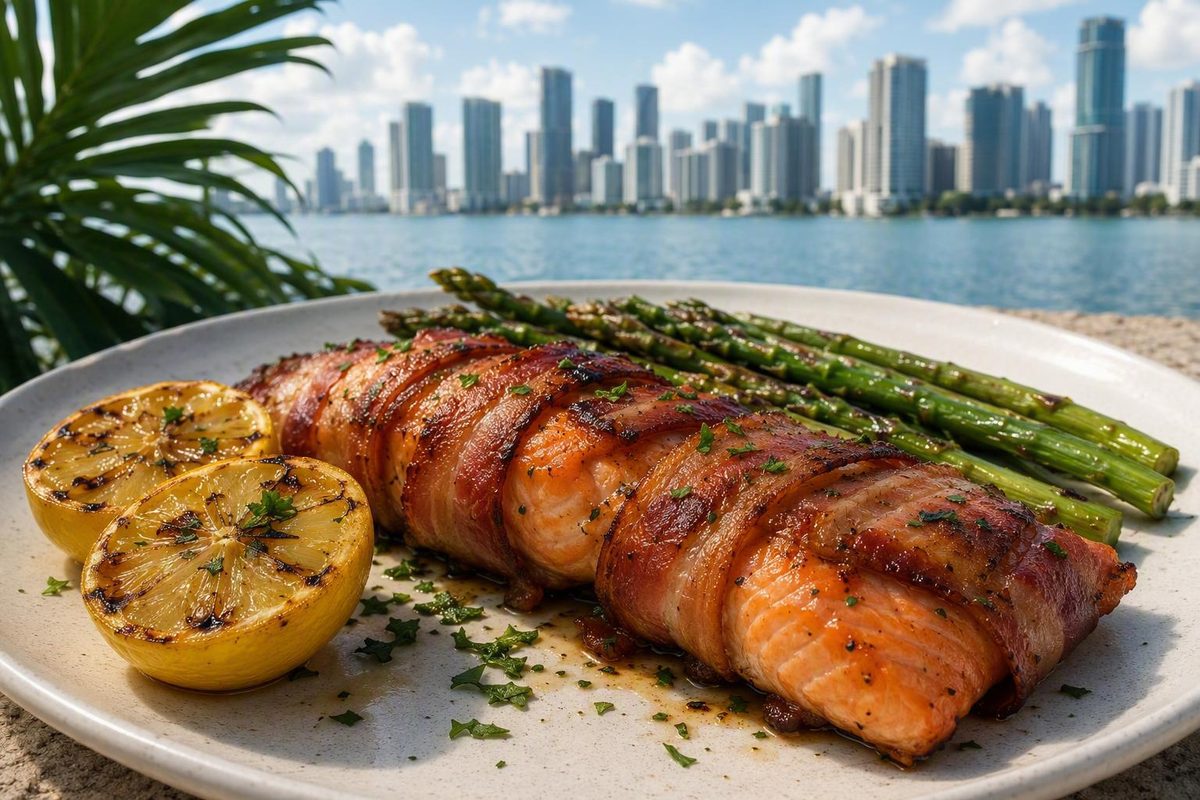
Wrap with raw, relatively thin bacon. For crisp thick bacon, cook it separately as a topping or use precooked crumbles in a breadcrumb crust.
A good salmon and bacon recipe has to reconcile two different cooking schedules: salmon cooks relatively quickly, while raw bacon needs enough direct heat to render and brown. Leaving both in the oven until the bacon looks crisp can result in overcooked fish.
This guide focuses on salmon fillets wrapped in pork bacon. It also covers bacon crusts, cooked bacon toppings, bacon grease, and the separate fish preparation sometimes called “salmon bacon.”
First, Decide Which Kind of Salmon and Bacon Recipe You Want
Within the reviewed recipe evidence, the dominant interpretation of “salmon and bacon recipe” is salmon served with conventional pork bacon—especially a fillet wrapped in raw bacon. Bacon appears in four distinct formats:
- Wrapped raw around the fillet. The bacon and salmon cook together, often with a sear followed by an oven or broiler finish.
- Precooked and added as a crust. Crumbled bacon is combined with breadcrumbs, aromatics, and oil before being spooned over the fish.
- Crumbled over cooked salmon. The fish is grilled or baked separately, and crisp bacon is added at the end.
- Used indirectly through its rendered fat. The salmon is pan-cooked in bacon grease without bacon strips on the finished plate.
“Salmon bacon” can mean something else: a bacon-like product made from fish. One version cuts smoked salmon into pieces and bakes them at 400°F for 15–20 minutes, flipping them halfway through. It uses 8 ounces of smoked salmon and cooking spray. Smoked salmon should not automatically be treated as synonymous with lox, and this preparation is not salmon wrapped in pork bacon. See the oven-baked salmon bacon method.
Another fish-based version starts with very thin raw salmon strips. They are marinated in a mixture containing soy sauce or coconut aminos, maple syrup, liquid smoke, and crushed red pepper, then dehydrated at 145°F for six hours. The result is described as a thin, jerky-like product that can be crumbled into salads, chowders, egg dishes, or sandwiches. The full quantities appear in Fish Alaska’s dehydrated salmon bacon recipe.
If you want dinner for two to four people, use the pork-bacon-wrapped method below. If you want a crisp garnish or fish-based snack, follow one of the dedicated “salmon bacon” preparations rather than adapting the wrapping instructions.
Reference Recipe: Lemon-Tarragon Bacon-Wrapped Salmon
This reference preparation follows the ingredients and skillet-to-oven schedule published by Paleo Leap. It has not been independently tested or developed by this publication. Techniques from other recipe authors are identified separately rather than presented as parts of the original method.
Yield: 4 servings Preparation: 10 minutes Cooking: approximately 15 minutes Total: approximately 25 minutes
The recipe uses four fillets weighing about 5 ounces each, for a combined total of 20 ounces, or 1.25 pounds. It pairs them with eight bacon slices, two tarragon sprigs, the zest of one lemon, cooking fat, seasoning, and an optional two tablespoons of maple syrup or honey. Its source page contains a contradictory total-weight description, but the individual fillet weights support the 20-ounce calculation. See the original lemon-tarragon bacon-wrapped salmon recipe.
Ingredients
- 4 salmon fillets, about 5 ounces each
- 8 slices bacon
- 2 sprigs fresh tarragon, divided among the fillets
- Zest of 1 lemon
- Freshly ground black pepper
- A restrained amount of salt, if needed
- Enough cooking fat or neutral cooking oil to coat the skillet lightly
- 2 tablespoons maple syrup or honey, optional
Use two bacon slices per fillet. Slightly overlapping the strips can help cover the fish and provide enough length to tuck the ends underneath.
Thin-cut bacon is a practical choice when the fish and bacon must finish at nearly the same time. Sugar, Spice and Glitter specifically recommends thin bacon because it should crisp more evenly without requiring as much cooking time as a thicker slice. That is recipe-author guidance, not proof that thin bacon is best for every salmon preparation. Its maple-glazed recipe also uses two slightly overlapping strips per fillet.
Use additional salt sparingly. Bacon is cured, and smoked bacon may be particularly assertive. Dijon mustard, miso, seasoned breadcrumbs, Parmesan, and bottled sauces can add still more salt in the variations.
Equipment
- Ovenproof skillet large enough to hold the wrapped fillets without crowding
- Tongs or a wide spatula
- Instant-read thermometer
- Small bowl and pastry brush if using a glaze
- Oven mitts
The cited skillet-to-oven method depends on an ovenproof pan. If you do not have one, choose one of the separately documented oven, foil, or grilling methods later in this guide rather than assuming the same timing will apply after an unsupported pan transfer.
Wrap, Sear, and Finish the Salmon Step by Step
1. Thaw frozen fish completely
The reviewed foil and maple-glaze recipes permit frozen salmon after it has been completely thawed. Before seasoning, blot the top, bottom, and sides of each fillet. Do not begin this recipe while the center remains icy or the exterior is visibly wet; the relevant recipe guidance calls for fully thawed fish and a dry surface. The foil preparation states the frozen-fish allowance in its method and doneness guidance.
The supplied evidence does not include an authoritative food-safety source establishing approved thawing procedures. Follow applicable official guidance for thawing seafood rather than treating a recipe blog as comprehensive safety instruction.
2. Heat the oven
Preheat the oven to 375°F. The underlying recipe uses that temperature for its skillet-to-oven preparation and lists an overall cooking period of about 15 minutes. Paleo Leap provides the complete temperature and schedule.
Have the oven ready before searing so the fillets can move directly into the finishing stage.
3. Season cautiously
Season the dried salmon with black pepper and only a small amount of salt, if needed. Divide the lemon zest and tarragon among the four portions.
Keep the seasoning primarily on the fish. Heavy seasoning over the bacon can make the combined dish saltier than the plain salmon initially suggests.
4. Wrap each fillet
Lay two bacon slices on a clean work surface, overlapping them slightly if necessary. Set one salmon fillet across the strips and bring the bacon around the fish.
Keep the wrap snug enough to maintain contact without stretching the bacon until it tears. Tuck the ends underneath the fillet. The source recipe specifies two slices around each portion; the seam-underneath arrangement is a practical technique used in other reviewed bacon-wrapped preparations.
5. Begin with the bacon ends underneath
Place the wrapped fillets with the tucked bacon ends against the pan first.
The Almond Eater specifically directs cooks to place the bacon ends downward so they begin adhering to the fish, then sear the portions for two minutes per side before baking. That seam-first direction is useful wrapping guidance, although its complete recipe uses a different oven temperature and schedule from this reference preparation. See the seam-first bacon-wrapped salmon method.
Leave enough room to turn each portion as a unit. If the pan is too small, sear in batches.
6. Brown briefly on both sides
Sear the wrapped salmon for about two minutes on the first side. Turn it carefully with tongs or a wide spatula, then brown the opposite side for approximately two minutes. These timings come from the underlying lemon-tarragon recipe.
The purpose of this stage is to begin coloring and rendering the bacon, not to finish the salmon on the stovetop. If a strip shifts, guide it back around the fish while supporting the entire portion.
7. Finish in the oven
Transfer the skillet to the preheated 375°F oven and bake for approximately 8–10 minutes. Begin checking earlier when the fillets are relatively thin or received a strong initial sear.
Treat the listed time as the source recipe’s estimate, not a universal schedule.
8. Check the center with a thermometer
Insert an instant-read thermometer into the thickest part of the salmon without measuring only the bacon or touching the pan. Two reviewed recipe sources use 145°F as their target; the maple-glaze recipe places that target alongside its skillet-and-broiler method. See its temperature guidance for bacon-wrapped salmon.
This is the numerical benchmark used by the supplied recipe evidence, not a substitute for official food-safety guidance. The evidence pack does not contain an authoritative government or recognized food-safety source with which to independently validate the target.
Opacity, firmness, and flaking can indicate cooking progress, but they do not provide the same measurement as a thermometer. Begin checking before the maximum estimated time rather than continuing to bake solely because the bacon looks pale.
9. Handle the optional glaze as a separate variation
The underlying lemon-tarragon source includes optional maple syrup or honey in its recipe.
Because the late-glaze approach comes from a separate recipe and has not been tested with this exact skillet-to-oven combination, treat it as an optional variation: either omit the sweetener or apply a light coating only at the end. Do not assume that a heavy glaze will behave the same way through the full sear and bake.
10. Serve promptly
Let the portions stop actively sizzling, then serve. The method is intended to give the bacon direct heat before the fish completes its oven finish, but it does not guarantee uniformly crisp bacon. Bacon thickness, fillet shape, pan heat, and oven performance all affect the result.
How to Get Better-Browned Bacon Before the Salmon Dries Out
Extending the bake indiscriminately cooks both ingredients, so it is not a reliable way to improve bacon color.
Five practical choices recur across the reviewed recipes:
-
Use relatively thin bacon for wrapping. One recipe author recommends it because it should crisp in less time than thick bacon.
-
Brown the exterior before baking. The skillet gives the bacon direct initial contact with a hot surface.
Foil produces a different result. Oh Sweet Basil’s foil method addresses that limitation by opening the packets after baking and broiling the exposed portions for about one minute. Its recipe bakes at 425°F for 9–12 minutes before that brief finish and specifically cautions against burning the bacon. The full schedule appears in the foil-baked mustard-maple salmon recipe.
Treat any broiler time as an observation window rather than a promise.
Do not invent a partial-cooking schedule for thick bacon and assume it will work for every brand or slice. If pronounced crispness matters more than the wrapped appearance, cook the bacon separately and add it as a topping, or use precooked crumbles in a crust. Those formats separate the bacon’s cooking schedule from the salmon’s.
Most importantly, check the fish before extending its cooking time for color. The supplied recipes do not support a universal thickness chart or a dependable rescue procedure once the salmon has already reached the cook’s chosen target.
Choose a Flavor Path: Maple-Dijon or Fully Savory
The bacon wrap can support sweet, tangy, herbal, or peppery flavors. Choose one coherent direction rather than combining every available seasoning.
Maple-Dijon
For a sweet-tangy version, combine maple syrup with Dijon mustard. One foil recipe adds garlic and mayonnaise, while a grilled recipe uses the simpler maple-Dijon pairing.
Apply the glaze modestly. Mustard can contribute salt, and maple syrup is exposed to less intense heat if added late. Honey-Dijon and spicy maple are also listed as variation ideas in the reviewed recipes, but different sweeteners and hot sauces should not be assumed to brown identically.
Lemon-tarragon
For a version without added sweetener, use the reference combination of lemon zest, fresh tarragon, black pepper, and restrained salt.
Divide the two tarragon sprigs among all four fillets rather than covering each portion heavily.
Herb butter
Another savory preparation combines 125 grams of butter with two teaspoons each of chopped chives and lemon thyme, plus black pepper, for two approximately 200-gram salmon fillets. If lemon thyme is unavailable, the recipe substitutes ordinary thyme with one teaspoon of lemon juice. Nigel Slater’s complete salmon with herb butter and smoked bacon recipe roasts that separate preparation at 200°C for 20 minutes.
Do not add the entire herb-butter quantity to the four-serving reference recipe and assume the result has been validated. Borrow the flavor combination in a quantity appropriate to your portions, accounting for the richness and salt already supplied by the bacon.
Other source-listed ideas include garlic-Parmesan, alternate herb butters, and prosciutto. Treat them as inspiration rather than direct substitutions: prosciutto and conventional bacon differ in thickness, fat, salt, and cooking behavior.
Avoid assigning dietary labels to any version without checking every packaged ingredient. Bacon, mustard, mayonnaise, miso, breadcrumbs, Parmesan, and prepared sauces can all affect whether the complete dish meets a particular requirement.
Other Supported Ways to Pair Salmon With Bacon
Wrapping and searing are not mandatory. The methods below use different ingredient arrangements, temperatures, and cooking sequences. They should be treated as separate recipes, not interchangeable stages of one master preparation.
Foil packets
Place each fillet over two bacon slices, season it, and add a sauce made with maple syrup, Dijon mustard, garlic, and mayonnaise. Add sliced onion, fold the bacon over the salmon, and enclose each portion in foil.
Bake at 425°F for 9–12 minutes, then open the packets and expose the bacon. The cited recipe calls for broiling for approximately one minute while watching the food closely. This format contains the sauce and reduces stovetop handling, although the enclosed moisture makes the final broiler stage important for color.
Bacon-and-breadcrumb crust
For three to four salmon fillets, combine:
- 1 cup seasoned breadcrumbs
- 4–5 strips precooked, crumbled bacon
- 2 chopped green onions
- 3 tablespoons olive oil
- ¼ teaspoon garlic powder
Spoon the mixture over the fish and bake at 400°F for approximately 15 minutes. Both the ingredient list and the author’s clarification specify precooked bacon. The quantities and schedule come from this bacon-crusted salmon preparation.
Because the source does not specify fillet weight or thickness, begin assessing the fish rather than assuming every portion will finish at exactly 15 minutes. Seasoned breadcrumbs and bacon can both contribute salt.
Grilled salmon with bacon topping
For a grill-based version, combine Dijon mustard and maple syrup, then brush the mixture over seasoned, skin-on salmon. The source recipe preheats the grill to 375°F and adds four slices of cooked, crumbled thick-cut bacon after the fish leaves the grill. See the grilled maple-Dijon salmon with bacon.
The source contains a malformed salmon quantity and unclear skin-handling directions. It therefore does not support reconstructing a dependable yield or expanding the method into a more detailed grilling schedule. Its useful concept is glazed grilled salmon finished with cooked bacon, not a precise adaptation of the wrapped recipe.
Salmon cooked in bacon grease
The most minimal option uses bacon flavor without serving bacon strips. Melt one tablespoon of bacon grease and one tablespoon of butter in a large skillet over medium heat. Add four boneless, skinless salmon portions and cook for approximately four to five minutes per side, adjusting for thickness. Those quantities and timings come from this bacon-grease salmon skillet method.
This version does not provide crisp bacon as a contrasting texture. Its advantage is a short ingredient list and no wrapping, oven transfer, breadcrumb topping, or glaze.
Do not combine the foil temperature, crust quantities, grill directions, and skillet timing into one supposedly validated recipe. Each method exposes the fish to heat differently. No air-fryer method is included because the supplied evidence does not establish one.
Troubleshooting Common Salmon-and-Bacon Problems
The bacon comes loose
Tuck the bacon ends underneath the fillet and begin with that side against the skillet. Allow the wrap to start adhering before attempting the first turn.
Support the whole portion with a wide spatula or stabilize it with tongs. Do not pull on one exposed strip.
The surface is wet and will not brown
Verify that previously frozen salmon has thawed completely, then blot every exposed surface before seasoning. Keep the initial wrap relatively dry.
Reserve liquid and sweet sauces for the finish when possible.
The bacon remains pale
For the next batch, use thinner slices, maintain contact between the bacon and fish, and brown the exterior before the oven stage. If you prefer very crisp or thick bacon, switch to a crust or finishing topping made with separately cooked bacon.
Check the salmon before adding more cooking time. Bacon color alone is not a dependable measure of the fish’s progress.
The glaze burns
Use a thin coating and add maple syrup or honey late. One reviewed method brushes maple syrup over the salmon after broiling rather than exposing it to the broiler.
If a glaze is already darkening rapidly, do not apply another heavy layer before returning the fish to intense heat.
The salmon is dry
Begin checking before the maximum estimated time, particularly with thin portions. Measure the thickest part rather than relying only on elapsed minutes.
Flaking, opacity, and firmness can signal progress, but a thermometer provides a numerical reading.
The finished dish is too salty
Reduce or omit added salt. Be particularly restrained when using smoked bacon, Dijon mustard, seasoned breadcrumbs, miso, Parmesan, or concentrated sauces.
Lemon zest, lemon juice at service, tarragon, chives, thyme, parsley, and black pepper can add contrast without another heavy salty component.
The wrap breaks or looks awkward
Salmon fillets are irregular, so a perfectly symmetrical wrap is unnecessary. Slightly overlap the strips, keep them reasonably snug, and tuck uneven ends beneath the fish.
If a fillet is broad, the bacon may cover only part of its length. Do not stretch a slice until it tears merely to achieve complete coverage.
The pan splatters
Bacon releases fat while it cooks, so some splattering may occur. Use a skillet large enough to turn the portions without crowding and handle the fish with controlled movements.
The supplied evidence does not establish exact draining intervals, smoke-control procedures, or a guaranteed way to prevent splatter. Adjust the heat and handling to the conditions in the pan rather than following an invented timetable.
Sides and Serving Combinations That Balance the Dish
The lemon-tarragon preparation suggests asparagus, green beans, or mashed potatoes. Roasted asparagus and green beans work particularly well when lemon is already part of the main dish.
Other reviewed recipes suggest roasted vegetables with rice or pasta, or serving the salmon over greens. These combinations let you control the overall weight of the meal: potatoes and pasta make it more substantial, while greens and roasted vegetables keep the focus on the fish.
Cauliflower rice with avocado dressing is another complete-meal direction. The cited preparation blends avocado with cilantro, garlic powder, salt, and water, then serves the dressing with bacon-wrapped salmon and cauliflower rice.
Rice or cauliflower rice can also be combined with vegetables, herbs, avocado, or pesto. Another reviewed preparation offers an optional sauce made from tahini, white miso, lemon juice, seasoning, and water. Because both miso and bacon contribute salt, use that combination sparingly. The proportions appear in the bacon-wrapped salmon with tahini-miso sauce.
As culinary contrast rather than a proven nutritional rule, vegetable-forward and acidic accompaniments can offset the richness of salmon and bacon. Options include:
- Roasted asparagus with lemon
- Green beans with black pepper
- A lightly dressed green salad
- Roasted broccoli or cauliflower
- Rice with chopped herbs
- Mashed potatoes with restrained seasoning
- Pasta with lemon and greens
- Cauliflower rice with avocado or herbs
Serve lemon wedges at the table if desired. They let diners add brightness without committing the entire dish to another sauce.
Do not assume any combination is inherently keto, low-carb, gluten-free, dairy-free, Whole30, or AIP. Those labels depend on the exact bacon, breadcrumbs, butter, mustard, miso, mayonnaise, pesto, dressing, and side ingredients used.
Frequently Asked Questions
What internal temperature should bacon-wrapped salmon reach?
Two recipes in the supplied evidence use 145°F in the thickest part of the salmon as their internal-temperature target. Check the fish itself rather than measuring only the bacon or touching the pan with the thermometer probe. The maple-glazed bacon-wrapped recipe states the 145°F target.
That figure is the benchmark provided by the reviewed recipe sources. Because the supplied evidence does not include an authoritative food-safety publication, consult applicable official guidance if you need a validated safety standard for a particular diner or circumstance.
Can I use frozen salmon for this recipe?
Yes, according to two of the reviewed recipes, provided the fish is completely thawed before cooking. Pat the top, bottom, and sides dry before seasoning and wrapping.
Do not begin while the center remains icy. The supplied evidence supports the use of fully thawed frozen fillets but does not establish comprehensive safe-thawing procedures.
Should bacon be cooked before wrapping it around salmon?
For the core skillet-to-oven method, use raw, relatively thin bacon. It remains flexible enough to wrap around the fish, and the initial sear begins browning it before the oven finish.
Do not assume thick-cut bacon will finish on the same schedule. When crisp thick bacon is the priority, cook it separately and use it as a topping, or use precooked crumbles in a breadcrumb crust.
How do I keep the bacon attached to the fillet?
Wrap the strips snugly, tuck the ends underneath the salmon, and place that side against the skillet first. The fillet’s weight holds the ends down while the bacon begins to cook.
When turning, support the entire portion with a wide spatula or stabilize it with tongs. Minor shifting is normal because bacon slices and salmon fillets vary in shape.
Is salmon bacon the same as salmon served with pork bacon?
No. Salmon served with pork bacon contains two distinct ingredients, whether the bacon is wrapped around the fish, added as a crust, crumbled over the top, or represented through rendered bacon fat.
“Salmon bacon” can instead mean smoked salmon baked into browned pieces or thin, marinated salmon strips dehydrated into a jerky-like product. Those fish-based preparations can fill some of bacon’s culinary roles, but they are not pork bacon and should not be expected to reproduce its exact flavor or texture.
For the wrapped preparation, keep the sequence simple: use completely thawed and dried salmon, season cautiously, wrap each fillet with relatively thin bacon, tuck the ends underneath, brown briefly, and finish according to the fish’s measured temperature rather than the clock alone. If crisp bacon matters more than the wrapped presentation, use precooked bacon as a crust or topping instead.