
A Calmer Miami Beach Base Without Leaving the Action Behind
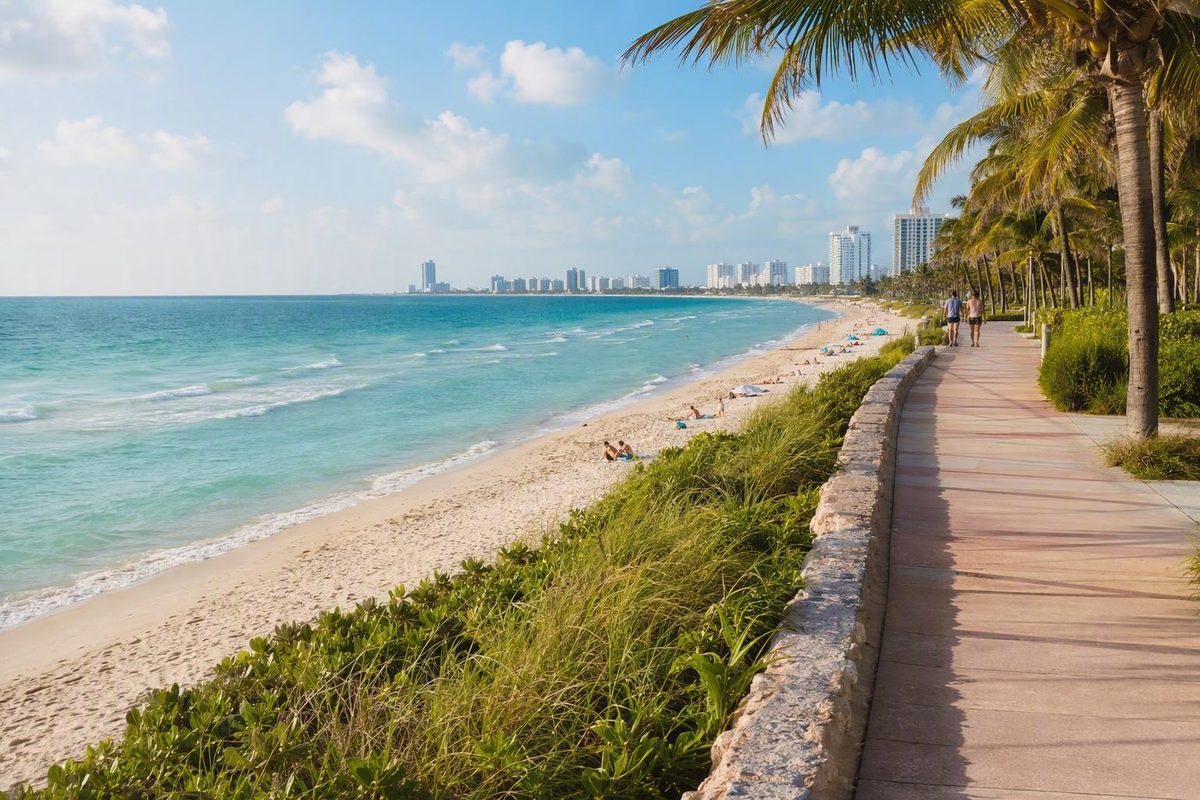
You trade some immediate access to South Beach's concentrated dining, shopping and nightlife for a beachfront setting where hotel amenities matter more.
Mid Beach Miami occupies the useful middle ground between two vacation styles. It is close enough to South Beach for a planned dinner, shopping trip, or night out, yet much of its oceanfront is more resort-centered and less saturated with street activity. That balance appeals to couples, families, architecture enthusiasts, beach-focused visitors, and travelers who expect their hotel, pool, beach setup, and spa to carry much of the trip.
The catch is that “Mid Beach” covers a long and uneven section of Miami Beach. A hotel near the Faena District offers a different experience from one near the everyday services of 41st Street or a large resort farther north. The most useful decision is therefore not simply Mid Beach versus South Beach. It is one Mid Beach block versus another.
Where Mid Beach Is—and Why Its Boundaries Look Different on Every Map
First, separate Miami from Miami Beach. Miami is the mainland city. Miami Beach is a separate city on a barrier island east of the mainland, and Mid Beach is the central part of that island city—not a neighborhood in mainland Miami.
There is no consistently stated Mid Beach boundary across the supplied visitor and neighborhood guides. Some descriptions begin around 23rd Street and others at 24th Street. Northern limits range from approximately 60th Street to the low 60s, with 63rd Street also commonly used. Treat those numbers as orientation rather than a universally accepted official border. The Greater Miami destination guide defines Mid Beach as 24th to 60th streets, while other supplied descriptions extend it farther north.
Landmarks are more useful than a rigid boundary:
- South Beach lies to the south. Its restaurants, shopping, Art Deco streets, and nightlife are more concentrated.
- North Beach lies to the north. It places visitors farther from the main South Beach activity zone.
- The Atlantic Ocean forms the eastern edge. The beach, Beachwalk, and many prominent hotels occupy this side.
- Indian Creek runs behind much of the eastern hotel corridor. The waterway separates many Collins Avenue hotels and condominiums from residential areas farther west.
- Collins Avenue is the principal beachfront hotel corridor. Many of the best-known resorts have Collins Avenue addresses.
- Indian Creek Drive is another important north-south road. Depending on the block and traffic pattern, it can be as relevant to an arrival as Collins Avenue.
- 41st Street is the practical cross-island corridor. It has a concentration of pharmacies, banks, cafés, specialty shops, and other everyday services that are not evenly distributed along the resort strip.
For trip planning, divide Mid Beach into three visitor zones.
The southern and Faena area is the most arts-and-design-oriented section. It is also relatively closer to South Beach, although that does not make every South Beach destination comfortably walkable.
The resort-and-services area around 41st Street is a practical compromise. Collins Avenue has major oceanfront hotels, while the cross-island commercial corridor improves access to routine errands and off-property food.
The farther-north stretch toward the low 60s becomes more strongly defined by large hotels, condominium buildings, and residential pockets. Businesses can be more dispersed, so this area works best when the property’s facilities are central to the stay or when guests are comfortable using transit and rideshare.
Do not assume that every attraction marketed as “near Mid Beach” is inside the neighborhood. Visitor pages and commercial booking sites sometimes mix Mid Beach with places elsewhere in Miami Beach or Greater Miami. Check the street address before adding anything to a walking itinerary.
Is Mid Beach the Right Miami Beach Base for You?
Mid Beach is commonly characterized as quieter and more resort-oriented than South Beach. That is a broad tendency, not a promise of silence. A large hotel can have restaurants, lounges, private functions, pool music, nightlife, or a busy arrival area. Road traffic, deliveries, construction, and events can also make one block feel much more active than another.
The central tradeoff is straightforward: visitors give up some immediate access to South Beach’s concentrated restaurant, shopping, and nightlife scene in exchange for a beachfront setting where large hotels and their amenities play a bigger role.
That trade can work especially well for:
- Couples who want beach and pool time with one or two deliberate evenings out.
- Families who value direct access to resort facilities and a less nightlife-centered base.
- Beach-focused travelers who plan to spend most days near the ocean.
- Resort travelers who expect to use on-site dining, pools, lounges, wellness facilities, or beach services.
- Architecture enthusiasts interested in the Faena corridor and prominent mid-century resort buildings.
- Car-free visitors willing to combine walking, trolley, bus, and occasional rideshare.
Mid Beach may disappoint travelers who expect to leave any hotel and find block after block of independent cafés, inexpensive restaurants, boutiques, and bars. Those businesses exist, but they are not distributed continuously. An attractive oceanfront property can still be inconvenient for groceries, a quick casual meal, or a multi-stop night out.
North Beach offers another alternative. In broad terms, Mid Beach keeps visitors closer to the main South Beach activity zone while retaining a more hotel-and-resort-centered atmosphere. North Beach may feel more removed from South Beach, which can be an advantage or a drawback depending on how often a traveler intends to go south.
These are broad tendencies rather than guarantees:
| Area | General atmosphere | Nightlife concentration | Typical lodging pattern | Practical walkability | Access to other areas |
|---|---|---|---|---|---|
| Mid Beach | Resort-centered, with quieter pockets and localized hotel activity | Less concentrated at street level than in South Beach; some hotels have their own nightlife | Large beachfront hotels, resorts, condominiums, and some smaller properties | Strong for Beachwalk recreation; uneven for errands and dining | Suitable for planned South Beach trips, but mainland travel requires a bay crossing |
| South Beach | Livelier and more activity-dense | More concentrated bars, restaurants, clubs, and evening foot traffic | A wide range of hotels, including smaller properties embedded in active streets | Generally better for combining dining, shopping, and attractions on foot | Convenient for South Beach-focused trips; farther from northern Miami Beach |
| North Beach | More removed from the main South Beach tourism zone | Generally less concentrated than in South Beach | Hotels, condominiums, apartments, and residential areas | Varies substantially by block and destination | Farther from South Beach, although island transit remains available |
The simplest verdict is:
- Choose Mid Beach for a resort-and-beach trip with occasional excursions.
- Choose South Beach when dense street activity and nightlife are central to the vacation.
- Choose North Beach when staying farther from South Beach suits the desired pace.
Mid Beach is a compromise, but not a bland one. It works best when travelers actively want that balance rather than merely selecting a hotel that appears under a Mid Beach search filter.
Where to Stay: Choose a Location Before Choosing a Hotel
Do not begin with a ranking of the “best” hotels. Begin with the part of Mid Beach that supports the expected daily routine, then compare properties within that zone.
Southern Mid Beach and the Faena zone
The southern portion is useful for travelers interested in the Faena arts-and-design corridor or planning occasional trips into South Beach. Faena Hotel, Faena Forum, and Faena Bazaar give this area a stronger cultural identity than many hotel-heavy blocks farther north.
Representative properties in or around southern Mid Beach include:
- Freehand Miami
- The Palms Hotel & Spa
- The Miami Beach EDITION
- Faena Hotel Miami Beach
These properties represent different lodging styles, budgets, room arrangements, and on-site experiences. Their presence on the same broad corridor does not mean their amenities or atmosphere are comparable.
The Greater Miami destination organization describes The Miami Beach EDITION as having a bowling alley and an ice-skating rink. Treat those as features to verify directly before booking because access, operating hours, private events, and guest policies can change.
Around 41st Street
The 41st Street area is often the most practical compromise for travelers who want a substantial resort without being surrounded exclusively by resort facilities. Its commercial corridor improves access to pharmacies, banks, cafés, specialty shops, and other routine needs.
Hotels associated with the broader 40s section include:
- Fontainebleau Miami Beach
- Eden Roc Miami Beach
- Nobu Hotel Miami Beach
- Holiday Inn Miami Beach – Oceanfront
- Radisson Resort Miami Beach
This area can be particularly useful for a longer stay. After the first few days, a pharmacy, casual breakfast option, or convenient place to buy essentials may matter more than an additional lobby bar.
The area is not uniformly pedestrian-oriented. A hotel can appear close to 41st Street while its actual entrance sits behind a long frontage, across a busy road, or on the opposite side of a large property. Test the walking route from the hotel entrance rather than relying on straight-line distance.
Farther-north Mid Beach
Moving north, large hotels, condominium towers, and longer gaps between pedestrian-scale businesses become more prominent. This can suit travelers who intend to remain at their resort for much of the day, but it should not be sold as automatically quieter, emptier, or more peaceful.
A large hotel may generate considerable activity of its own. Traffic, deliveries, pool music, events, and nearby work can matter more than the neighborhood label. Travelers sensitive to noise should ask about room orientation, including whether a room faces the ocean, pool, street, elevators, or an event space.
Commercial hotel listings associate various Collins Avenue properties with combinations of beach access, pools, spas, restaurants, and bars. The exact package differs by hotel, room, and booking terms. Treat these as features to investigate rather than standard inclusions.
The pre-booking checklist
Compare the complete stay, not just the first room rate displayed. Before paying, verify:
- The total nightly cost after mandatory charges and taxes
- Whether a resort or destination fee applies
- Overnight parking and valet terms
- Whether beach chairs are included
- Whether umbrellas cost extra
- How many beach-service items are included per room
- Pool access and any age or operating restrictions
- Which on-site restaurants are open during the stay
- Whether non-guests can enter hotel restaurants, bars, or other venues
- Room location and likely exposure to street, pool, elevator, or event noise
- Active or planned construction
- Cancellation and change rules
- Deposit and incidentals policies
- The actual route to the businesses and attractions the traveler expects to use
Confirm important amenities and charges directly with the property shortly before arrival. Booking pages, restaurant operations, inclusions, and prices can change. Star classifications, platform ratings, displayed rates, and loyalty affiliations can help filter options, but they do not establish which property is best for a particular trip.
Beach Access, Beachwalk, and the Most Useful Public Facilities
Separate municipal beach access from hotel service. A documented public entrance does not imply public access to a nearby hotel’s chairs, umbrellas, food service, pools, restrooms, or private setup.
The beach and oceanfront Beachwalk are Mid Beach’s central recreational features. Beachwalk provides a north-south route behind oceanfront buildings and supports walking and conventional bicycling. It can be useful for exercise and for some trips between nearby hotels, beach entrances, and restaurants.
The clearest officially documented public facility in the supplied evidence is Mid Beach Park at 46th Street and Collins Avenue. The city lists adjacent beach access, on-site parking, public restrooms, drinking water, seating, urban sports equipment, and an accessible playground. Its nautically themed playground is designed for children ages 5 to 12 and includes shaded play areas, climbers, safety surfacing, and an ADA swing. The City of Miami Beach lists the park as open daily from sunrise to sunset, although visitors should confirm conditions before making a special trip.
The official park description does not establish lifeguard coverage, shower availability, beach-wheelchair service, parking capacity, or identical accessibility from every approach. Travelers who depend on a particular facility should confirm it before arrival.
There is also a naming ambiguity. Some third-party material refers to a facility near 46th Street as Indian Beach Park, while the municipal page calls the location Mid Beach Park. Use the address—46th Street and Collins Avenue—when checking maps or requesting directions.
Do not infer water conditions from the number of people on the beach. Conditions can vary by day, so follow information and instructions posted at the beach rather than treating a quieter-looking stretch as inherently suitable for swimming.
What to Do Beyond Sitting on the Sand
Mid Beach is not organized around one concentrated sightseeing district. Its strongest activities are linear, architectural, or hotel-centered. That makes it better suited to a few compact modules than to an overloaded attraction checklist.
Walk or cycle Beachwalk
The simplest independent activity is a walk along Beachwalk. Start near the hotel, choose a direction, and turn around before the distance becomes inconvenient. A conventional bicycle extends the range and makes it easier to connect several hotel or beach areas.
A December 2025 Greater Miami transportation article describes Beachwalk as a nine-mile, ADA-accessible route across Miami Beach and reports that electric bicycles are prohibited on Miami Beach sidewalks, Beachwalk, and Lincoln Road. That broad accessibility description does not mean every entrance or transition is identical, and the electric-bicycle rule should be checked before renting because regulations can change. The Greater Miami transportation overview provides the dated description and mode overview.
Beachwalk also helps visitors understand the neighborhood’s scale. Two hotels may look close on a map, but large grounds, service areas, and long oceanfront frontages can make the walk feel longer than expected.
Explore the Faena District
The Faena District is described as an arts-and-culture corridor running approximately from 32nd to 36th streets and anchored by Faena Hotel, Faena Forum, and Faena Bazaar. The Greater Miami Mid Beach guide identifies these boundaries and venues.
Approach the area as a district walk rather than assuming that every building is continuously open to casual visitors. Exhibitions, performances, shops, admission terms, and hotel access can vary. Confirm any venue that would be disappointing to miss.
Build an architecture mini-route
For an architecture-focused outing, pair the Faena area with the Fontainebleau and Eden Roc farther north. The Greater Miami destination guide attributes the designs of the Fontainebleau and Eden Roc to architect Morris Lapidus, making the resorts a natural visual pairing.
This can be an exterior-focused route. Do not assume that every lobby, pool deck, restaurant, or interior space is open for unrestricted sightseeing. Check visitor policies before entering a hotel specifically to tour, dine, or attend an event.
Consider smaller nearby options
The Mid Beach destination overview also identifies the Indian Creek boardwalk, Miami Beach Golf Club, and boat charters near North Bay Road as options. These are not interchangeable walk-up attractions. Exact locations, access rules, tee-time requirements, charter departure points, prices, and operating status should be checked individually.
Dining and nightlife are similarly dispersed. Expect hotel restaurants, lounges, poolside venues, and scattered independent businesses rather than a continuous South Beach-style entertainment strip. Broken Shaker is one named example associated with the area, but hours, reservation practices, age rules, and public access require confirmation.
Three easy itinerary modules
Beach-and-park morning
- Begin with an early beach walk or a section of Beachwalk.
- Have breakfast near the hotel.
- Continue to Mid Beach Park if its playground, restrooms, or documented beach access are useful.
- Return to the hotel or another indoor stop before committing to the next part of the day.
Faena and architecture afternoon
- Begin around the Faena District.
- Walk the surrounding blocks at a comfortable pace.
- Continue north by trolley, bus, conventional bicycle, or rideshare.
- View the Fontainebleau and Eden Roc as an architecture pair.
- Stop for a drink or meal only at a venue whose public access has been confirmed.
Resort-dining evening
- Take a break at the hotel after the afternoon outing.
- Choose dinner in or near the same hotel cluster.
- Add a lounge or bar only if it fits the route.
- Avoid moving repeatedly between Mid Beach, South Beach, and the mainland in one evening.
The modules can be combined without turning the day into a transportation exercise.
Getting Around Mid Beach Without a Rental Car
A car-free Mid Beach stay is feasible when the beach and Miami Beach are the center of the trip. It requires more planning when Downtown, Brickell, Wynwood, Coconut Grove, the Everglades, or other dispersed destinations dominate the itinerary.
Use this practical mode hierarchy:
- Walk or use Beachwalk for nearby stops.
- Use the free Miami Beach trolley for longer island connections.
- Use Metrobus when a direct route fits the trip.
- Use rideshare or taxi for awkward gaps, luggage, bad weather, or late journeys.
- Rent a car only when several remote destinations justify the parking and traffic burden.
The City of Miami Beach lists free trolley service and provides links to a trolley tracker, parking information, bicycle resources, traffic alerts, and scheduled lane closures. Consult the city’s official getting-around hub rather than relying on an old screenshot or saved schedule.
Published visitor information identifies a Middle Beach Loop and a Collins Express. Routes, stops, service periods, and intervals can change, so use official maps and alerts when planning the day.
Rail does not directly serve Mid Beach. Reaching Metrorail, Brightline, or other mainland rail services requires a bus, trolley, rideshare, or another connection. That does not make a car-free trip impractical; it means rail is not the neighborhood’s front-door system.
It also helps to distinguish two kinds of walkability.
Recreational walkability is one of Mid Beach’s strengths. Beachwalk offers an oceanfront route for exercise and some north-south movement.
Practical walkability is uneven. Large resorts, dispersed businesses, long blocks, multilane roads, and Indian Creek can make errands or cross-neighborhood trips less convenient. A hotel may be excellent for walking beside the ocean and weak for finding an inexpensive off-site breakfast.
Driving has its own friction. Before renting, account for whether the hotel charges for parking, whether destinations have convenient parking, and whether retrieving a vehicle improves a short journey enough to justify the effort.
Use this decision rule:
- Skip the rental car for a Mid Beach-centered vacation with occasional South Beach visits.
- Compare transit and rideshare for one or two mainland days.
- Consider a car only when several remote destinations, day trips, or group needs make it worthwhile.
For a broader neighborhood-cluster strategy, see Miami Finder’s guide to exploring Miami without renting a car.
Airport, South Beach, and Mainland Connections
Route 150 is reported as a direct bus connection between Miami International Airport and Mid Beach via the Julia Tuttle Causeway. Visitor transportation information also describes the route as continuing toward South Beach along corridors that include Collins Avenue and Indian Creek Drive. Check the current route, stops, fares, service schedule, and luggage practicality through official transit tools before departure; the Visit Florida transportation guide provides the supplied route overview but advises travelers to verify changing details.
Choose an airport option according to the trip:
- Route 150: Consider it when cost matters and the current route serves a practical stop near the hotel.
- Rideshare or taxi: Preferable for direct door-to-door movement, substantial luggage, young children, mobility needs, or a group that can divide the fare.
- Rental car: Sensible only if the wider itinerary requires one. Renting solely for the airport transfer may create an unnecessary parking problem.
Airport travel is traffic-sensitive. Total journey time also depends on the wait for the bus or car, the exact hotel entrance, the number of stops, luggage handling, and any transfer. Avoid scheduling a tight arrival-day reservation around a fixed online estimate.
For drivers, city transportation material identifies the Julia Tuttle Causeway via I-195 as an approach to Middle and North Beach. Check live navigation, traffic alerts, and scheduled lane closures through the City of Miami Beach transportation hub before setting out.
Trips south within Miami Beach can use trolley, Metrobus, rideshare, or bicycle depending on distance, weather, and the time of day. South Beach is not necessarily a practical walk from a hotel simply because both places are on Miami Beach.
Downtown, Brickell, Wynwood, and other mainland districts require crossing the bay. They should not be treated as quick walks from Mid Beach, and road conditions or an inconvenient transit connection can add substantial friction.
A better pattern is to devote one day to one mainland cluster. Combine Downtown and Brickell rather than returning to Mid Beach between them, or make Wynwood and the Design District the focus of a separate outing. Repeated island-mainland crossings consume time without improving the trip.
A Realistic Mid Beach Plan—and the Tradeoffs to Expect
A successful Mid Beach stay leaves room for the resort, beach, and changing weather. It does not treat the neighborhood as a launchpad for several distant districts every day.
A one-day Mid Beach itinerary
Early morning: Walk the beach or Beachwalk before committing to a longer day outside.
Breakfast: Eat at or near the hotel. This is where location matters: a property close to a service corridor may offer several choices, while a resort-heavy block may make the hotel restaurant the easiest option.
Late morning to early afternoon: Explore the Faena area, then continue with an architecture-focused look at the Fontainebleau and Eden Roc. Use transit or rideshare if the distance or street conditions make walking unattractive.
Afternoon: Return to the hotel for the pool, spa, lunch, or an indoor break. This buffer keeps the itinerary flexible if conditions change.
Evening: Have dinner near the chosen hotel. If South Beach nightlife is part of the plan, make it one deliberate round trip rather than a series of scattered stops.
A two-day extension
On the second day, use Mid Beach Park and the 41st Street area as one compact part of the itinerary. Families can prioritize the playground and documented beach access; other travelers can use the park as a break between Beachwalk and the businesses around 41st Street.
Then choose one excursion:
- A planned trolley, bus, or rideshare trip to South Beach
- A single mainland cluster such as Downtown and Brickell
- Wynwood and the Design District as one combined outing
- A longer resort day with no cross-city travel
Hotel location affects convenience more than the broad Mid Beach label. A property near 41st Street offers different practical access from one surrounded mainly by other resorts. A southern hotel can reduce the friction of reaching South Beach. A farther-north property can work well when its pools, dining, and beach setup are the purpose of the vacation.
The principal tradeoffs
Plan around these drawbacks before check-in:
- Fewer concentrated street-level businesses than in South Beach
- Uneven practical walkability
- Traffic-sensitive travel off the island
- Possible hotel and destination parking charges
- Greater dependence on hotel dining and amenities in some blocks
- Localized noise from events, traffic, pools, nightlife, or construction
- A longer or more complicated journey to mainland attractions than a map may suggest
Compare the full hotel bill rather than the room rate alone. Check resort fees, parking, beach-service terms, umbrellas, on-site meals, and the likely cost of reaching off-property dining. The important point is not that every hotel charges for every item, but that inclusions differ and can change the value of a displayed rate.
Heat and rain should also shape the day. Start longer outdoor periods earlier, preserve an indoor break, and avoid building an itinerary around repeated long crossings of the island or bay. Miami Finder’s flexible rainy-day discovery plan offers a structure based on indoor anchors and short outdoor windows.
Mid Beach occupies a low-lying barrier-island setting. The supplied neighborhood evidence describes general exposure to heavy rain, flooding, king tides, tropical systems, and hurricane disruption, but that does not establish the risk to a specific hotel, building, or block. Consult official emergency information and property-level data when evaluating a particular address; the general neighborhood context is summarized in this Mid Beach overview.
Shortly before each outing, check:
- The weather forecast
- Information posted at the beach
- Trolley and bus alerts
- Traffic and lane closures
- Hotel beach-service and pool policies
- Restaurant and venue status
- Reservation or admission requirements
Before booking, complete one final check:
- Choose the preferred zone: Faena, 41st Street, or farther north.
- Confirm what is genuinely walkable from the exact hotel entrance.
- Verify the total lodging cost and beach-service terms.
- Check available trolley and bus connections.
- Keep one weather-flexible alternative.
Mid Beach is a strong choice when the beach and a substantial resort experience matter more than having South Beach nightlife outside the door. Decide block by block, then build each day around one compact area instead of spending the trip crossing Miami unnecessarily.
Frequently Asked Questions
Where does Mid Beach Miami begin and end?
There is no single boundary used consistently by all visitor and neighborhood sources. The most practical approach is to treat Mid Beach as the central part of the City of Miami Beach, between South Beach and North Beach, while recognizing that maps may place its southern and northern edges differently.
For orientation, Collins Avenue follows the eastern hotel corridor, Indian Creek lies behind much of that corridor, and 41st Street provides an important cross-island commercial district.
Is Mid Beach better than South Beach for a quieter vacation?
Mid Beach is commonly described as quieter and more resort-oriented, but “quieter” is relative. It generally has less concentrated street nightlife than South Beach, yet individual hotels may host events, lounges, pool activity, and nightlife. Traffic and construction can also create localized noise.
Choose Mid Beach if the resort and beach will anchor the trip. Choose South Beach if immediate access to dense restaurants, shopping, bars, and street activity matters more.
Can you stay in Mid Beach without renting a car?
Yes. A car-free stay is practical when most of the trip will be spent in Mid Beach and elsewhere on Miami Beach. Walk for nearby stops, use Beachwalk where it fits, take the free trolley for island connections, use Metrobus for suitable routes, and fill occasional gaps with rideshare.
A rental car becomes more useful when the itinerary includes several remote or poorly connected destinations. Even then, compare its benefit with parking terms, congestion, and the inconvenience of retrieving it for short journeys.
How do you get from Miami International Airport to Mid Beach?
Route 150 is reported to connect Miami International Airport with Mid Beach via the Julia Tuttle Causeway. Confirm the route, stop, fare, and schedule before traveling because transit details can change. The Visit Florida transportation overview summarizes the connection and directs travelers to verify service information.
A taxi or rideshare provides a more direct door-to-door journey and may be preferable with heavy luggage, children, mobility needs, or multiple travelers. Timing varies with traffic, the hotel’s exact location, waiting time, and any transfers.
What does Mid Beach offer families with children?
The neighborhood’s practical family features include the beach, resort facilities, Beachwalk, and a documented public playground. At 46th Street and Collins Avenue, Mid Beach Park has adjacent beach access, parking, restrooms, drinking water, seating, and an accessible playground. The City of Miami Beach park directory provides the official facility details.
Family suitability still depends on the hotel and exact block. Confirm room configuration, pool rules, food options, beach-service terms, likely noise exposure, and the real walking route to anything the family expects to use.