
Choose the Right Place to Camp in Everglades National Park
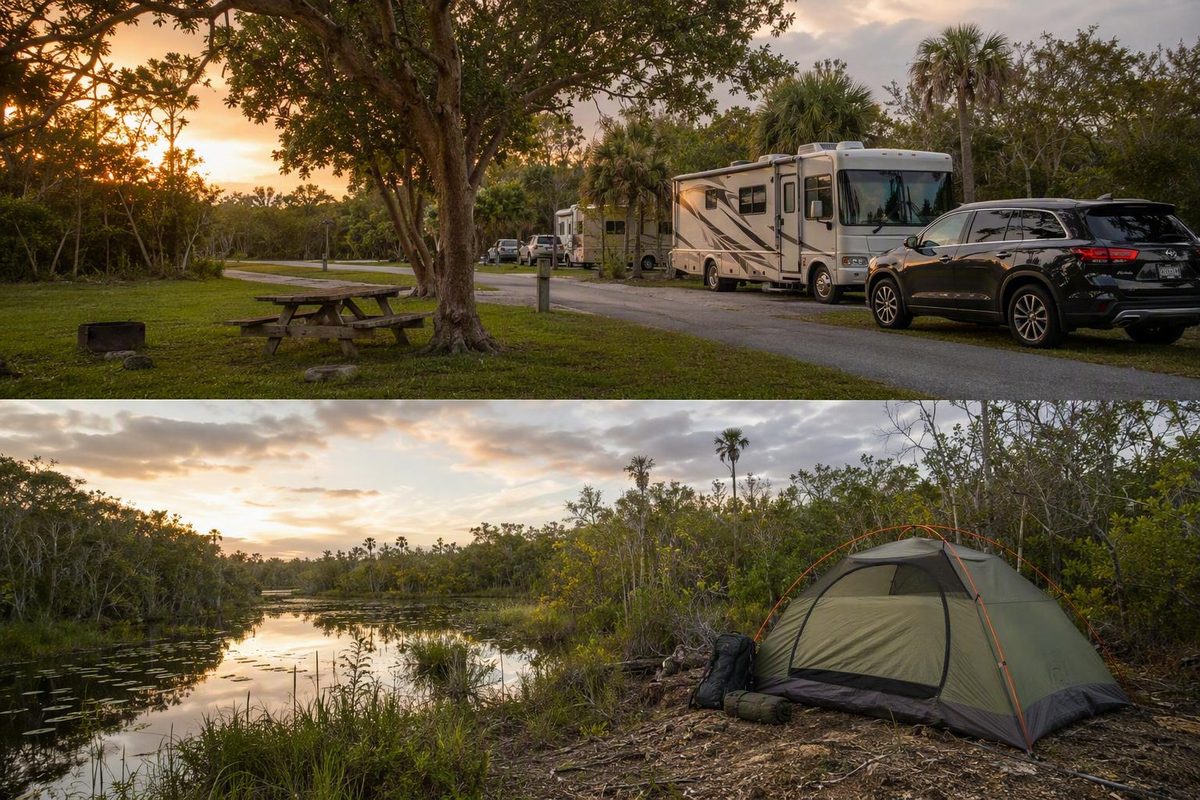
Distinguish drive-in campgrounds from wilderness sites, then compare access, electricity, seasons, listed rates, permit steps, water needs, and rules.
Choose Flamingo or Long Pine Key for a drive-in tent or RV stay. Choose a permitted chickee, ground, or beach site only if your party is equipped for self-sufficient wilderness travel.
Long Pine Key is the simpler drive-in option near the Homestead entrance when it is open. Flamingo is farther inside the park and is the only one of the two with electric RV sites. Seasons, prices, closures, utilities, and rules can change, so verify every time-sensitive detail before departure.
Everglades camping options at a glance
Flamingo and Long Pine Key are the only frontcountry drive-in campgrounds inside Everglades National Park. Both accept tents and RVs. Wilderness camping uses designated sites, a separate permit system, and access by water or another backcountry route. The National Park Service permits and reservations page distinguishes frontcountry reservations from wilderness camping.
| Feature | Flamingo | Long Pine Key | Wilderness sites |
|---|---|---|---|
| Access | Drive-in, deep inside the park | Drive-in, near the Homestead entrance | Primarily by water or another backcountry route |
| Setting | Southern park destination near coastal waters | Pine-rockland setting closer to the main entrance | Chickee, raised-ground, or beach sites |
| Operating pattern | Broadly year-round, with reduced wet-season capacity | Seasonal; confirm current dates | Controlled by permits, quotas, closures, and conditions |
| Electricity | Selected electric RV sites | No electrical hookups listed | None |
| Potable water | Campground water; RV filling near the dump station | Campground water | Campers carry their own supply |
| Dump station | Listed | Listed | Not applicable |
| Reservation system | Authorized campground concessioner | Authorized campground concessioner | Recreation.gov wilderness permit |
| Best fit | RV travelers needing electricity or visitors staying deeper in the park | Campers prioritizing a shorter drive from the entrance | Equipped paddlers and backcountry travelers |
Choose Long Pine Key for a straightforward drive-in stay relatively close to the Homestead entrance, provided the seasonal campground is open. Because it has no electrical hookups, RV travelers must be prepared to camp without shore power.
Choose Flamingo when its deeper location fits the itinerary or an electric RV site is important. Electricity does not mean full hookups: individual water and sewer connections are not provided at those sites.
Choose wilderness camping only when everyone in the party can manage navigation, route planning, tides, weather, insects, limited communication, drinking-water transport, and waste without campground services. A wilderness platform or beach is not merely a more secluded drive-in campsite.
Big Cypress National Preserve and commercial campgrounds near the Everglades can provide alternatives, but they are not campgrounds inside Everglades National Park.
Flamingo versus Long Pine Key
Flamingo is approximately 38 miles from the Homestead entrance; Long Pine Key is approximately seven. Both list water, bathhouses and dump stations. Selected Flamingo sites have electricity, with no individual water or sewer connection.
The distances, general operating patterns, utilities, and campground amenities are documented on the National Park Service camping page. Facility availability remains subject to seasonal operations, maintenance, and closures.
The distance difference can shape the entire stay. Long Pine Key is convenient when camping is one part of a broader Homestead-side visit or when a family wants to avoid the longer drive to Flamingo. Flamingo is more suitable when activities in the southern part of the park are central to the trip.
Selected Flamingo RV sites offer electricity. Confirm the assigned site’s electrical service and dimensions before booking.
Both campgrounds list potable water, restrooms or bathhouses, showers, dump stations, picnic tables, and grills. Do not assume the showers will provide hot water because the available National Park Service and concessioner descriptions conflict.
Flamingo is described as operating broadly throughout the year, although not every camping area or site remains available during the wet season. The current concessioner page lists Long Pine Key’s season as November 1 through April 30. It also says Bayside campground is closed for the 2026 season, so do not treat Flamingo’s general year-round label as opening every area. Check the live booking calendar, current park alerts, and the campground operator’s page instead of relying on a remembered date.
Do not rely on an old RV-length figure or a blanket statement about trailer acceptance. Match the complete vehicle-and-trailer combination to the rules and dimensions for the exact site being reserved.
Reservations, listed rates, and sample trip costs
Frontcountry campsites are reserved through the park’s authorized campground concessioner, not through the wilderness-permit system. Flamingo reservations are strongly recommended from December through April, but that recommendation does not guarantee availability.
The campground operator lists the following rates:
- Flamingo non-electric site: $33 Monday through Thursday and $38.50 Friday through Sunday
- Long Pine Key regular site: $33 per night on the current concessioner listing; verify the final booking quote
- Flamingo electric RV site: $50 Monday through Thursday and $60 Friday through Sunday
- Group site: $60 per night, covering as many as 15 people, five tents, and three vehicles
- Advertised discount: 10% for qualifying seniors, active and retired military personnel, and Access Pass holders
Camping charges do not include the separate park entrance fee. These are listed rates rather than guaranteed future prices; confirm the current price, eligibility rules, taxes, fees, and discount implementation through the authorized campground operator.
| Example stay | Calculation using listed rates | Example camping total |
|---|---|---|
| Two weekend nights, Flamingo non-electric site | 2 × $38.50 | $77 |
| Two weekend nights, Flamingo electric RV site | 2 × $60 | $120 |
| Two weekday nights, non-electric site | 2 × $33 | $66 |
| One group-site night | 1 × $60 | $60 |
These calculations are examples based on the listed rates. They exclude park admission, transportation, food, equipment, boat expenses, and optional purchases.
Use this booking sequence:
- Check park alerts. Look for road, campground, utility, weather, and area closures.
- Confirm operating status. This is especially important for seasonal Long Pine Key and individual Flamingo areas.
- Choose the correct inventory. Distinguish among tent, non-electric RV, electric RV, and group sites.
- Verify dimensions and utilities. Match the parking area and rules to the full vehicle-and-trailer setup.
- Review the final total. Confirm nightly rates, added fees, discount treatment, cancellation terms, and park admission requirements.
- Check arrival instructions. Note registration procedures, kiosk hours, late-arrival directions, and checkout time.
- Save the confirmation offline. Keep a screenshot or downloaded copy with directions to the campground and check-in point.
Wilderness camping: chickee, ground, and beach sites
Wilderness camping is separate from a Flamingo or Long Pine Key reservation. It involves designated sites, campsite quotas, a wilderness permit, and a planned itinerary.
The three principal campsite types are:
- Chickees: Roofed platforms built above the water. Recreation.gov describes each platform as approximately 10 by 12 feet, with no more than six people or one group per platform. Space is limited, so shelter dimensions and a stable, compact setup matter.
- Ground sites: Raised-earth camping areas generally located beside interior bays and rivers. They may accommodate multiple permitted parties, subject to campsite quotas.
- Beach sites: Shoreline campsites. These are the only wilderness campsite type where a campfire may be allowed, subject to current restrictions.
Wilderness quotas limit both the number of groups and the number of people at each site. Neither quota may be exceeded.
Expect to navigate among mangroves, bays, rivers, and coastal waters without dependable mobile service. Wind, rain, tides, heat, thunderstorms, and lightning can change travel times or make a route imprudent. Every party needs drinking water, navigation information, insect protection, weather protection, a realistic itinerary, and the ability to pack out waste.
Do not select a route simply because its mileage appears short. Distance does not account for currents, tides, wind exposure, landing conditions, navigational complexity, or the experience required. Obtain route-specific guidance before choosing an itinerary, particularly for a first wilderness trip.
How to get an Everglades wilderness permit
A wilderness permit is required for an overnight stay at a designated chickee, ground, or beach site. The listed exception applies when a traveler sleeps aboard a boat instead of occupying a designated wilderness campsite.
Recreation.gov states that reservations are available online year-round. They open daily at 10:00 a.m. Eastern, on a rolling basis 90 days before the trip’s start date. One reservation can cover multiple consecutive campsites and nights on a single itinerary; separate reservations are not required for each night.
The confirmation email serves as the permit. Campers do not have to collect a paper permit in person, but they must have a printed copy or screenshot of the final itinerary.
The listed cost is:
- Nonrefundable reservation fee: $21
- Per-person charge: $2 per person per night
- Park entrance fee: charged separately
For four people camping for two nights:
- Reservation fee: $21
- Nightly charges: 4 people × 2 nights × $2 = $16
- Example permit total: $37 before park admission
These figures come from the Recreation.gov wilderness-permit information and are subject to live verification. Fees, reservation windows, quotas, closures, and operating rules can change.
Check campsite-specific stay limits in the permit system for your intended dates.
Before reserving, build the complete itinerary. Confirm each night’s site, travel direction, expected distance, tide considerations, launch and exit arrangements, party size, and contingency options. The party should use the campsite listed on the permit unless safety requires a change.
Rules for food, fires, pets, generators, water, and waste
Frontcountry and wilderness rules differ substantially. Follow the checklist for the camping system being used rather than transferring assumptions from one setting to the other.
Frontcountry checklist
- Occupancy: A standard campsite has a listed maximum of eight people and two vehicles. Group sites have separate limits of up to 15 people, five tents, and three vehicles.
- Food at Flamingo: Seal food and food-preparation materials inside a vehicle or hard-sided camping unit whenever they are not in use.
- Pets: Keep pets on a leash no longer than six feet. Pets are restricted to specified developed areas, including campsites and parking lots.
- Fires at Flamingo: Use grills as permitted, keep every fire attended, and comply with current fire restrictions.
- Quiet hours: The listed quiet period is 10 p.m. to 6 a.m.
- Checkout: The listed checkout time is noon. Confirm current registration, arrival, and late-check-in procedures.
- Wastewater: Use the dump station for sewage and gray water. Do not drain wastewater onto the ground.
- Generators: Available guidance conflicts over where generators may operate at Flamingo. Ask the campground directly which locations permit them and what hours apply.
These occupancy, food, pet, fire, quiet-hour, and wastewater rules are detailed on the National Park Service camping page. Check the live version before arrival because restrictions can change.
Wilderness checklist
- Pets: Pets are prohibited at wilderness campsites.
- Equipment: The wilderness rules list generators, portable motors, airboats, and personal watercraft as prohibited. Because the rules separately address powerboats traveling in wilderness waters, motorized visitors should verify how the current provisions apply to their craft and route.
- Chickee and ground-site fires: Wood-, charcoal-, and coal-fueled fires, grills, and stoves are prohibited. Gas stoves or gas grills are allowed.
- Beach fires: Check current restrictions. Where a fire is allowed, build it below the high-tide line, use only dead and downed wood, attend it, and remove all evidence afterward.
- Food and water storage: Use hard-sided containers or secure them aboard a boat; do not leave them in tents. Never feed wildlife.
- Trash: Pack out garbage, packaging, and food scraps.
- Human waste: Follow the current procedure for the site type and route; do not assume facilities will be present.
- Itinerary: Stay at the campsite shown on the permit unless a safety concern forces a change.
- Powerboats in the wilderness: Operators must meet the applicable Everglades Boater Education requirement.
Review the current wilderness rules with every member of the party before departure.
Water, weather, insects, and offline preparation
Recreation.gov instructs campers traveling along coastal wilderness routes to carry at least one gallon of drinking and cooking water per person per day because fresh water is unavailable along those routes. That is a minimum, not a guarantee that the amount will be enough under every condition.
For four campers:
- 4 people × 1 gallon = at least four gallons per day
- For two full days: 4 gallons × 2 = at least eight gallons
- Add an appropriate contingency supply for heat, delays, spills, or a longer-than-expected exit
Count all time away from a water supply: a two-night trip can extend across three days and need more than the two-day example.
Water is heavy, so include its full weight when evaluating boat capacity and gear placement. Protect containers against punctures and divide the supply among multiple containers so one leak does not eliminate the entire reserve.
Tides can change route time and difficulty. A channel that is straightforward at one tide stage may be shallower, slower, or harder to navigate at another. Wind can impede open-water travel, while intense sun, rain, thunderstorms, lightning, and occasional cold can affect the itinerary.
Mosquitoes and no-see-ums may be aggressive, but conditions vary. Do not rely on a fixed “good” or “bad” month. Bring effective repellent, protective clothing, and screened shelter, then check recent conditions before departure.
Do not make mobile reception part of the safety plan. Available campground descriptions conflict, and wilderness coverage may be poor or absent.
Save the following offline:
- Campground confirmation or wilderness permit
- Final campsite itinerary
- Campground, launch, and check-in directions
- Current park alerts and closure notices
- Maps, charts, bearings, and other navigation information
- Tide data for the route and travel dates
- Weather forecast
- Emergency contacts and procedures
- Vehicle, equipment, and boat-rental details
- Important reservation and campground telephone numbers
Check conditions again immediately before leaving. Delay, shorten, reroute, or cancel the trip when closures, unsafe weather, water conditions, or equipment problems warrant it.
Before you leave
Check the live campground calendar, park alerts, weather and route conditions. Match RV dimensions and utility needs to the actual site; confirm generator rules directly. Wilderness parties need the final itinerary, navigation equipment, water for the full trip plus a reserve, and a contact who knows the expected return time.
Nearby commercial campgrounds and Big Cypress sites are alternatives outside Everglades National Park, with their own fees and rules.
Frequently asked questions
Do I need a wilderness permit if I sleep aboard my boat?
No. The wilderness-permit requirement has an exception when you sleep aboard your boat rather than occupy a designated chickee, ground, or beach campsite. Other applicable park entrance, boating, navigation, and operating requirements still apply, as explained on the Everglades wilderness-permit page.
Do powerboat operators need an Everglades boating certificate?
Powerboat operators entering the wilderness must have an Everglades Boater Education course completion certificate. This requirement should not be generalized to every powerboat operation everywhere in the park; verify the rules for the intended route on the current wilderness-permit page.