
What to Know Before Playing Doral’s Famous Championship Course
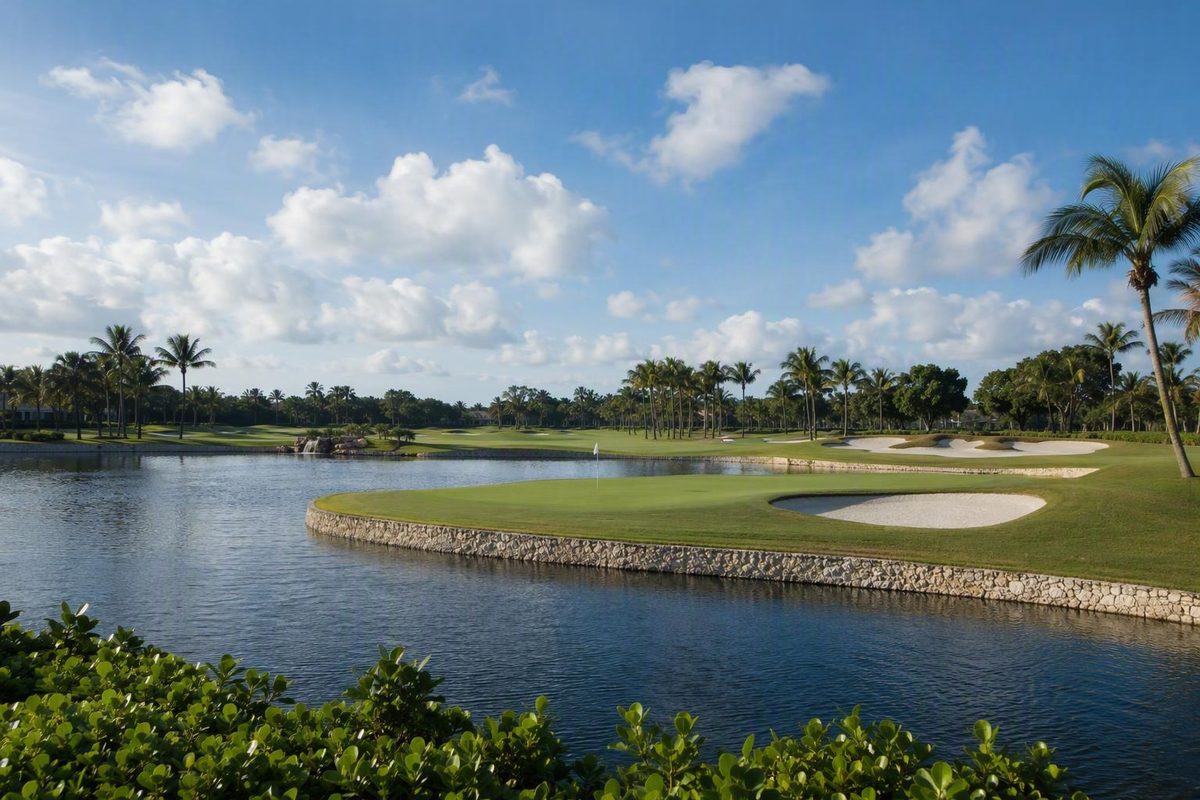
The Blue Monster at Doral is an 18-hole, par-72 championship course at Trump National Doral Miami. Its reputation rests on substantial length, extensive water, deep bunkering and a professional-tournament history stretching back to the 1960s.
For visiting golfers, however, the practical questions matter as much as the course’s name: Which tees should you play? What will the round actually cost? Can a nonmember book? And is the course operating normally on your travel dates?
Those questions require careful answers because published yardages differ, advertised green fees exclude some charges, and maintenance or tournament operations can affect availability. The longest published yardage should not automatically determine your tee selection, and the first price displayed should not be treated as the complete budget.
Blue Monster quick facts: what it is and where to find it
The Blue Monster is an 18-hole, par-72 golf course at Trump National Doral Miami in Doral, Florida. Its documented address is 4400 NW 87th Avenue, Miami, Florida 33178. The course opened in 1962 and was originally designed by Dick Wilson. GolfPass lists the address, opening year, architect, par and tee specifications.
The resort currently promotes four courses: Blue Monster, Golden Palm, Red Tiger and Silver Fox. That distinction matters when searching for a tee time because a booking at Trump National Doral is not necessarily a reservation for the Blue Monster.
The resort says members, resort guests and daily-fee guests may play the Blue Monster, subject to availability and operating restrictions. A visitor therefore does not necessarily need a membership or hotel stay, although public access does not guarantee a particular time, date or price. The official Blue Monster page explains that access extends to resort guests, daily-fee guests and members.
Blue Monster quick facts
Item Detail Location Trump National Doral Miami, 4400 NW 87th Avenue, Miami, FL 33178 Holes 18 Par 72 Original opening 1962 Original architect Dick Wilson Major modernization Gil Hanse-led redesign, with Jim Wagner also credited; reopened in 2014 Signature hole 18th, a 473-yard par 4 Resort course count Four currently promoted courses Public booking Resort guests and daily-fee guests may book, subject to availability and restrictions Primary booking route Resort’s online tee-time system
Always inspect the course name before paying. A lower rate, wider time selection or third-party search result may apply to Golden Palm, Red Tiger or Silver Fox. Those can be legitimate Doral rounds, but they are not interchangeable with a Blue Monster reservation.
Miami Finder provides an independent planning guide. Rates, restrictions and playing conditions should be confirmed with the resort or the company accepting payment.
How the 1962 course became the modern Blue Monster
The course visitors encounter today reflects two main design periods. Dick Wilson designed the original layout, which opened in 1962. Gil Hanse later led a substantial modernization, and Jim Wagner is also credited in the published historical material. The remodeled course officially reopened in February 2014.
That chronology is more accurate than describing the entire course as a Hanse design. Wilson created the original course; Hanse and his team substantially reworked it decades later. The course history published by Top 100 Golf Courses describes the Wilson design, Hanse remodel and February 2014 reopening, while the property’s encyclopedia profile also credits Jim Wagner.
The modernization was not merely cosmetic. Documented work included enlarged lakes and new or revised bunkers, tees and greens.
Historical comparisons therefore require context. A yardage, score or tournament account from the earlier layout may relate to a different set of tees, hazards or playing surfaces from those encountered after the renovation.
The nickname’s origin is less firmly established. Top 100 Golf Courses says the difficult professional-tour debut in 1962 led to the name “Blue Monster.” That is a commonly repeated explanation, but the available material does not trace the story to a primary contemporary archive. It is best treated as the traditional account rather than a conclusively documented naming event.
For visitors, the practical takeaway is straightforward: this is a Dick Wilson course at its foundation, extensively modernized by Hanse and his team for contemporary championship golf.
How long is the Blue Monster? Resolving the conflicting yardages
There is no single universally reliable Blue Monster yardage across the published material. Depending on the source, the course is listed at 7,510, 7,590, 7,608 or 7,739 yards.
The differences could reflect distinct tees, tournament configurations, scorecard revisions or measurement dates. The sources do not reconcile the figures, however, so assigning one definitive explanation would be speculation.
| Published source or context | Listed length |
|---|---|
| Wikipedia property profile | 7,510 yards |
| Resort golf-course overview | 7,590 yards |
| GolfPass black tees | 7,590 yards |
| Top 100 Golf Courses profile of the remodeled course | 7,608 yards |
| Current Blue Monster promotional page | 7,739 yards |
For someone choosing whether and how to play, the tee-by-tee breakdown is more useful than the largest promotional figure. GolfPass publishes the following yardages, course ratings and slope ratings:
| Tee | Yardage | Par | Rating | Slope |
|---|---|---|---|---|
| Black | 7,590 | 72 | 77.4 | 146 |
| Gold | 7,034 | 72 | 75.0 | 140 |
| Blue | 6,698 | 72 | 73.5 | 139 |
| White | 6,334 | 72 | 71.7 | 139 |
| Red | 5,463 | 72 | 72.9 | 138 |
These are the tee specifications listed by GolfPass. The figures indicate a demanding layout across the listed tees, but they do not establish a universal handicap cutoff for any one set of markers.
Tee selection should begin with the distance from which you normally enjoy golf. Consider your usual approach clubs, reliable carry distances and comfort with forced carries. If 6,300 to 6,700 yards already provides a full test at home, selecting 7,590 yards simply because it is associated with the Blue Monster can turn the round into a succession of long approaches and defensive recoveries.
Moving forward does not remove the course’s defining features. Water, bunkers, rough and green contours still influence decisions. A shorter tee simply makes those decisions more proportionate to the player’s game.
Before the round, consult the current resort scorecard and confirm which markers are available. Temporary tees or operating changes may alter the effective distance. Choose according to your normal game rather than the longest number found in an advertisement, tournament article or directory.
What makes the Blue Monster difficult
Length is the most obvious source of difficulty, but it is not the only one. Published descriptions consistently identify long fairways, extensive water, deep bunkers, Bermuda rough and contoured or undulating greens. GolfPass lists Bermuda grass on both the fairways and greens.
Those elements compound one another. Added distance can leave a longer club into the green. A ball in Bermuda rough can also leave a less predictable recovery to a contoured putting surface.
The Blue Monster is therefore better understood as a sequence of demanding decisions than as one intimidating total yardage. Trouble often grows when a player responds to one poor shot by attempting an even more difficult recovery.
A sensible first-round approach includes several basic principles:
- Check the useful playing distance. Wind and the day’s tee position can change how far a shot needs to travel.
- Prioritize playable positions. The shortest route is not always the safest when water or bunkers narrow the landing area.
- Use enough club on approaches. Trying to manufacture extra distance with too little club can bring several hazards into play.
- Accept imperfect holes. A conservative bogey can be a good result after a misplaced drive.
- Avoid escalating risk. If a recovery requires a shot you rarely execute, advance the ball to safety first.
- Use local information. A forecaddie may help identify lines, hazards and green contours, but the decision should still reflect your own carry distances.
Tee selection is the strongest adjustment available to a recreational golfer. Moving forward can shorten carries, reduce the clubs required for approaches and create more realistic landing areas. It does not guarantee an easy round; it makes the challenge more appropriate.
Preparation should also account for outdoor play in Miami. Bring or obtain adequate water, use suitable sun protection and check the live forecast shortly before leaving. A local lodging provider’s summer playing guide emphasizes hydration, sun protection, yardage checks and conservative course management.
Rain and wind can also change how the course plays. Do not treat a forecast checked several days earlier as final, and ask the golf operation whether weather or maintenance has produced any temporary restrictions.
The 473-yard 18th and the course’s professional-tournament history
The signature 18th is listed as a 473-yard par 4. It is narrow, with water running along the left side. Those features create an imposing finish because the hazard affects both visual comfort and shot selection. A third-party course profile documents the hole’s length, narrow corridor and left-side water.
A player who cannot comfortably challenge the left side can favor a more conservative line away from the water. That does not mean aiming blindly as far right as possible. The correct target depends on the day’s tee position, wind, landing area and other hazards. The useful principle is to choose a line compatible with your normal shot shape and carry distance rather than automatically taking the most aggressive route.
Some promotional descriptions have placed the hole in prominent rankings or characterized it as one of the professional tour’s hardest. Those claims should not be treated as settled current facts without the original ranking details or comparable scoring data. Its observable characteristics—a long par 4, constrained width and a major water hazard—are sufficient to explain its reputation.
The supported professional-event chronology is:
| Period | Professional event era |
|---|---|
| 1962–2006 | Doral Open |
| 2007–2016 | World Golf Championship competition |
| 2022–2025 | LIV Golf Miami |
These dates appear in the Wikipedia overview of Trump National Doral. Because that is a collaboratively edited source, readers researching individual tournaments should confirm details through the relevant tour’s official archive.
Notable winners associated with professional golf at Doral include Jack Nicklaus, Greg Norman and Tiger Woods. In the modern WGC period, Patrick Reed won in 2014, Dustin Johnson won in 2015 and Adam Scott won in 2016. The Top 100 Golf Courses history records those three WGC results.
Official promotional pages describe Doral’s PGA Tour run in slightly different ways, ranging from “more than 50” to 55 consecutive years. The event chronology establishes a long professional history, but an exact consecutive-year claim should not be treated as independently settled without a complete primary event archive and a clear definition of which events count.
Tournament pedigree does not mean the professional setup is appropriate for a recreational visitor. The more useful way to experience the same course is to choose a suitable tee, respect the water and play a strategy matched to your own game.
What it cost to play in 2026—and what the headline rate omitted
The resort published specific Blue Monster rates for two periods in 2026. These are dated planning figures, not permanent prices or a guarantee of what will appear at checkout.
| 2026 play period | Standard rate | Twilight rate |
|---|---|---|
| January 1–May 31 | $695 | $595 |
| June 1–September 30 | $395 | $350 |
Twilight was defined as beginning after 1 p.m. A twilight rate does not guarantee enough daylight to finish 18 holes. Starting time, pace, delays and seasonal daylight all matter.
The published rates included a cart but excluded taxes, a mandatory $37 forecaddie fee and a recommended $40 gratuity per player. The gratuity was recommended rather than mandatory. These rates, inclusions and additional charges appeared in the resort’s 2026 golf information.
A more realistic pre-tax planning budget adds the stated forecaddie fee and recommended gratuity to the green fee:
| 2026 play period and rate | Green fee | Mandatory forecaddie fee | Recommended gratuity | Pre-tax planning total |
|---|---|---|---|---|
| January–May standard | $695 | $37 | $40 | $772 |
| January–May twilight | $595 | $37 | $40 | $672 |
| June–September standard | $395 | $37 | $40 | $472 |
| June–September twilight | $350 | $37 | $40 | $427 |
Tax still needs to be added. A player who chooses a different gratuity can adjust the planning total accordingly, but the mandatory $37 charge remains part of the calculation.
These totals do not establish the cost of rental clubs, food, merchandise or other optional purchases. They also do not prove that every tee time carried identical conditions. The final booking screen and its associated terms should control the purchase decision.
Comparing direct rates with late-2026 UnderPar packages
UnderPar advertised selected prepaid packages for play after the resort’s listed August maintenance period. The displayed offers included one 18-hole round per player, a cart and taxes:
| Package play period | Days | Two players | Four players | Booking window shown |
|---|---|---|---|---|
| August 28–September 30, 2026 | Monday–Wednesday | $750 | $1,500 | Up to 7 days |
| August 28–September 30, 2026 | Thursday–Sunday | $850 | $1,690 | Up to 7 days |
| October 1–December 31, 2026 | Monday–Wednesday | $1,160 | $2,320 | Up to 30 days |
| October 1–December 31, 2026 | Thursday–Sunday | $1,230 | $2,460 | Up to 30 days |
These were restricted products rather than unrestricted cash rates. Terms included specified play periods, weekday limitations, booking windows, blackout dates and availability requirements. The October–December offers identified December 4–23 as a blackout period. Purchasing a package did not guarantee a desired starting time. The detailed conditions appeared on the UnderPar Blue Monster offer page.
A direct rate and a prepaid package are not equivalent simply because both can lead to a round. Compare:
- total price per player;
- whether taxes and carts are included;
- forecaddie and gratuity treatment;
- valid weekdays and playable date ranges;
- booking lead time;
- blackout dates;
- transferability;
- cancellation or refund terms;
- and actual tee-time availability.
The least expensive displayed option may not be the most useful if it restricts play to an unsuitable weekday, delays booking until shortly before the trip or fails to secure a workable starting time. Verify all terms before buying nonrefundable travel or a prepaid golf product.
How to book and what to verify before traveling to Doral
The official Doral tee-time page provides online booking and identifies all four resort courses. Starting there makes it easier to verify that the selected round is on the Blue Monster.
GolfNow and TeeOff are additional search channels. If one platform shows no availability, check the selected date, party size, number of holes and time filters before drawing a conclusion.
A no-availability message means only that the platform found no matching inventory for that particular search. It does not establish that the course is generally sold out. Maintenance, restrictive filters, an interface problem or differences among booking channels may all affect the result.
The August 2026 maintenance closure
The resort listed the Blue Monster as closed for maintenance from August 3 through August 27, 2026. As of August 24, 2026, that stated closure period had not yet ended. Golfers should not assume normal play is available before the listed reopening date, and anyone planning a round immediately afterward should confirm both reopening and course conditions directly. The same 2026 resort schedule also listed a cart-path-only period from January 6 through May 3.
A scheduled reopening does not establish what playing conditions will be present afterward. Ask whether all greens and tees are in normal use and whether temporary restrictions remain.
The larger lesson is that an annual rate calendar is not enough to plan a visit. Maintenance, tournament operations and cart rules can affect access even when a seasonal price is published.
Dress code and equipment questions
GolfPass lists a collared-shirt requirement and prohibits denim. Treat that as useful preparation rather than an unchangeable policy. Verify the current resort dress code, particularly if anyone in the group plans to wear a modern collarless golf top or other apparel that may be interpreted differently.
The available information does not establish current rental-club charges, practice-ball inclusions, locker access, pace of play or identical forecaddie requirements across every booking type. It also does not establish the current cancellation, weather, refund or no-show policy. Ask before paying rather than relying on assumptions from another resort or a previous Doral visit.
Travel logistics matter as well. Visitors staying elsewhere in the Miami area can use Miami Finder’s guide to exploring Miami without renting a car when deciding whether a rideshare or other transportation plan is practical. If weather disrupts a golf day, a flexible Miami rainy-day plan can help organize an alternative itinerary.
Pre-booking checklist
Before finalizing a Blue Monster round, confirm:
- Course: Make sure the reservation says Blue Monster, not Golden Palm, Red Tiger or Silver Fox.
- Date and starting time: Verify the calendar date and whether the rate is standard or twilight.
- Tee options: Review the current scorecard and choose a realistic playing distance.
- All-in price: Confirm the green fee, taxes, cart inclusion, forecaddie charge and gratuity guidance.
- Caddie arrangement: Ask whether the forecaddie requirement applies to the specific booking and what the service includes.
- Maintenance: Check for closures, temporary greens, aeration or other work.
- Tournament operations: Ask whether an event affects access, parking, practice facilities or course setup.
- Cart rules: Confirm whether carts are unrestricted, cart-path-only or subject to another limitation.
- Dress code: Verify current shirt, shorts, footwear and denim policies.
- Cancellation terms: Check deadlines, weather treatment, refunds, credits and no-show consequences.
- Practice access: Ask whether the range is open and whether practice balls are included.
- Rental clubs: Confirm availability, specifications and price if needed.
- Live weather: Recheck the forecast shortly before departure.
- Package restrictions: Verify the play period, valid weekdays, booking window and blackout dates.
- Reservation status: Make sure a prepaid product has been converted into a confirmed tee time.
Frequently asked questions
Can the public play the Blue Monster at Doral?
Yes. The resort says daily-fee guests and resort guests may play, in addition to members. Access remains subject to available tee times, maintenance, tournaments and other operating restrictions. A public-access policy does not guarantee a starting time on a specific date.
How long is the Blue Monster golf course?
Published figures range from 7,510 to 7,739 yards, and the available sources do not fully explain the discrepancy. The practical tee table lists 7,590 yards from the black tees, 7,034 from the gold tees, 6,698 from the blue tees, 6,334 from the white tees and 5,463 from the red tees. Consult the current resort scorecard rather than treating one overall figure as universal.
Why is it called the Blue Monster?
A commonly repeated account says the difficult professional-tour debut in 1962 produced the nickname. The course’s extensive water and demanding character fit that explanation, but the naming story is not confirmed here through a primary contemporary archive. It is best understood as the traditional account.
How much did it cost to play the Blue Monster in 2026?
The resort’s dated 2026 prices varied by season and by standard or twilight play. The rate table above gives the published green fees and transparent pre-tax planning totals after adding the mandatory forecaddie charge and recommended gratuity. Taxes and any optional purchases still had to be added.
Are carts, caddies and gratuities included in the green fee?
The listed 2026 rates included a cart. They excluded taxes, the mandatory forecaddie charge and the recommended per-player gratuity. Golfers should confirm whether the same arrangement applies to their specific direct rate, package or third-party reservation.
Final planning advice
The Blue Monster is a historically significant and demanding resort course, but its reputation should not replace practical planning.
Three decisions matter most. First, select an appropriate tee rather than fixating on the longest published yardage. Second, calculate the full cost beyond the headline green fee. Third, verify live availability, maintenance and booking conditions directly before committing to the trip.
Most importantly for travel in August 2026, the resort schedule listed the Blue Monster as closed for maintenance from August 3 through August 27. Confirm reopening, course conditions, rates and policies before making travel arrangements or purchasing a restricted package.