
Why Miami Event Rentals Deserve an Earlier Look
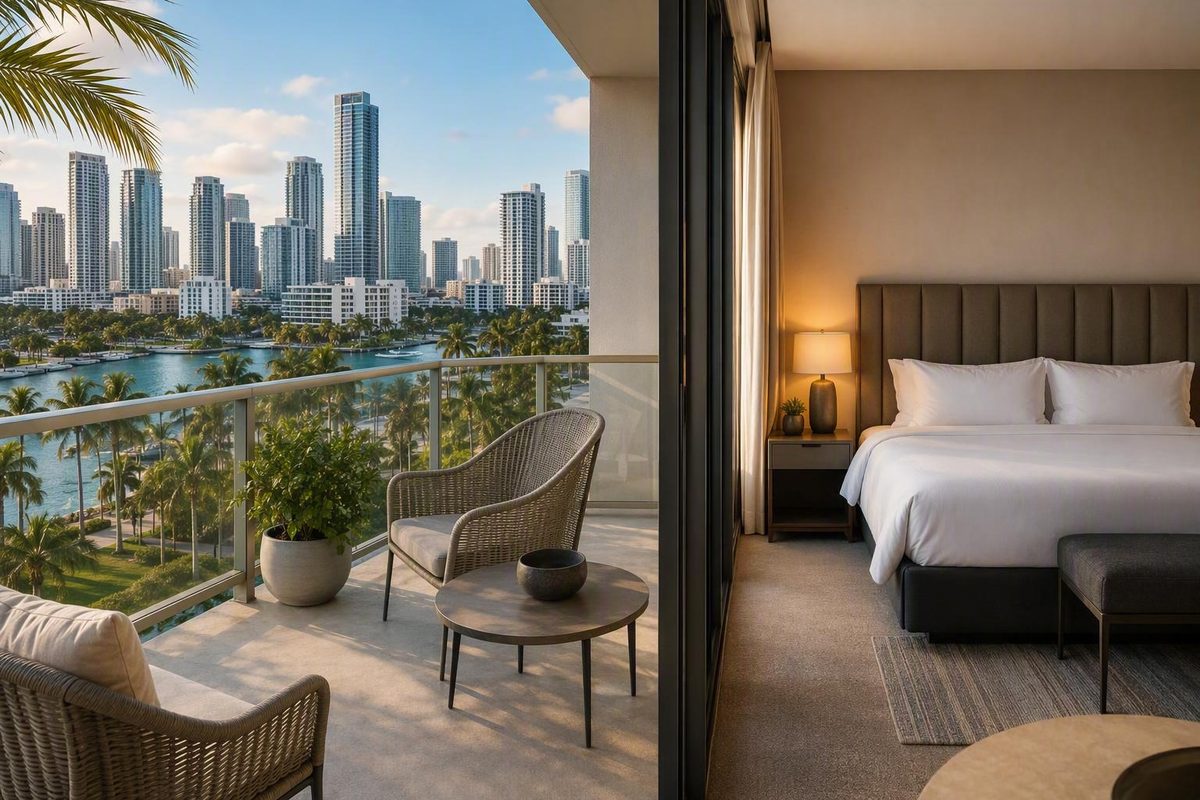
World Cup results upended Miami lodging assumptions. See when rentals absorb event demand and when a hotel's location and support justify the premium.
For a big Miami event, do not treat hotels as the automatic place to look first: compare verified short-term rentals at the same time, especially for groups and stays extending beyond the headline night. During South Florida’s 2026 World Cup window, short-term-rental revenue rose roughly 300% on game nights and outperformed the broader market by about 50%, while hotel operators reported mixed results (CBS News Miami).
That verdict is about where to search, not a claim that every rental is cheaper or safer than every hotel. The available evidence does not include matched final prices for equivalent properties, and the hotel example came from Fort Lauderdale rather than every Miami market. Live refundable totals, venue access, legal property use, sleeping arrangements, and support still determine which individual booking wins.
Choose an event tier and date, then add your live hotel and rental quotes to see which side wins.
The World Cup figures are a demand reference, not a price forecast. Use the live-quote fields to decide between actual properties.
The example group and stay length are planning inputs, not Miami market averages.
Booking-window note: compare refundable options now and keep checking both markets.
Hotel for All Required Rooms
Short-Term Rental for the Group
| World Cup Evidence | Observed Result | What It Means | What It Does Not Prove |
|---|---|---|---|
| Rental game nights | Revenue up roughly 300% | Strong demand concentrated on match nights | Not a 300% nightly-price forecast |
| Broader rental performance | About 50% above typical market | Rentals captured substantial event demand | Not every listing outperformed |
| Late booking | More than one in four within seven days | Rental activity continued near match day | Waiting is not guaranteed to save money |
| Guest spending | Roughly $123 million projected | Rental guests contributed substantial regional spending | Not a lodging-only total |
| Reported hotel | Sold out twice; slower nights discounted | Peak and surrounding nights behaved differently | One hotel is not the entire market |
| Fan Fest | About 600,000 visitors over 24 days | The event generated genuine regional demand | Attendance does not equal hotel occupancy |
Source: CBS News Miami’s post-World Cup report, citing Airbnb data and local operators. Future event prices and availability are — because the source provides no conversion from attendance tier to lodging rates. Read the report.
The Hotel-First Case Is Still Strong for Short Trips
The usual hotel-first advice is reasonable for a couple arriving shortly before a game, race, concert, or festival. A staffed front desk, documented late check-in, luggage storage, predictable room configuration, and on-site help can matter more than extra living space when there is little time to recover from an access problem.
Hotels also simplify capacity for one or two travelers. One room is easier to compare than a rental with a cleaning charge, building instructions, house rules, and a minimum stay. A well-located hotel can remain the better value even at a higher nightly rate if it avoids repeated rideshares or a difficult late-night return.
The World Cup result does not disprove those operational advantages. It disproves the broader assumption that hotels necessarily capture a mega-event’s demand more reliably than rentals do. The strongest evidence concerns market performance, not the quality of every visitor’s stay.
The World Cup Demand Did Not Flow Evenly Into Hotels
Demand was real. Miami’s Fan Fest drew about 600,000 visitors over 24 days, the largest Fan Fest attendance in the country, according to the CBS report. Airbnb projected that its guests spent roughly $123 million across South Florida during the tournament window.
Yet the hotel outcome was uneven. The Atlantic Hotel on Fort Lauderdale Beach sold out on only two specific game nights and discounted slower nights after occupancy fell below expectations. Management described the period as “good, not great” and said it would rather host a Super Bowl (CBS News Miami). Higher game-day rates helped offset weaker surrounding nights.
Short-term rentals showed the stronger demand signal. Airbnb data cited by CBS indicated roughly 300% revenue increases on game nights and performance about 50% above the typical market. Revenue is not the same as nightly price: it can reflect rates, occupancy, additional inventory, longer bookings, or a combination. The report does not provide enough data to separate those effects.
The comparison is also not a complete regional market study. One hotel cannot represent all hotels in Miami-Dade and Broward, and platform data does not describe every rental. What the case establishes is narrower and useful: even during a genuine mega-event, hotel demand may concentrate on a few peak nights while short-term rentals absorb substantial demand that a hotel-only search would miss.
Late Rental Bookings Changed the Availability Assumption
More than one in four Airbnb bookings covered by the report were made within seven days of a match. That does not prove waiting is cheaper, and it is not a reason to gamble with an essential event trip. It does show that meaningful rental activity continued close to game day rather than disappearing as soon as tournament demand became obvious.
For the next F1 weekend, Ultra, championship game, or future mega-event, begin with simultaneous searches. Save a refundable hotel option if its terms permit, but keep checking legitimate rentals and extended-stay properties instead of assuming late availability will exist only in hotels.
Price each night separately. The headline night, arrival night, and departure night may behave differently. A hotel can sell out or raise rates for the event night while discounting the following night. A rental can look inexpensive per night but require unused minimum-stay nights. A fixed cleaning fee may become more reasonable over a longer stay but dominate a two-night booking.
A split stay can work when the venue’s peak nights are expensive and the remaining itinerary belongs in another neighborhood. It can also fail after luggage storage, transportation between properties, another set of mandatory fees, and the disruption of moving are included. Avoid changing properties on the main event day unless the schedule has ample margin.
Compare Final Totals Rather Than Advertised Nightly Rates
The evidence does not establish whether a future Miami rental or hotel will be cheaper. Only matched checkout totals can answer that question.
For a hotel, include every room the group needs, taxes, resort or amenity fees, parking, additional-occupant charges, and transportation to the venue. For a rental, include the accommodation charge, cleaning and service fees, taxes, mandatory property charges, parking, transportation, and any minimum-stay nights the group will not use.
The correct unit is the whole group. If eight adults need four hotel rooms, compare the rental with four rooms rather than one. If a family can comfortably occupy one confirmed suite, do not assume it needs two standard rooms.
| Comparison | Hotel | Rental |
|---|---|---|
| Lodging for the full group | $— | $— |
| Mandatory fees and taxes | $— | $— |
| Parking and venue transport | $— | $— |
| Refundable all-in total | $— | $— |
Cost per guest per night equals the refundable all-in total divided by the number of guests and then by the number of nights.
Keep refundable and nonrefundable quotes in separate columns. A lower nonrefundable total is compensation for accepting additional risk, not a like-for-like saving. Save the itemized price and material policies before purchase so the final reservation can be checked against the comparison.
Venue Access Can Reverse the Price Winner
A cheaper property loses its advantage when added transportation, parking, travel time, and schedule risk exceed the lodging saving. Compare each property door to door using the correct entrance, desired arrival time, likely finish time, and late-night return plan.
Miami Beach, Brickell, Wynwood, an airport district, and Fort Lauderdale are not interchangeable event bases. A beach stay may suit the leisure portion of a trip while creating an inefficient stadium journey. A Fort Lauderdale property may fit a Broward event but perform poorly for an event farther south.
Check current information from the organizer, venue, transit providers, and public authorities before booking and again before departure. Event traffic plans, parking reservations, pickup zones, and service hours can change the practical value of a location.
Schedule risk sometimes deserves veto power rather than a dollar estimate. Missing part of an expensive event because the group selected a remote bargain can outweigh a modest lodging saving.
Group Size Is Where Rentals Gain Their Clearest Advantage
A whole-property rental becomes compelling when it replaces several hotel rooms and supplies enough real bedrooms, beds, bathrooms, and shared space. Maximum occupancy alone is not evidence of comfort.
Count enclosed bedrooms, standard beds, bunks, sofa beds, air mattresses, and beds in open living areas separately. Then decide who will actually use each one. A sofa bed may satisfy an occupancy limit while eliminating the common room as soon as one traveler goes to sleep.
Bathrooms can reverse the result. One large rental with one bathroom may function worse before an early event than three hotel rooms with three bathrooms. Several hotel rooms can also provide more privacy for couples, children, and multigenerational groups, even when the rental has more total floor space.
| Traveler | Start With | What Can Reverse It |
|---|---|---|
| Couple, two or three nights | Nearby hotel | Lower rental total with equal access |
| Family | Suite and rental | Beds, laundry, meals, commute |
| Large group | Whole-property rental | Bathrooms, privacy, house rules |
| Longer stay | Rental or extended stay | Service needs and fixed fees |
For a group comparison, subtract the rental’s final total from the hotel total for the correct number of rooms, then divide the difference by the number of guests. A modest group saving may translate into too little per person to justify weaker sleeping arrangements or a more complicated arrival. A substantial saving combined with better bedrooms and common space makes the rental a stronger choice.
Booking Reliability Still Favors Some Hotels
Hotels generally offer a more standardized support structure, but that tendency is not a guarantee. A limited-service hotel may have reduced overnight staffing, while a professionally managed rental may have documented access procedures and responsive support.
Compare the actual finalists. Confirm the cancellation cutoff, amount at risk, payment schedule, check-in hours, late-arrival process, occupancy limit, visitor policy, parking method, and stated remedy if the provider cancels. For multiple hotel rooms, determine whether proximity or connecting rooms are confirmed rather than requested.
For a rental, read recent feedback tied to the same property and current management. Look for repeated reports involving entry, cleanliness, noise, bed descriptions, parking, building access, or slow support. Confirm the precise access process before the free-cancellation deadline.
A listing’s availability does not by itself establish that a stay complies with current municipal, county, condominium, lease, or building rules. Check the relevant official requirements and obtain property-specific confirmation where needed. Nothing in the World Cup performance data removes that due diligence.
Accessibility also requires property-level verification. Confirm the route from the street or parking area, thresholds, elevator access, bed clearance, bathroom configuration, accessible parking, and access to any required shared facilities. Do not infer suitability from the lodging category alone.
The Best Booking Sequence Uses Both Markets
When a major event is announced, search hotels, short-term rentals, suites, and extended-stay properties for identical dates and guest counts. Record refundable totals and map the event trip from each finalist.
For a short couple’s stay, a nearby hotel should usually remain the benchmark because its service and arrival process may justify a modest premium. For a family, compare a multi-bedroom rental with a suite or the correct number of hotel rooms. For a large group, give verified rentals an early look because replacing several rooms is where their economics become most favorable.
Recheck the surrounding nights rather than only the event night. The World Cup hotel example sold out on selected game nights but needed discounts on slower dates, while more than a quarter of the reported Airbnb bookings arrived within a week of a match. Those patterns support continued comparison; they do not guarantee a future bargain.
The final choice is the property with the lowest acceptable refundable total that does not create unacceptable capacity, commute, compliance, accessibility, or booking risk. The 2026 result changes the search order: rentals belong in the first comparison, not as a fallback after hotels appear full or expensive.